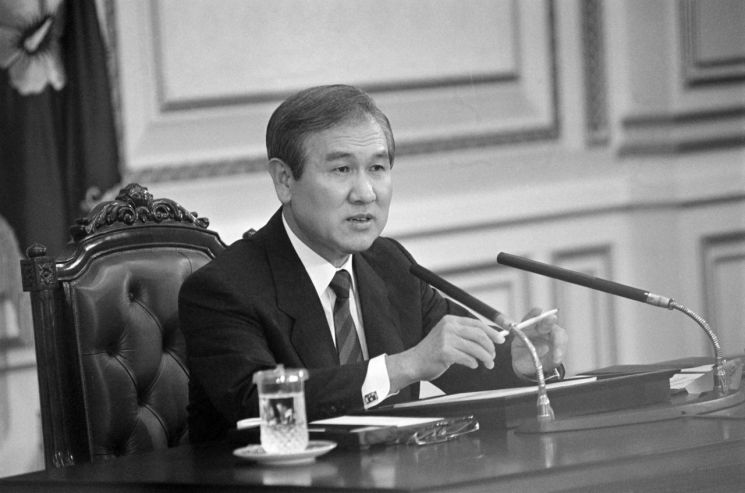
[Asia Economy Reporters Lee Ji-eun and Kim Dong-pyo] The economic achievements during the tenure of the late former President Roh Tae-woo are starkly contrasted between real estate and collusion between politics and business. Regarding real estate policy, stabilizing the skyrocketing housing prices caused by the 'three lows (low dollar, low interest rates, low oil prices) boom' through new town development is considered a major accomplishment. The introduction of progressive economic concepts such as the public ownership of land under a conservative government is also notable. While promoting economic openness and liberalization based on the Northern Policy and successfully hosting the Seoul Olympics amid high growth, his administration faced criticism for enabling the vicious cycle of collusion between politics and business, which contributed to the onset of the foreign exchange crisis, including the Hanbo scandal.
The Roh Tae-woo administration left significant marks in construction and real estate sectors through large-scale housing supply and expansion of social overhead capital (SOC). The late 1980s, during his rule, saw the 'three lows boom' (low dollar, low interest rates, low oil prices), which led to a surge in liquidity in the market, overheating the real estate and stock markets. As public opinion worsened, the late President Roh announced a plan in 1989 to supply 2 million housing units, including five new towns such as Bundang and Ilsan. This accounted for nearly 20% of the total housing stock at the time. Consequently, nationwide housing prices showed a downward stabilization trend from 1991 to 2000 over a decade.
He was also well known for actively advocating the introduction of the public ownership of land concept. In 1989, the so-called 'three laws on public ownership of land'?the Excess Land Gains Tax, the Development Gains Recovery System, and the Land Ownership Ceiling System?were established. Although the Land Ownership Ceiling System and the Excess Land Gains Tax were abolished following constitutional court rulings of unconstitutionality, the Development Gains Recovery System remains in effect. The comprehensive real estate tax and the reconstruction excess profit recovery system are based on the concept of public ownership of land.
Bold investments were also made in social overhead capital (SOC). Plans for Incheon International Airport and the Gyeongbu High-Speed Railway were finalized in June 1990. Although there was strong criticism of overinvestment at the time, these have become essential core infrastructures today. Efforts were also made to build transportation infrastructure such as Seoul Subway Lines 5 to 8 and the Seoul Inner Ring Road.
Another key economic theme was openness and liberalization. During the post-Cold War upheaval, based on the 'Northern Policy,' diplomatic relations were established for the first time with over 40 communist countries, including the former Soviet Union, China, and Vietnam. The simultaneous admission of North and South Korea to the United Nations greatly expanded South Korea's diplomatic scope. Overseas expansion of companies also accelerated, sustaining a rapid average annual growth rate of 8.5% during this period. Financial and stock market liberalization also took place at this time. Through foreign exchange and interest rate liberalization (1988), financial institutions were allowed to autonomously set interest rates, and through 'capital market internationalization,' foreign securities firms entered the domestic market (1991), and foreign investment in stocks was permitted (1992). During the Roh Tae-woo administration, the KOSPI index reached four digits for the first time.
The late former President Roh, who served as the second minister of political affairs during the Chun Doo-hwan administration, was the chief organizer of the Olympic bid, achieving the 'Baden-Baden Miracle' by defeating Nagoya, Japan. He successfully hosted the Olympics during his presidency. The economic effect of hosting the Olympics was 4.7 trillion dollars, after which South Korea's per capita gross national product (GNP) surpassed 5,000 dollars.
However, behind the rapid growth was the shadow of collusion between politics and business and corruption. In 1991, during his fourth year in office, the 'Suseo Corruption Scandal' broke out, involving preferential land supply intended for the homeless being given to private developers. The main figure in the Suseo corruption, Chung Tae-soo, chairman of Hanbo Group, included the late President Roh among his lobbying targets. However, as this case was not properly investigated and was quietly closed, it eventually led to the Hanbo scandal in 1997, which triggered the IMF foreign exchange crisis.
© The Asia Business Daily(www.asiae.co.kr). All rights reserved.

















