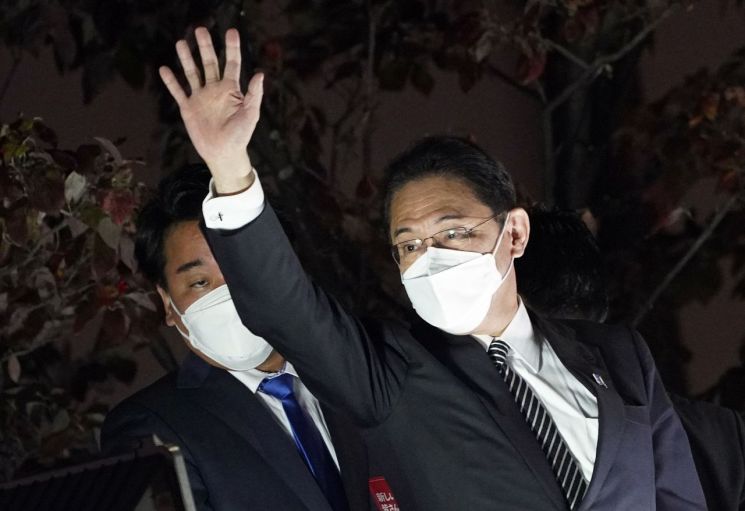
 ▲Japanese Prime Minister Fumio Kishida waving his hand during an election campaign [Image source=EPA Yonhap News]
[Asia Economy Reporter Kwon Jae-hee] In the upcoming Japanese House of Representatives election on the 31st, the ruling Liberal Democratic Party (LDP), together with its coalition partner Komeito, is expected to secure the "absolute stable majority" of 261 seats out of the total 465 seats. However, there are observations that the LDP's own number of seats may decrease compared to just before the dissolution of the House of Representatives (276 seats).
Kyodo News reported that this was understood based on an analysis of telephone opinion polls and coverage conducted from the 23rd to the 26th targeting approximately 119,000 voters nationwide.
The absolute stable majority refers to a level of seats that allows a party to hold all the chairmanships of the standing committees of the House of Representatives and maintain a majority in all standing committees.
The LDP is leading in about 200 of the 289 single-member districts (constituencies), but Kyodo News diagnosed that 70 of these are in close contests, making it difficult to predict the results.
The LDP's proportional representation seats are analyzed to be close to the number just before dissolution (66 seats).
For Komeito, which had 29 seats, most of the 9 district candidates have "penetrated" their areas, and the proportional representation seats are expected to increase from the existing 21 seats.
The main opposition party, the Constitutional Democratic Party (CDP), after promoting candidate unification with opposition parties such as the Japanese Communist Party, is leading in over 50 districts and is seeking to increase its proportional representation seats from the 40s, Kyodo News reported.
While the CDP's seats seem likely to increase, the growth is not as much as expected, and whether it can surpass the number just before dissolution (110 seats) depends on the outcomes in the closely contested districts, Kyodo News analyzed.
The Communist Party, which previously held 12 seats, may expand its proportional representation seats, and the Japan Innovation Party, which had 11 seats, is realistically expected to achieve the 30-seat range, surpassing the 21 seats required to independently propose legislation.
© The Asia Business Daily(www.asiae.co.kr). All rights reserved.

















