Corporate Tax Rate Increase Replaced by Minimum 15% Taxation on Large Corporations
Billionaires to Face 20% Tax on Unrealized Capital Gains
Top 10 Wealthiest to Bear 322 Trillion Won Burden
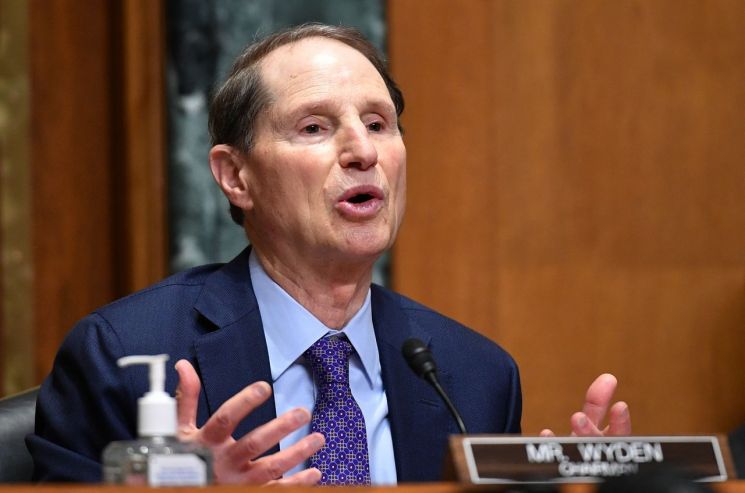 Senator Ron Wyden of the U.S. Democratic Party, who is leading the introduction of a 15% minimum corporate tax and a billionaire tax.
 [Image source=EPA Yonhap News]
[Asia Economy New York=Correspondent Baek Jong-min] The White House and the Democratic Party in the United States have opted to introduce a minimum 15% corporate tax on large corporations and a tax on unrealized capital gains of billionaires instead of raising the corporate tax rate to secure funding for large-scale social infrastructure investments.
According to the New York Times on the 26th (local time), three senators?Elizabeth Warren, Ron Wyden, and Angus King?unveiled a proposal for a 15% minimum corporate tax to be applied to companies that report book profits but pay no corporate tax.
Under the bill, companies with book profits exceeding $1 billion must pay taxes at a minimum rate of 15% annually. The NYT analysis estimates that about 200 companies would be subject to this tax. Amazon, which has been paying near-zero corporate tax, would also have to pay 15% if the bill passes. The proposing senators pointed out that Amazon reported $45 billion in profits over the past three years but paid a corporate tax rate of only 4.3%, far below the statutory 21% rate.
This is a measure to secure infrastructure investment funds without touching the corporate tax rate, amid opposition to raising the corporate tax rate from Democratic Representative Kirsten Sinema.
The senators’ proposal strengthens the conditions compared to President Biden’s earlier proposal to impose a 15% minimum corporate tax on companies with book profits exceeding $2 billion. At that time, the U.S. government estimated that about 45 companies would be subject to the tax.
CNBC also reported that the senators’ proposal would apply to more companies than President Biden’s proposal.
The Wall Street Journal (WSJ) predicted that manufacturers and technology companies benefiting from capital investments or stock option expenses would fall under the scope of this bill. WSJ estimated that some companies could be subject to both the global minimum corporate tax and the U.S. minimum corporate tax.
Senator Wyden stated, "The most profitable companies in the United States are often the worst offenders when it comes to paying their fair share. They report record profits to shareholders but pay little or no taxes."
Representative Sinema, who has opposed corporate tax hikes and stalled President Biden’s infrastructure investment bill, also gave a positive evaluation of the introduction of the minimum corporate tax. If all Democratic lawmakers agree, the $2 trillion infrastructure investment plan is likely to be passed in Congress. Democratic leadership also expects discussions on the infrastructure investment bill to conclude soon.
The Democratic Party is also pushing for stronger taxation on billionaires. Senator Wyden announced that the details of the 'billionaire tax' will be revealed soon.
The billionaire tax would impose taxes on unrealized capital gains of the wealthy. It would apply a minimum 20% tax rate on unrealized gains from assets such as stocks and bonds, making billionaires who have avoided taxes by receiving stock-based compensation instead of wages bear the cost of infrastructure investments.
The Washington Post (WP) reported that if the billionaire tax is implemented, the top 10 billionaires, including Tesla CEO Elon Musk, Amazon founder and WP owner Jeff Bezos, and Facebook’s Mark Zuckerberg, would pay nearly $276 billion (approximately 322 trillion KRW) in taxes.
According to analysis by Gabriel Zucman, an economist at UC Berkeley, Musk would have to pay $50 billion (58 trillion KRW) in taxes on unrealized gains during the first five years after the law’s enactment, followed by Bezos with $44 billion (51 trillion KRW).
Zuckerberg, Google co-founder Larry Page ($29 billion / 33 trillion KRW), Warren Buffett ($25 billion / 29 trillion KRW), and Bill Gates ($19 billion / 22 trillion KRW) would also have to pay tens of trillions in taxes.
Senator Wyden argued regarding billionaire taxation, "Just as nurses and firefighters pay taxes every time they receive wages, billionaires who have not paid taxes simply because they have no wages must pay their share."
Musk immediately opposed the proposal. In a letter sent to the senators that day, Musk requested opposition to Wyden’s proposal to tax unrealized capital gains. He argued, "Starting with billionaires, next will be millionaires, and within ten years, it will affect investments for middle-class retirement."
Musk also strongly criticized the proposal on Twitter, saying, "After they spend everyone else’s money, they will reach out to you."
© The Asia Business Daily(www.asiae.co.kr). All rights reserved.

















