DGIST Researchers Choi Seonggyun and Lee Seongjun Confirm Neurotoxic Substance Effects in Animal Experiments

[Asia Economy Reporter Kim Bong-su] Domestic researchers have confirmed the toxicity of microplastics. When these hazardous substances penetrate even the protective barriers and accumulate in the brain, they act as neurotoxic agents that kill brain cells.
The Daegu Gyeongbuk Institute of Science and Technology (DGIST) announced on the 27th that a research team led by Dr. Choi Sung-gyun and Dr. Lee Sung-jun from the Bio-Convergence Research Division confirmed through animal experiments and immune response analysis that microplastics ingested orally accumulate in the brain and act as neurotoxic substances.
Globally, 8 million tons of plastic are discarded annually, breaking down into very small fragments called microplastics due to ultraviolet rays and waves. These microplastics are ingested by lower organisms such as plankton, posing a threat to humans at the top of the food chain in the future.

To assess the harmfulness of microplastics, the research team conducted an experiment administering microplastics smaller than 2 μm orally to mice for seven days, confirming accumulation of microplastics in the kidneys, intestines, and even the brain of the mice. At this time, ultrafine microplastics smaller than 2 μm even passed through the Blood-Brain Barrier, which normally blocks hazardous substances from entering the brain. This was an unusual phenomenon showing that solids like microplastics, not gases, can cross the brain-blood-brain barrier.
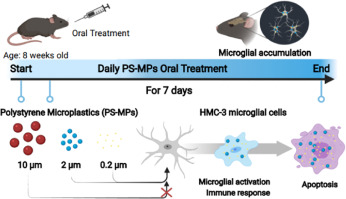
Applying immunostaining methods, the research team also succeeded in discovering that microplastics accumulate in microglial cells within the brain. When experimenting with microplastics of different sizes (0.2 μm, 2 μm, 10 μm), they found that microplastics smaller than 2 μm accumulated in the cytoplasmic region of microglial cells and significantly reduced the cells’ proliferation ability after several tens of hours. The team explained that microglial cells recognize microplastics as external threats, triggering phagocytosis to engulf and remove them, which subsequently leads to cell death due to changes in cell morphology.
Furthermore, the research team succeeded in confirming the effects of microplastics on animal brains and changes in immune responses at the molecular biology level. From the early stages of microplastic ingestion, the M1 marker (inflammatory activation) and M2 macrophage marker (inflammation resolution), which are specifically expressed in microglial cells, decreased. After seven days, both markers sharply declined while cell death rapidly increased. This indicates that when microplastics accumulate for a certain period, they can act as neurotoxic substances inducing cell death within the brain.
Senior researcher Choi Sung-gyun stated, “This study confirmed that microplastics, especially those smaller than 2 μm, begin to accumulate in the brain within seven days of short-term ingestion, causing microglial cell death and changes in immune and inflammatory responses. We plan to use these findings as a foundation for further research to elucidate the mechanisms of microplastic accumulation in the brain and the resulting neurotoxicity.”
The research results were published online on the 7th in the international environmental science journal, Science of the Total Environment.
© The Asia Business Daily(www.asiae.co.kr). All rights reserved.



















