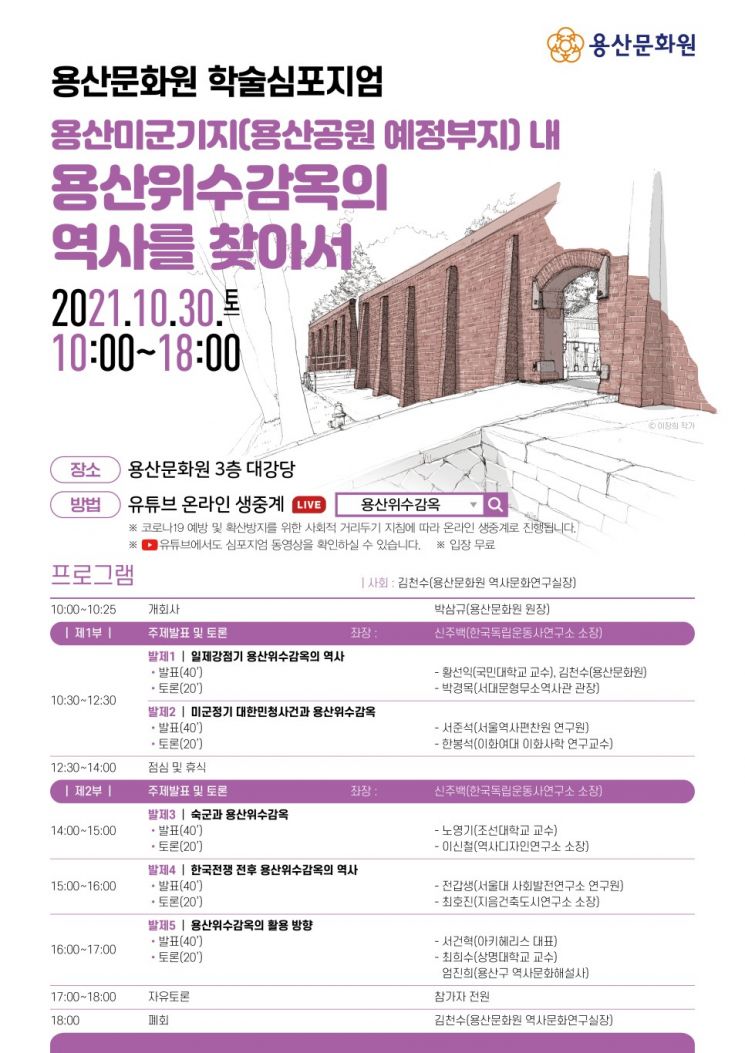
Yongsan-gu to Hold Yongsan Military Prison Academic Symposium on the 30th from 10 AM to 6 PM at Yongsan Cultural Center 3rd Floor Auditorium... Discussion on History and Utilization Plans of Yongsan Military Prison... Live Broadcast on Yongsan Cultural Center YouTube
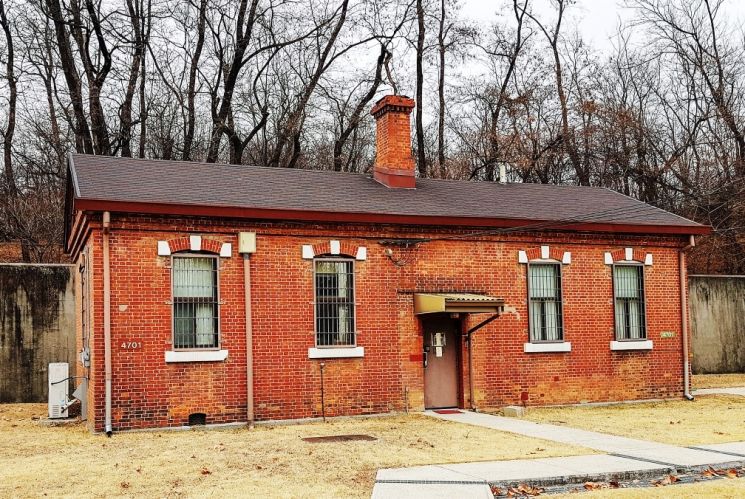
[Asia Economy Reporter Jong-il Park] Uibyeong leader Kang Gidong, general’s son Kim Doohan, Park Sihyun, secretary to Park Heonyeong, and Namrodang organizer Lee Jung-eop... What do they have in common? They all passed through the ‘Yongsan Military Police Prison’ established by the Japanese army. The name changed with each era: Military Police Prison, US 7th Division Detention Center, Army Prison, and the building still retains its original form today, located within the Yongsan US military base.
Yongsan District Office (Mayor Seong Jang-hyun) and Yongsan Cultural Center will hold an academic symposium titled ‘Tracing the History of Yongsan Military Police Prison (hereafter Military Police Prison)’ on the 30th from 10 a.m. to 6 p.m.
The event will take place in the large auditorium on the 3rd floor of Yongsan Cultural Center. Considering the COVID-19 situation, attendance will be limited and the symposium will be broadcast live on Yongsan Cultural Center’s YouTube channel.
The presentation topics (presenters) are ▲History of Yongsan Military Police Prison during the Japanese colonial period (Professors Hwang Seon-ik of Kookmin University and Kim Cheon-su, Director of Yongsan Cultural Center’s History and Culture Research Office) ▲The Korean Democratic Youth League Incident and Yongsan Military Police Prison during the US military government period (Researcher Seo Jun-seok of Seoul History Compilation Institute) ▲Political Purges and Yongsan Military Police Prison (Professor Noh Young-gi of Chosun University) ▲History of Yongsan Military Police Prison before and after the Korean War (Researcher Jeon Gap-saeng of Seoul National University Social Development Research Institute) ▲Utilization Plans for Yongsan Military Police Prison (Seo Geon-hyeok, CEO of ArchiHeris) among five topics.
Discussants include Park Kyung-mok, Director of Seodaemun Prison History Hall; Han Bong-seok, Research Professor of Ewha Womans University Ewha History; Lee Sin-cheol, Director of History Design Research Institute; Choi Ho-jin, Director of Jium Architecture and Urban Research Institute; Choi Hee-su, Professor at Sangmyung University; and Eom Jin-hee, former historical cultural guide of the district.
The chairperson is Shin Ju-baek, Director of the Korean Independence Movement History Research Institute.
The Military Police Prison was a military facility constructed within the Yongsan base by the Korean Garrison Army (Japanese army stationed in Joseon) to imprison Japanese soldiers and military personnel who violated military orders. The permanent Japanese military barracks, conceptualized during the Russo-Japanese War (1904?1905), were fully established after the disbandment of the Korean Empire army in 1907, including the military headquarters, infantry barracks, and the Military Police Prison.
Notably, although 112 years have passed since its completion (July 24, 1909), parts of the building still remain in their original form within the Yongsan US military base.
Professors Hwang Seon-ik and Kim Cheon-su introduce the installation and operation process of the Military Police Prison under Japanese military orders. The prison covered an area of 384 pyeong (approx. 1,268 square meters) and was surrounded by red brick walls. It consisted of an office building, prison cells, and other auxiliary structures, with the main gate (gammun) located on the southeast side and an emergency gate (presumed to be a side gate) on the northwest side.
An interesting fact is that in March 1911, Uibyeong leader Kang Gidong (1884?1911) was imprisoned here and subjected to a military trial. On April 17 of the same year, he was executed by firing squad at the Yongsan Army Shooting Range. This is confirmed by an article in the April 19 issue of the Maeil Shinbo newspaper.
Researcher Seo Jun-seok focuses on Kim Doohan (1918?1972), who was imprisoned in the Military Police Prison (then called the US 7th Division Detention Center) due to the Korean Democratic Youth League (Daehan Mincheong) incident. The Daehan Mincheong incident occurred on April 20, 1947, when Kim Doohan, the inspection chief of Daehan Mincheong, led people to kidnap, beat, and kill his longtime friend Jeong Jin-ryong, who had been active in leftist youth organizations.
Kim Doohan was sentenced to death on February 12, 1948, by a trial presided over by the US military and imprisoned in the military prison within the Yongsan US military base. However, the final approval authority, Far East military commander MacArthur, commuted the sentence to life imprisonment on May 17, 1948, and after the establishment of the Republic of Korea, he was pardoned by President Syngman Rhee on October 6, 1948.
According to Kim Doohan’s memoirs, suspects involved in the ‘Jang Deok-su assassination incident’ (December 2, 1947, when Jang Deok-su, political director of the Korean Democratic Party, was shot at his home in Jegi-dong by independence activists affiliated with the Korean Independence Party) were also imprisoned in the US 7th Division Detention Center. Researchers Seo Jun-seok and Kim Cheon-su discovered related documents (US Military Government Military Tribunal Order No. 4 dated April 21, 1948), confirming this for the first time.
The US 7th Division Detention Center was upgraded to the ‘US Forces Korea Prison’ on January 13, 1949, and after the withdrawal of US forces in June 1949, it became the Republic of Korea Army Prison. During the large-scale purge of leftists within the military (political purges) at that time, most suspects were believed to have been imprisoned here.
Professor Noh Young-gi explains, “One characteristic of this period was that civilians were subjected to military trials and imprisoned in the Army Prison. Civilians such as Kim Tae-jun and Yoo Jin-oh, former partisans, and Lee Yong-woon (the main culprit in the assassination of Police Superintendent Kim Ho-ik in August 1949) were tried by military courts.”
Additionally, in June 1949, seven people including Park Sihyun, secretary to Park Heonyeong of the South Korean Labor Party (Namrodang), and liaison Jeong Jae-han were imprisoned in the Army Prison due to the ‘National Assembly spy (agent) incident.’ Around the same time, Namrodang organizer Lee Jung-eop escaped from here on July 17, 1949.
Researcher Jeon Gap-saeng examines the history of the Military Police Prison before and after the Korean War. Particularly, the building damaged by US bombing during the Korean War (Army Prison) appears to have been used as the ‘Eighth US Army Detention Center’ from July 1953 to 1963, though further research is needed to confirm this.
The district plans to compile research materials on the Military Police Prison into a booklet next month.
Seong Jang-hyun, Mayor of Yongsan District, said, “Yongsan Military Police Prison is a very meaningful place where the history of the Japanese colonial period, liberation era, and US military occupation can be examined all at once. It is probably the only case nationwide where a local government, not the central government, is conducting such in-depth research on the history of Yongsan base, a key site in modern Korean history.”
He added, “Through academic research, we hope many citizens will properly understand the historical significance and value buried here, and the creation of Yongsan National Park should also proceed based on its historicity and sense of place.”
© The Asia Business Daily(www.asiae.co.kr). All rights reserved.


















