Gradual Easing of Quarantine Measures Starting Next Month
Samsung, Hyundai Motor, LG Group, etc. Reduce Remote Work and Resume In-Person Meetings
Considering Various Work Styles Combining Efficiency and Work-Life Balance
Companies are returning to their daily routines. The proportion of employees working from home, which exceeded 50% during the height of COVID-19 last year, is gradually decreasing from 40% back to 30% as more employees return to the office one by one. Although daily life is being restored, it is different from before. Major conglomerates plan to introduce flexible work-from-home systems targeting employees who showed high work efficiency while working remotely, including pregnant women, and to steadily expand the hub offices established during COVID-19.
Returning to the Office with the Transition to With-Corona
According to the business community on the 26th, major domestic conglomerates such as Samsung Group, Hyundai Motor Group, and LG Group have reduced the proportion of employees working from home to around 30% of the total workforce. Hyundai Motor Group has also brought back employees who were working remotely and resumed face-to-face meetings and training for those who have completed vaccination. LG Electronics reduced the proportion of employees working from home from over 50% to 40%. They plan to reduce it further to below 30% within the year and adjust the ratio depending on the COVID-19 situation.
Major conglomerates stated that pregnant women, people with underlying health conditions, and others will continue to work from home for the time being. Although no specific guidelines have been established yet, many companies plan to use remote work flexibly depending on job types and individual circumstances.
An official from a large corporation said, "At the beginning of the COVID-19 outbreak, the health authorities' message to 'stay home if you are sick' gained social acceptance, and it was confirmed that remote work was much more efficient for pregnant women and others. Once the government issues additional guidelines related to the transition to With-Corona (gradual recovery of daily life), we will internally establish new regulations regarding the level of quarantine measures."
Improving Productivity is Key
The IT industry, which has a high proportion of developers, is also preparing to return to normal. Nexon has reduced the proportion of remote work and switched to a ‘3+2 work system,’ where employees come to the office for 3 days and work from home for 2 days. A Nexon official explained, "This is a measure to gradually restore the previous daily routine while adapting to changes in the COVID-19 situation in the long term."
Naver and Kakao plan to maintain remote work for all employees until the end of the year while implementing a twice-weekly rotational attendance system. Major game companies such as NCSoft and Netmarble have not changed their remote work policies but are considering flexible operation plans depending on job types. The three major telecommunications companies have not changed their remote work policies yet but plan to adjust attendance methods to improve productivity, including through hub offices.
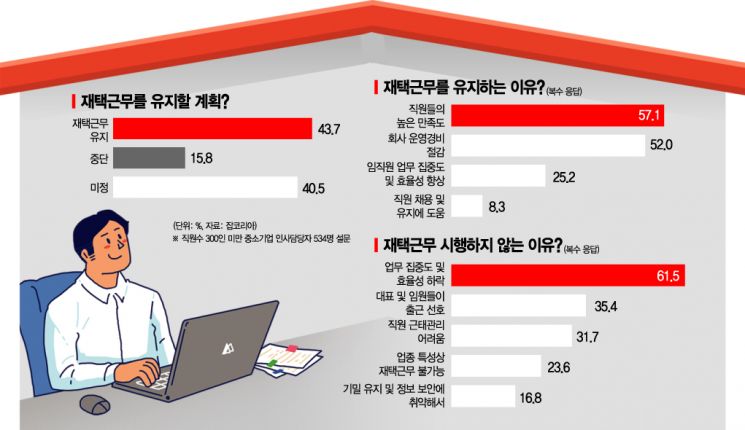
Among small and medium-sized enterprises (SMEs), opinions are split evenly between supporting office attendance and remote work. According to a survey by JobKorea, 40% of domestic SMEs have not decided whether to continue remote work, while 43.7% said they will maintain remote work going forward. This is due to high employee job satisfaction and, depending on the industry, the ability to reduce company operating expenses.
Professor Seo Yong-gu of Sookmyung Women's University (Department of Business Administration) diagnosed, "After COVID-19, the concept of working methods has changed significantly due to remote work, and in a situation where the advantages of remote work outweigh the disadvantages, it has become virtually impossible to return 100% to the pre-COVID commuting method." Professor Seo predicted, "Except for some industries where face-to-face services are impossible, various work styles such as commuting, remote work, and hybrid methods combining both will coexist, with core performance indicators of work being fully measurable."
© The Asia Business Daily(www.asiae.co.kr). All rights reserved.
![Clutching a Stolen Dior Bag, Saying "I Hate Being Poor but Real"... The Grotesque Con of a "Human Knockoff" [Slate]](https://cwcontent.asiae.co.kr/asiaresize/183/2026021902243444107_1771435474.jpg)
















