Government Unveils With-Corona Roadmap... Daily Life Recovery in January Next Year
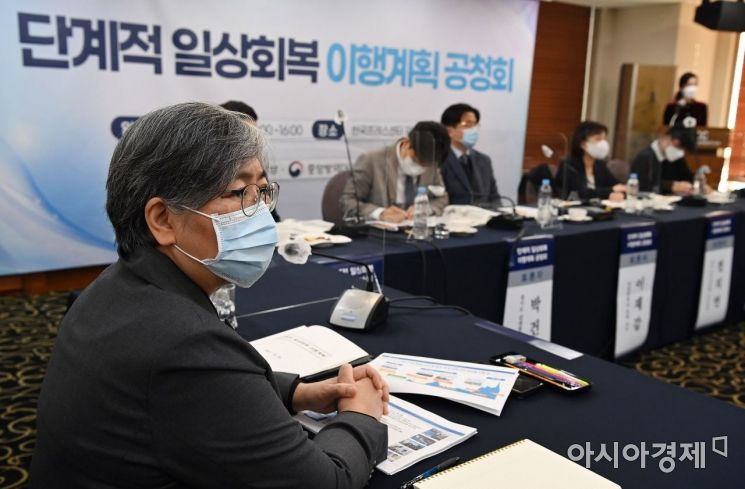 Jung Eun-kyung, Commissioner of the Korea Disease Control and Prevention Agency, attended the "COVID-19 Phased Recovery Implementation Plan Public Hearing" held on the 25th at the Korea Press Center in Jung-gu, Seoul, and listened to the keynote presentation by Park Hyang, Head of the COVID-19 Central Disaster and Safety Countermeasures Headquarters' Quarantine General Division. The public hearing was organized by the Quarantine and Medical Subcommittee of the Recovery Support Committee to introduce the draft of the phased recovery plan and to gather opinions from experts and the public. Photo by Moon Ho-nam munonam@
[Asia Economy Reporter Seo So-jeong] The government will enter the ‘gradual return to normal life (With Corona)’ starting from the 1st of next month, following the achievement of the national vaccination completion rate goal of 70%. This comes approximately 1 year and 9 months after the first COVID-19 case was reported in the country.
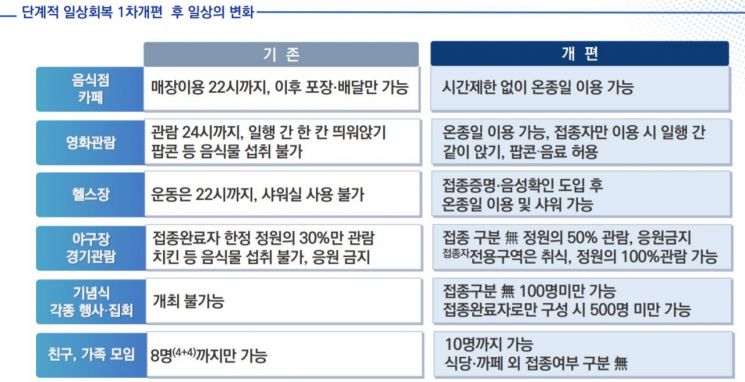
The government plans to implement phased easing of quarantine measures in three stages at six-week intervals. Phase 1 will begin on November 1, Phase 2 on December 13, and Phase 3 on January 24 of next year. Starting next month with Phase 1, restrictions on operating hours for restaurants and cafes will be lifted. Private gatherings will be allowed up to 10 people regardless of vaccination status, and vaccine passes (proof of vaccination or negative test) will be introduced for certain facilities such as karaoke rooms, bathhouses, and indoor sports facilities.
The Central Disaster and Safety Countermeasures Headquarters of the Ministry of Health and Welfare held a ‘Public Hearing on the COVID-19 Gradual Return to Normal Life Implementation Plan’ at 2 p.m. on the 25th at the Korea Press Center, unveiling the government’s draft strategy for returning to normal life.
In her opening remarks, Jeong Eun-kyung, Commissioner of the Korea Disease Control and Prevention Agency, said, “Last Saturday (the 23rd), 70% of the entire population completed vaccination, laying the foundation to begin the gradual return to normal life. To successfully promote the return to normal life, it is necessary to continuously monitor the situation within manageable levels and proceed with a stable and phased transition.”
Commissioner Jeong emphasized, “We will increase the vaccination rate to over 80% nationwide and swiftly promote additional vaccinations for high-risk groups. Through proof of vaccination and negative test systems, we plan to ease social distancing centered on vaccinated individuals and promptly restore key socio-economic functions.” However, she added, “We will proceed cautiously to ensure that unvaccinated individuals are not discriminated against or marginalized during this process.”
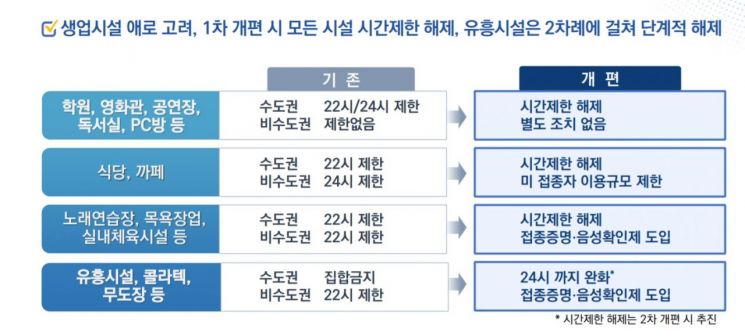
According to the government’s draft plan released that day, the government will ease quarantine measures in three phases at six-week intervals starting early next month. In particular, the government will introduce proof of vaccination and negative test requirements for certain high-risk facilities such as entertainment venues to gradually lift quarantine restrictions.
In the first phase of reform, considering the difficulties faced by livelihood facilities, operating hour restrictions will be lifted for all facilities, and entertainment venues will have their time restrictions lifted in two stages. Accordingly, restaurants and cafes in the metropolitan area will be allowed to operate past 10 p.m., and high-risk facilities such as entertainment venues, colatecs, and dance halls, which were previously banned from gathering, will be accessible until midnight for vaccinated individuals and those with negative test results.
Gathering Ban on Entertainment Venues Lifted... Weddings Allowed for Up to 500 People
Private gatherings will be allowed up to 10 people regardless of vaccination status during the first and second phases, with restrictions lifted in the third phase. Accordingly, gatherings in the metropolitan area will increase from the current 8 to 10 people, while the current limit of 10 people will remain in non-metropolitan areas. Park Hyang, head of the quarantine division at the Central Disaster and Safety Countermeasures Headquarters, explained, “Considering the relatively low impact on the livelihood economy compared to the worsening quarantine situation due to increased year-end and New Year gatherings and restrictions on livelihood facilities and events, we are promoting gradual easing.” However, in places like restaurants and cafes where masks are removed and people stay for extended periods generating droplets, the number of unvaccinated individuals is limited to fewer than 4.
For high-risk facilities such as nursing hospitals, nursing homes, inpatient visits, and facilities for the disabled where the risk of death upon infection is high, only vaccinated individuals are allowed to visit. Unvaccinated staff and caregivers are required to undergo mandatory weekly PCR (polymerase chain reaction) testing.
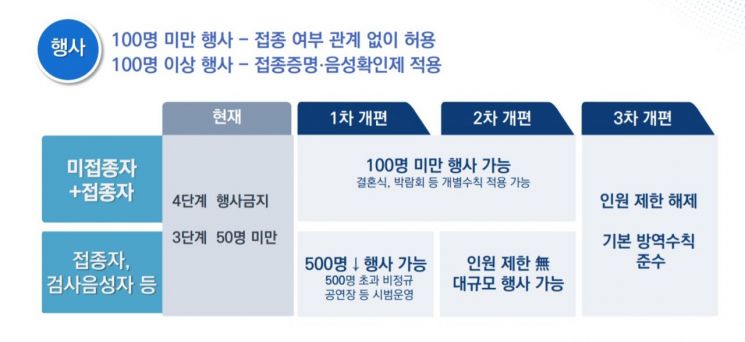
The allowed number of participants for events and assemblies will also increase significantly. In the first phase, events with fewer than 100 people will be allowed regardless of vaccination status, while events with 100 or more people will be limited to vaccinated individuals and others who meet the criteria. Accordingly, weddings, first birthday parties, exhibitions, concerts, and assemblies can host up to 500 people without restrictions if operated only by vaccinated individuals and those with negative test results. In the second phase, the government plans to remove participant limits to allow large-scale events, and in the third phase, all participant limits will be lifted.
Three-Stage Quarantine Easing at Six-Week Intervals... Emergency Plans to Be Established if Situation Worsens
The government will begin the first phase of reform on the 1st of next month and operate it for four weeks, followed by a two-week evaluation period to assess stability before deciding on the next phase implementation. Criteria for transition include vaccination completion rate, ICU and inpatient bed capacity, weekly severe cases and deaths, epidemic scale, and reproduction number.
Before entering the gradual return to normal life, the government plans to establish emergency plans to stabilize the quarantine situation. There is a possibility of a sharp increase in confirmed cases once normal life resumes, as seen in other countries. Accordingly, if ICU and inpatient bed occupancy rates worsen to over 80% or if weekly severe cases and deaths surge, strong emergency measures may be temporarily implemented. The implementation of emergency plans will be decided by the Central Disaster and Safety Countermeasures Headquarters after consultation with the Return to Normal Life Support Committee.
The government expects that by mid-December, when the second phase begins, 80% of the population will have completed vaccination. Even if the vaccination completion rate reaches 80%, about 11 million people will remain unvaccinated, and there is concern about waning vaccine efficacy among vaccinated individuals. Son Young-rae, head of the social strategy division at the Central Disaster and Safety Countermeasures Headquarters, said, “Experts agree that easing quarantine rules will inevitably lead to an increase in confirmed cases, and the government concurs. No matter how gradual the easing, it is unavoidable that the fourth wave will shift from decline to increase.” The government plans to consider lifting the outdoor mask mandate in the second phase, while indoor mask-wearing, as a core rule, will be maintained until the end.
Additionally, in line with the gradual return to normal life, home treatment will be expanded step-by-step, and the role of residential treatment centers will be adjusted. Commissioner Jeong stated, “Medical response will be reorganized to focus on severe patients, expanding home treatment for asymptomatic and mild patients to optimize the use of medical resources. Quarantine response will be rationally adjusted considering risk levels such as vaccinated individuals in epidemiological investigations and diagnostic systems.”
The draft plan for the gradual return to normal life released that day will be further discussed at the third Return to Normal Life Support Committee meeting on the 27th and finalized after the Central Disaster and Safety Countermeasures Headquarters meeting on the 29th.
© The Asia Business Daily(www.asiae.co.kr). All rights reserved.



















