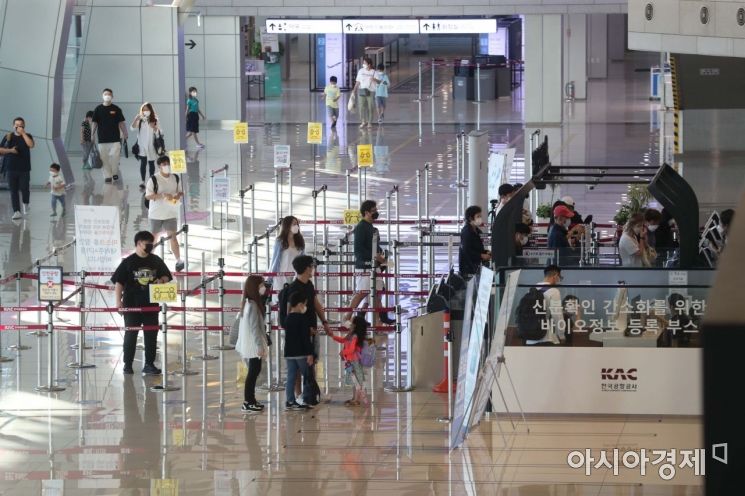
 Ahead of the Chuseok holiday, the spread of COVID-19 is accelerating mainly in Seoul and the metropolitan area. On the 16th, the domestic terminal of Gimpo Airport in Gangseo-gu, Seoul, was crowded with passengers. Photo by Mun Ho-nam munonam@
[Asia Economy Reporter Dongwoo Lee] Domestic low-cost carriers (LCCs) are expected to continue operating at a loss in the third quarter of this year, as the recovery of international flights is delayed due to the prolonged COVID-19 pandemic, compounded by rising oil prices and the KRW-USD exchange rate.
According to financial information firm FnGuide on the 24th, Jeju Air's consensus revenue forecast for the third quarter of this year is 86.7 billion KRW, with an operating loss of 67 billion KRW. Although revenue is expected to increase by 15.4% compared to the previous quarter and the operating loss is projected to decrease by about 4 billion KRW, it is inevitable that the company will record losses for seven consecutive quarters since the COVID-19 outbreak last year. During the same period, Jin Air is expected to record an operating loss of 45.3 billion KRW, and T'way Air is also forecasted to have an operating loss of 38.8 billion KRW.
The slow recovery of LCCs' performance is due to the fact that while major airlines continue to operate profitably focusing on cargo transport, LCCs, which have difficulty in cargo transport, face intensified challenges from limited domestic passenger demand and fierce low-fare competition. Although LCCs have recently increased their cargo transport share, structural limitations make it difficult to improve their performance significantly.
Rising jet fuel prices are also acting as a negative factor. According to the International Air Transport Association (IATA), the average international jet fuel price this month exceeded 95 USD per barrel, more than double the average price of about 44 USD in October last year.
With the rise in jet fuel prices, fuel surcharges added to base fares have also increased. Next month, international fuel surcharges are expected to be charged on a one-way basis according to distance, ranging from 10,800 KRW to 84,000 KRW. Compared to last month’s 4,800 KRW to 36,000 KRW, this is an increase of over 120%.
Due to the spread of COVID-19, international fuel surcharges, which had not been imposed for one year from April last year to March this year, resumed in April this year. International fuel surcharges are applied stepwise when the average price of Singapore jet fuel exceeds 150 cents per gallon (1 gallon = 3.785 liters).
With the upcoming implementation of 'With COVID-19' policies next month, concerns are rising that the increase in oil prices could hamper the airline industry's profitability recovery. The industry is currently reluctant to immediately include the increased oil costs in airfares and raise ticket prices.
The airline industry plans to actively pursue passenger demand recovery by resuming some international flights by the end of this year. Jeju Air will operate a golf tourism charter flight on the Incheon?Chiang Mai, Thailand route next month, and Air Seoul will resume the Incheon?Guam route starting December 23.
An LCC industry official said, "The recovery of international passenger demand has been delayed more than expected due to the resurgence of COVID-19, and the rise in oil prices has added to the burden," adding, "We are placing our hopes on passenger demand recovery through 'With COVID-19' policies by the end of the year."
© The Asia Business Daily(www.asiae.co.kr). All rights reserved.

















