[Asia Economy Reporter Jeong Hyunjin] Over the past five years, production losses suffered by domestic companies due to labor union strikes have exceeded 4 trillion won, prompting calls for improvements in strike practices, including allowing replacement labor during strikes, prohibiting union occupation of workplaces, and strict enforcement of public authority.
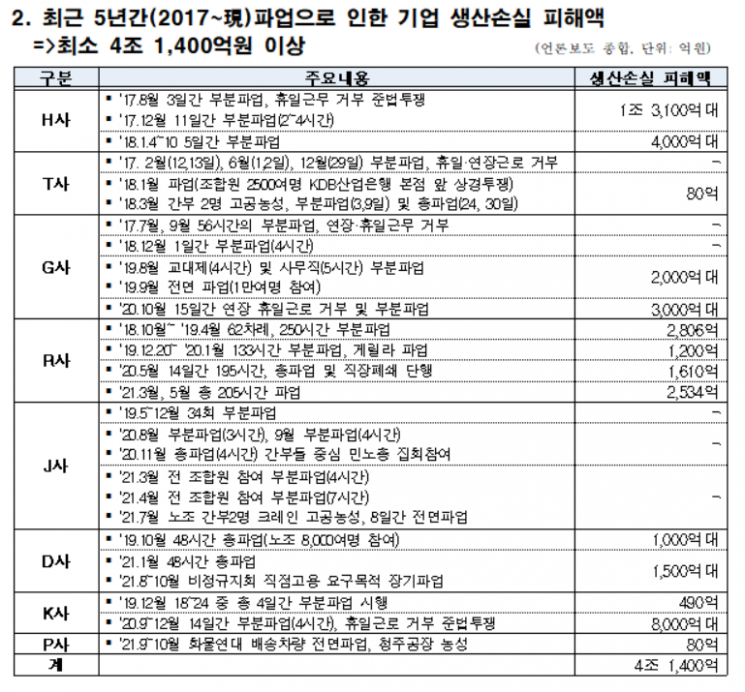
On the 25th, the Korea Economic Research Institute under the Federation of Korean Industries claimed that based on media reports from 2017 to the present, the total production loss damage caused by strikes was calculated at 4.14 trillion won. The institute analyzed that "Korea experiences more strikes compared to advanced countries, and the industrial damage caused by unreasonable strike practices by unions has been significant."
Using statistics from the International Labour Organization (ILO), the Korea Economic Research Institute compared the average annual work loss days due to strikes from 2009 to 2019 between Korea and five major countries (G5). It found that Korea had 38.7 work loss days per 1,000 wage workers, which is higher than ▲France with 35.6 days ▲the United Kingdom with 18.0 days ▲the United States with 7.2 days ▲and Japan with 0.2 days.
To reduce the damage caused by such strike practices, the Korea Economic Research Institute proposed three improvement measures. First, it emphasized the need to allow replacement labor. Korea currently prohibits replacement labor during strikes, which leads to production disruptions causing damage such as sales and export setbacks and the closure of partner companies, according to the institute.
According to the Korea Economic Research Institute, in the case of domestic conglomerate H Company, losses of 3.1 trillion won occurred because replacement labor was not permitted during a total of 36 strikes in 2016. R Company experienced production disruptions due to a total of 312 hours of strikes in 2019, which led to the closure of a partner company that once had sales of 20 billion won.
In contrast, G5 countries including the United States allow replacement labor. The United States permits permanent replacement labor during economic strikes aimed at wage increases and improved working conditions and may refuse the return of striking workers to the business later. Japan, the United Kingdom, Germany, and France utilize replacement labor through new hiring and subcontracting methods.
The Korea Economic Research Institute stated, "If replacement labor is allowed, the number of employed persons substituting striking workers will increase, and companies will experience reduced losses from strikes, which can lead to increased investment and job creation."
Along with this, the institute suggested the need to prohibit workplace occupation. Korea only prohibits occupation of major business facilities during strikes but allows partial occupation within workplaces. It recommended referring to cases in the United States, the United Kingdom, France, and Germany, where workplace occupation is considered illegal and prohibited. In the United States and the United Kingdom, violations can lead to disciplinary action or dismissal, while in Germany, forcibly blocking workers wishing to enter the workplace and coercing strike participation through intimidation can be prosecuted under criminal law for threats.
The Korea Economic Research Institute also argued for strict public authority responses to illegal strikes. It diagnosed that lenient public authority responses to strikes can lead to prolonged strikes, increasing the scale of damage to companies.
Choo Kwang-ho, head of the Economic Policy Office at the Korea Economic Research Institute, said, "To minimize economic damage and maintain a balance of power between labor and management, it is necessary to promote advanced labor-management relations policies such as allowing employer replacement labor, restricting union occupation of workplaces, and strict public authority responses, similar to advanced countries."
© The Asia Business Daily(www.asiae.co.kr). All rights reserved.

















