Product Names, Logos, and Other Printed Materials Melt and Colors Bleed... Unified with Black Pigment
Recycling Difficult if PET Bottles and Labels Are Not Separated
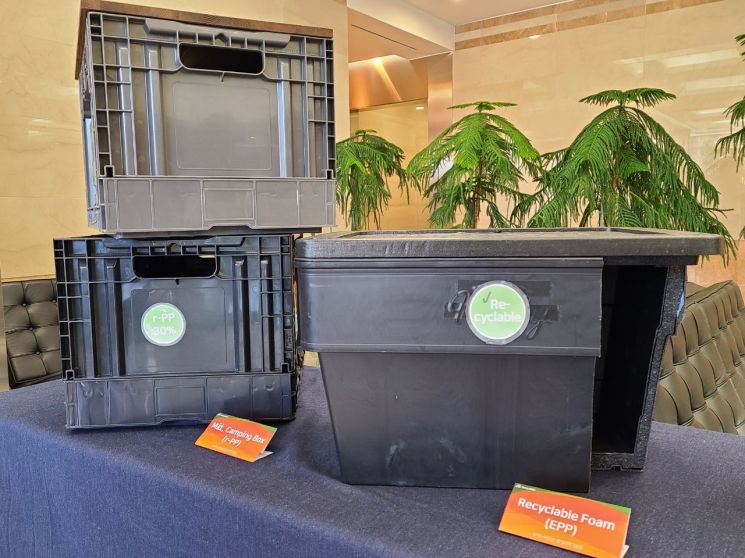
[Asia Economy Reporter Hwang Yoon-joo] As governments worldwide are specifying regulations for 'carbon neutrality' and companies accelerate ESG (Environmental, Social, and Governance) management, interest in recycled plastic products is increasing. Products made from recycled plastic by famous brands are gaining popularity and attention. Did you know that only 14% of the plastic we use is recyclable? There is also a reason why many recycled plastic products are black or dark-colored.
The process of producing products by recycling plastic is not simple. First, since each type of plastic has a different melting point, recyclable plastics must be collected by the same type of single plastic. Among these, only four types?PE, PP, PS, and PET?are recyclable.
After carefully sorting the types, plastics without added color are separated. Colored plastics or recyclable vinyl with product names or brand logos are sorted separately. This is because ink colors mix during the melting process, making it impossible to produce transparent plastic.
Above all, recycled plastics must be free of foreign substances and contamination. If food residue or foreign substances remain, they contaminate other recyclable plastics, making recycling difficult. This is why there is a recommendation to thoroughly clean plastic containers before placing them in recycling bins. For PET bottles, separating the label is for the same reason. PET bottles and labels are different types, and if not separated, they cannot be recycled.
Only after this laborious process does recycling truly begin. Plastics carefully separated through detailed steps are gathered by the same product type and crushed into small pieces. The crushed fragments are washed again and heated to form pellet-shaped granules called 'pellets.' Pellets are the basic raw material of plastic.
If plastics are not properly separated, they must be incinerated. Plastics that are not incinerated are discarded as is and remain without decomposing for 500 years, destroying ecosystems. By separating PET bottles and labels and thoroughly cleaning foreign substances during recycling, the amount of recyclable plastic increases. Of course, more importantly, companies need to reduce plastic production. Accordingly, the domestic chemical industry is also intensifying efforts to develop and produce recycled plastic products. SK Geocentric, LG Chem, and Lotte Chemical are representative examples.
The government is also participating in reducing plastic use. The Ministry of Environment is discussing measures to reduce plastic use from the chemical product production stage and increase the recycling rate of waste plastics. To this end, it recommends setting production ratios for container manufacturers above a certain scale. The container thickness is also limited from the existing 1.2mm to 1.0mm, and production of plastic containers that are difficult to recycle is encouraged to be reduced, with the government's goal to lower the proportion of plastic containers to 38% of all containers by 2025.
Along with consumers who aim to consume eco-friendly products, as the government and companies focus on recycled plastic production, expectations for a 'plastic-free' society are growing even stronger.
© The Asia Business Daily(www.asiae.co.kr). All rights reserved.

















