Polarization in Service Sector Employment, Worsening Labor Market Mismatch, and Declining Employment Among People in Their 30s
"Labor-Related Laws and Systems Must Be Improved, and Employment Services and Vocational Training Systems Need to Be Reorganized"
[Asia Economy Reporter Ki-min Lee] To ensure that economic recovery leads to employment stability and job creation across all age groups and social classes, it has been pointed out that labor-related laws and systems need to be improved, and employment services and vocational training systems must be reorganized.
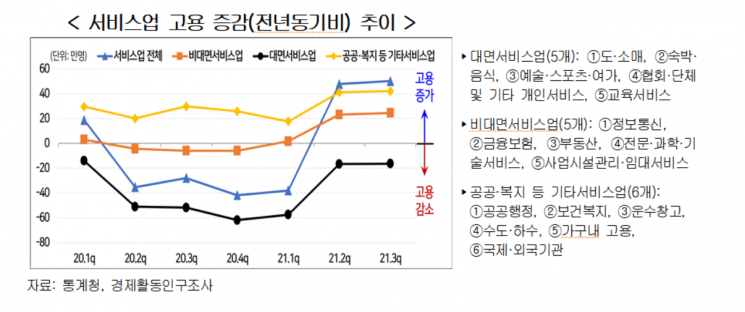
The Korea Employers Federation (KEF) released a report on the 24th titled "Three Characteristics and Implications of Recent Employment Trends," identifying the characteristics of recent employment trends as polarization in service sector employment, worsening labor market mismatch, and a decline in employment among those in their 30s.
During the COVID-19 pandemic, employment in non-face-to-face service sectors such as information and communications, and finance and insurance, which experienced relatively smaller declines, shifted to an increasing trend in the first quarter of this year, with the growth rate also expanding. In contrast, employment in face-to-face service sectors such as wholesale and retail trade and the arts continues to decline, resulting in polarization in service sector employment.
While there is an increasing difficulty in hiring on the ground, the labor market mismatch is worsening as more job seekers (job applicants) are postponing employment in search of better jobs.
The labor shortage rate in the first half of this year was 2.2%, up 0.4 percentage points compared to the same period last year, and the number of shortages increased by 59,000 to 282,000 compared to the same period last year.
On the other hand, among the 857,000 economically inactive people preparing for employment who were asked why they had not sought jobs, 32.8% (281,000 people) answered "due to lack of education, skills, or experience," and 25.8% (221,000 people) said "because there seemed to be no jobs matching the desired wage level or working conditions," according to KEF.
According to KEF, the labor shortage rate was higher in smaller workplaces. Employment among youth (ages 15?29), people in their 40s (ages 40?49), and middle-aged and older workers (50 and above) increased in the third quarter of this year, but employment among those in their 30s decreased. The decline in employment among those in their 30s was particularly notable in regular positions, which are relatively considered "stable jobs."
KEF pointed out that for economic recovery to achieve full employment recovery, various labor-related laws and systems that discourage hiring must be improved, and employment services and vocational training systems must be reorganized to resolve labor market mismatches.
Lim Young-tae, head of KEF’s Employment Policy Team, emphasized, "To restore employment in face-to-face service sectors and among those in their 30s, the private sector’s job creation capacity must be enhanced, but higher minimum wages compared to competing countries and rigid labor-related laws and systems are making companies reluctant to hire people. We need to create an environment that expands the private sector’s employment capacity by stabilizing the minimum wage and improving labor-related laws and systems to reduce employment rigidity, such as establishing flexible working hours."
He added, "We should actively provide employment information to facilitate connections between job seekers and hiring companies, expand the vocational training budget rather than public sector job creation, and strengthen vocational training in new technology fields in response to industrial structural changes."
© The Asia Business Daily(www.asiae.co.kr). All rights reserved.

















