Promoted as a Government Priority Project, Companies Also Invest in the 'Trillion-Won' Range
Real Estate Value Expected to Rise Alongside Establishment of Core Industries
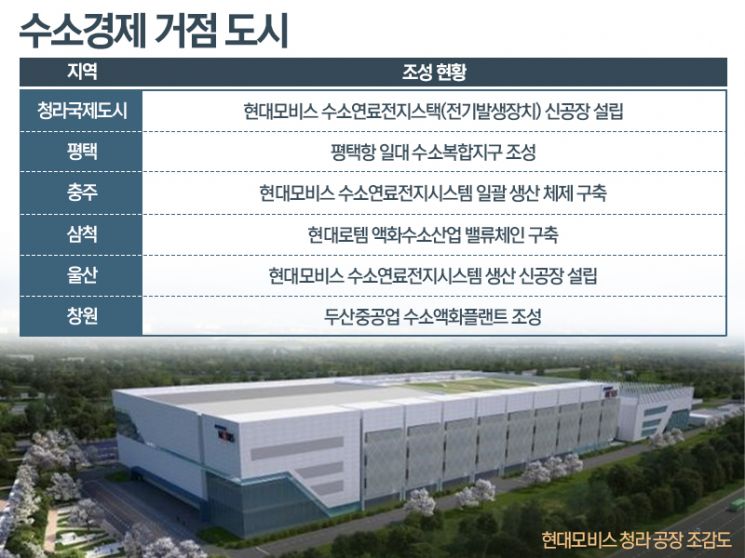
The hydrogen economy wave is blowing strongly in the real estate market as well. Recently, as the government has reiterated the activation of the hydrogen economy, 'trillion-won' investments are being concretized in various places, raising expectations for an increase in real estate value. Incheon Cheongna, Ulsan, and Gyeonggi Pyeongtaek are representative areas of interest.
According to the related industry on the 23rd, as the hydrogen economy grows, the landscape of the real estate market seems to be changing. Following the real estate boom triggered by semiconductors and bio industries, there is growing anticipation that the hydrogen economy will act as a catalyst to heat up the housing market in the future.
Representative beneficiary areas include Incheon Cheongna International City and Ulsan. Hyundai Mobis has decided to build a new factory for hydrogen fuel cell production in Cheongna International City by the second half of next year and also plans to establish a new factory in Ulsan. A total of 1.3 trillion won will be invested in building the two factories.
Local governments are also actively moving. Gyeonggi Pyeongtaek has signed an agreement with Gyeonggi Province and plans to invest 630 billion won by 2024 to transform the Pyeongtaek Port area into a hydrogen complex district.
Changwon in Gyeongnam is also building a hydrogen liquefaction plant with Doosan Heavy Industries aiming for completion next year, which will produce 5 tons of liquefied hydrogen per day upon completion. Gangwon Province announced it will invest a total of 6 trillion won to foster the liquefied hydrogen industry and is planning hydrogen production facilities in Donghae and Samcheok.
Kwon Il, head of the research team at Real Estate Info, said, "Bio industries in Incheon Songdo and semiconductor hub cities like Suwon and Pyeongtaek have continuously attracted demand with purchasing power, and as local infrastructure has steadily improved, real estate values in these areas have consistently risen. The hydrogen economy, which companies are putting their lives on the line for, is expected to have a comparable impact." He added, "However, some local governments merely present blueprints, and there may be a long time before actual hydrogen production begins, so the hydrogen economy should be viewed from a long-term perspective."
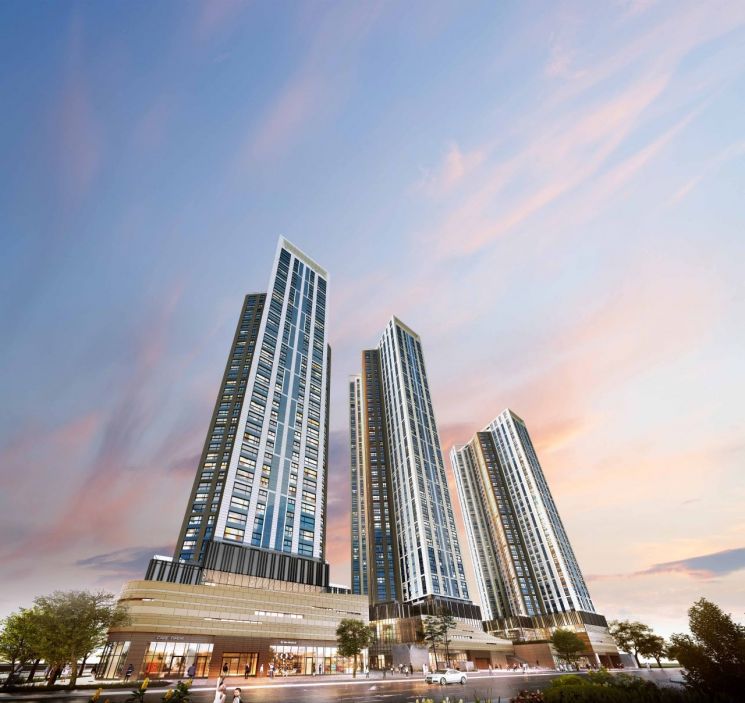
New pre-sales in hydrogen economy hub cities are also attracting attention. In Cheongna International City, the residential officetel 'Cheongna Hanyang Sujain The Destin (84㎡ exclusive area, 702 units)' will begin pre-sales within the year.
Not only hydrogen companies centered around Hyundai Mobis but also Hana Financial Group's headquarters and affiliates are scheduled to relocate sequentially, and the Seoul Asan Hospital consortium has been selected as the preferred negotiator for the Cheongna Medical Complex Town, which is expected to become a bio-medical cluster in the future. The planned City Tower Station (tentative name) on Line 7 (planned) is within walking distance, and discussions on extending Seoul Subway Line 2 are also underway.
In Ulsan, Dongwon Development plans to supply about 600 apartment units through the reconstruction of Samho Jugong in Nam-gu within the year. It boasts a pleasant residential environment, surrounded by Samho Mountain and Taehwa Square.
Hyundai Construction plans to pre-sell 1,107 units of 'Hillstate Pyeongtaek The First' in Pyeongtaek. It is accessible via Songtan Station on Line 1, and Gyeonggi-daero is adjacent, making it easy to move to Pyeongtaek General Industrial Complex.
Additionally, in Changwon, IS Dongseo plans to supply about 1,400 units through the reconstruction of Daewon 3 District housing. Convenience facilities such as the intercity bus terminal and Fatima Hospital are nearby.
Meanwhile, the government announced last month that it will increase hydrogen usage from 220,000 tons to more than 100 times (27 million tons) by 2050. It also plans to raise the proportion of clean hydrogen, which emits no carbon dioxide, to 40% by 2030 to achieve carbon neutrality by 2050.
Corporate movements are also active, with five groups including Hyundai Motor, SK, and POSCO planning to invest 43 trillion won in the hydrogen economy by 2030.
© The Asia Business Daily(www.asiae.co.kr). All rights reserved.


















