[Asia Economy Reporter Jang Hyowon] As Jair Bolsonaro, President of Brazil, continues his populist moves such as expanding subsidy payments, economic officials opposing this have been resigning one after another.
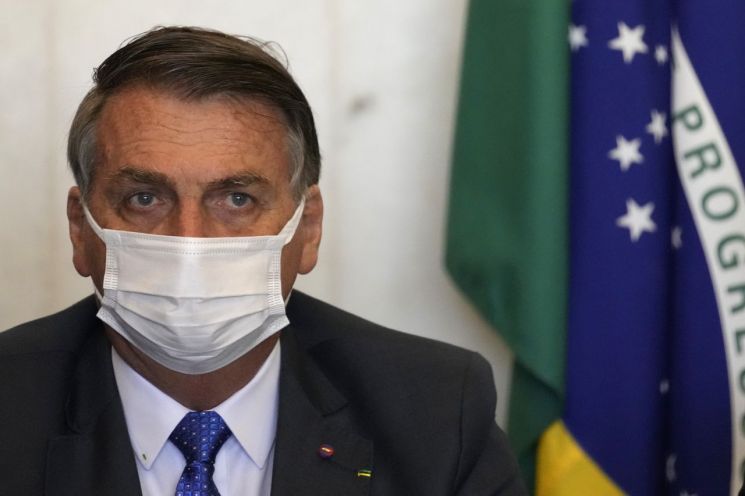 Brazilian President holding a meeting on next year's government expenditure expansion.
 [Image source=Yonhap News]
According to Brazilian media on the 22nd (local time), four senior economic officials resigned after President Bolsonaro and Minister of Economy Paulo Guedes announced the day before a plan to expand subsidy payments.
Bruno Funchal, head of the Treasury Budget Office, a key position in the Ministry of Economy, opposed the move, saying he could not follow measures that would deepen the fiscal crisis by exceeding the public spending cap.
President Bolsonaro confirmed his confidence in Minister Guedes at a press conference that day, saying, "The financial market is reacting too sensitively," but it is not easy to calm the market turmoil.
In particular, Minister Guedes is facing criticism for allegedly hiding assets by diverting money to tax havens, which is expected to weaken his position.
The Brazilian Ministry of Economy announced the day before that it would increase the low-income household living expense support from the current 190 reais per household to 400 reais (about 84,000 won), and provide subsidies to 750,000 truck drivers demanding increases in freight rates and stabilization of diesel fuel prices.
President Bolsonaro and Minister Guedes stated they would adhere to the legally mandated public spending cap, but an increase in fiscal burden is inevitable.
Experts point out that with Bolsonaro’s approval ratings falling and his prospects for re-election in next year’s presidential election dimming, he is leaning toward populism that deepens the fiscal and economic crisis.
The financial market has been volatile for four consecutive days due to the possibility of a fiscal crisis.
The Bovespa index of the S?o Paulo stock exchange fell 3.3% on the 19th, then the decline narrowed on the 20th, but it dropped 2.75% the day before and 1.34% on the day. The Bovespa index has fallen 7.28% this week and 10.69% for the year overall.
The exchange rate of the Brazilian real against the US dollar approached 5.7 reais per dollar the day before but closed at 5.627 reais on the day, showing signs of stabilization.
© The Asia Business Daily(www.asiae.co.kr). All rights reserved.

![Clutching a Stolen Dior Bag, Saying "I Hate Being Poor but Real"... The Grotesque Con of a "Human Knockoff" [Slate]](https://cwcontent.asiae.co.kr/asiaresize/183/2026021902243444107_1771435474.jpg)















