China Criticizes Nuriho While Raising Concerns Over ICBM Conversion
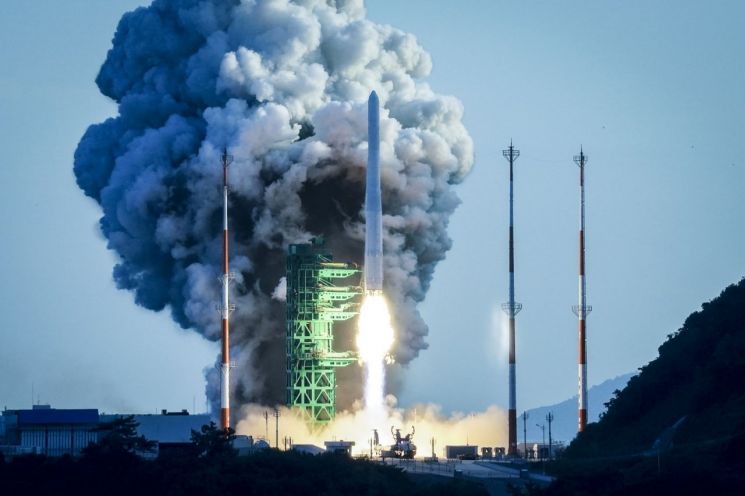 The Korean launch vehicle Nuriho (KSLV-II), designed and manufactured with purely domestic technology, is being launched on the 21st at Naro Space Center in Goheung-gun, Jeollanam-do. [Image source=Yonhap News]
[Asia Economy Reporter Heo Midam] Major foreign media outlets around the world simultaneously reported on the launch process and results of the Korean launch vehicle Nuriho (KSLV-II), while China harshly criticized it, saying it "does not even reach the level of China in the 1970s."
On the 22nd, Chinese space expert Huang Zicheng said in an interview with Global Times, "Nuriho's carrying capacity is higher than China's first rocket Changzheng 1, but overall, it does not reach Changzheng 2 developed by China in the 1970s." 'Changzheng 1' is China's first independently developed rocket, which launched China's first satellite Dongfanghong 1 into space in 1970. 'Changzheng 2' was developed in 1979.
Huang Zicheng stated, "Nuriho's three-stage rocket used liquid engines but did not use high-pressure afterburner technology," adding, "The reason is that afterburners require advanced technology, and it usually takes more than 15 years to acquire such technology."
Nevertheless, he said that South Korea could build an intercontinental ballistic missile (ICBM). Huang added, "If South Korea modifies its launch vehicle slightly, it could become an ICBM," and "This would change the military situation on the Korean Peninsula, so it is necessary to pay attention to the reactions of North Korea and other countries around the world."
Earlier, on the afternoon of the 21st, Nuriho was launched from Naro Space Center in Goheung-gun, Jeollanam-do, and successfully separated the satellite mock-up after reaching an altitude of 700 km.
However, the finally separated satellite mock-up failed to achieve orbital insertion, resulting in a partial success. Nevertheless, the Nuriho, developed purely with domestic technology, is evaluated to have achieved several accomplishments.
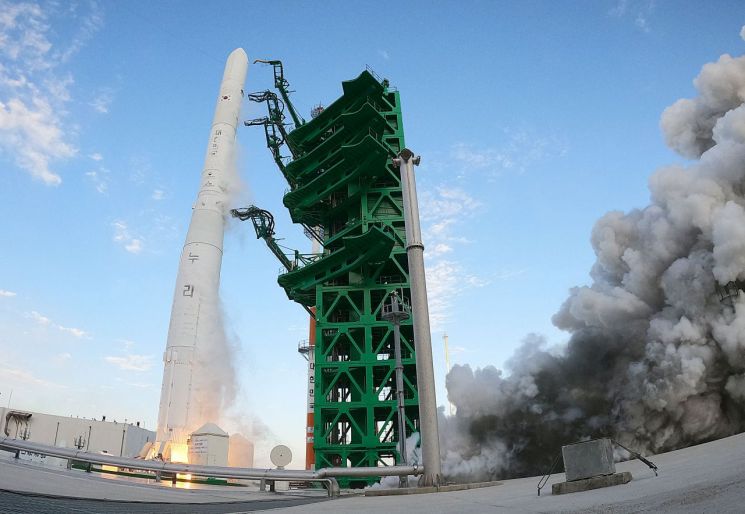 Nuriho is a three-stage launch vehicle designed to deploy a 1.5-ton class practical satellite into low Earth orbit (600?800 km). It is the first domestically produced launch vehicle completed entirely with Korean technology, from engine design to manufacturing, testing, and launch operation. The photo shows Nuriho being launched on the 21st at Naro Space Center in Goheung-gun, Jeollanam-do. [Image source=Yonhap News]
British broadcaster BBC reported the Nuriho launch news on the same day, introducing it as "making South Korea the seventh country to successfully launch a rocket into space."
BBC said, "The success of the Nuriho launch came amid escalating military competition between South and North Korea," adding, "Both sides recently tested new weapons." Previously, North Korea launched a submarine-launched ballistic missile (SLBM) east of Sinpo, Hamgyongnam-do, on the 19th.
BBC also reported, "South Korea plans to launch Nuriho four more times by 2027 to increase reliability."
American CNN also explained, "South Korea has so far completely relied on the United States for satellite intelligence on North Korea," and "Having its own launch vehicle means South Korea can possess reconnaissance satellites."
Meanwhile, Minister of Science and ICT Lim Hyesook said on KBS Radio's 'Choi Kyung-young's Strongest Current Affairs' program that morning, "We plan to form a launch investigation committee soon," and "Through this, we will analyze the large amount of data sent by Nuriho to identify the cause of the early combustion of the third-stage engine and overcome the issues."
© The Asia Business Daily(www.asiae.co.kr). All rights reserved.
![Clutching a Stolen Dior Bag, Saying "I Hate Being Poor but Real"... The Grotesque Con of a "Human Knockoff" [Slate]](https://cwcontent.asiae.co.kr/asiaresize/183/2026021902243444107_1771435474.jpg)

















