Autonomous Delivery Robot Forum on the 22nd... Newbility, Woowa Brothers, and Others Attend
"Delivery Robots Are Small, Lightweight, and Low-Speed... Reducing Delivery Fee Burden for Small Businesses"
Road Traffic Act and Park Greenery Act Pose Obstacles... Government Also Agrees on the Need for Regulatory Improvement
Concerns Over Privacy Invasion Raised... "Public Confidence in Safety Is Essential"
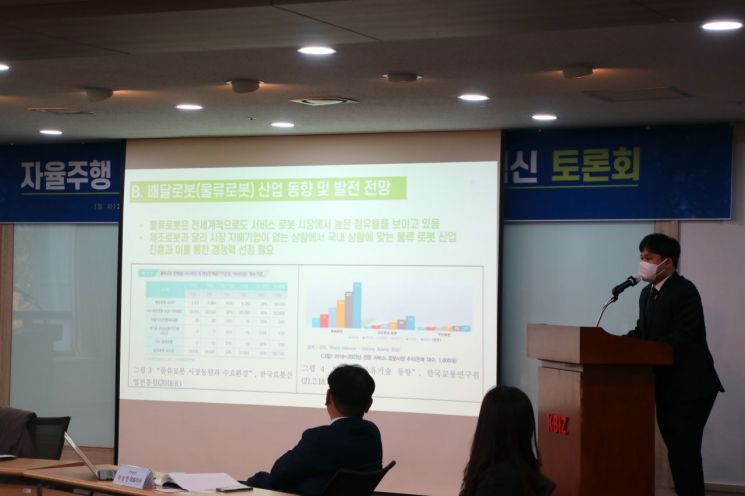 Lee Sang-min, CEO of delivery robot startup Newbility, is giving a presentation at the "Regulatory Innovation Forum for the Activation of the Autonomous Robot Industry" held on the 22nd at the Korea Federation of SMEs in Yeouido, Seoul. CEO Lee said, "Last-mile delivery robots are service robots that deliver products to customers by driving at low speeds with a small and lightweight design," adding, "Unlike general manufacturing, there is no dominant company in the market yet, so it is necessary to actively enhance the competitiveness of the logistics robot industry according to the domestic situation." Photo by Newbility
[Asia Economy Reporter Junhyung Lee] “The last mile delivery robot industry, which refers to the final stage of delivering products to consumers, could waste more than 10 years due to regulations. If we apply the dichotomous regulations centered on automobiles and pedestrians directly to delivery robots, it will remain a fundamental limitation to the development of the related industry.”
Lee Sang-min, CEO of delivery robot startup Newbility, stated this on the 22nd at the ‘Regulatory Innovation Forum for Revitalizing the Autonomous Robot Industry’ held at the Korea Federation of SMEs in Yeouido, Seoul. Lee said, “Last mile delivery robots are small, lightweight, and operate at low speeds to deliver products to customers as service robots,” adding, “Unlike general manufacturing, there is no dominant company in the market yet, so it is necessary to actively enhance the competitiveness of the logistics robot industry tailored to the domestic situation.”
The forum was hosted by Democratic Party lawmakers Kang Hoon-sik and Jung Il-young, along with Newbility, to discuss regulatory difficulties related to the commercialization of delivery robots. Delivery robot developers such as Woowa Brothers and ROBOTIS, as well as government officials from the Ministry of Trade, Industry and Energy, Ministry of Land, Infrastructure and Transport, and the National Police Agency attended. Lawmaker Kang said, “When I was a first-term lawmaker, I witnessed the failure of the startup ‘Tada’ business and thought that if I were re-elected, I would like to foster startups,” adding, “The difficulties arising from classifying delivery robots as automobiles were also concerns I had during my first term.” He continued, “After 3 to 4 years, the indoor serving robot market has grown rapidly,” and pledged, “We will work to establish proper institutional support.”
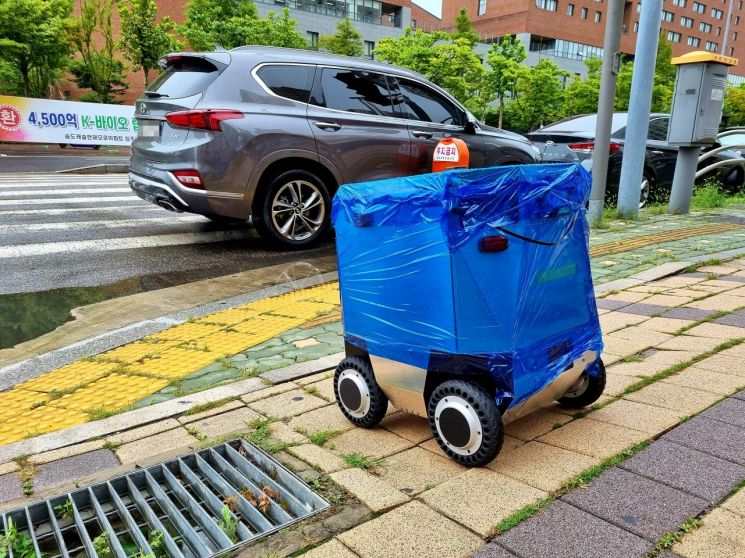 Newbility's delivery robot 'Newbi' is conducting a pilot operation near Yonsei University International Campus in Songdo, Incheon.
 Photo by Joonhyung Lee
The industry emphasized the necessity of introducing delivery robots. Although the delivery market has exploded due to COVID-19, the rider-centered delivery method struggles to meet the increased demand. Lee explained, “Small business owners spend about 18% of their total sales on delivery-related costs, which is a significant burden,” adding, “Delivery robots can reduce delivery costs, thereby alleviating the burden not only on users but also on restaurant operators.” Lee Hyun-jae, director at Woowa Brothers, said, “The existing delivery method poses safety issues not only for riders but also for female customers,” adding, “Some female customers avoid ordering delivery food because meeting delivery workers exposes them to potential crimes.” He further noted, “Safety accidents caused by riders rushing to deliver are also on the rise,” and stated, “Delivery robots can be an alternative that can mediate social problems and conflicts.”
Regulatory Relaxation in the US, Japan, etc... Ministry of Industry “Efforts to Improve Logistics Robot Regulations”
Criticism of regulations continued. According to the industry, the main regulatory obstacles to the development and commercialization of delivery robots are the Road Traffic Act, Automobile Management Act, Parks and Greenery Act, and Personal Information Protection Act. Under the Parks and Greenery Act, delivery robots are classified as ‘automobiles’ and are prohibited from entering urban parks. Since delivery robots must detour around parks, delivery times increase. Lee said, “It is necessary to classify delivery robots as pedestrians,” adding, “In the US, more than 10 states already recognize robots as pedestrians, and related regulations are being eased in countries like Japan.”
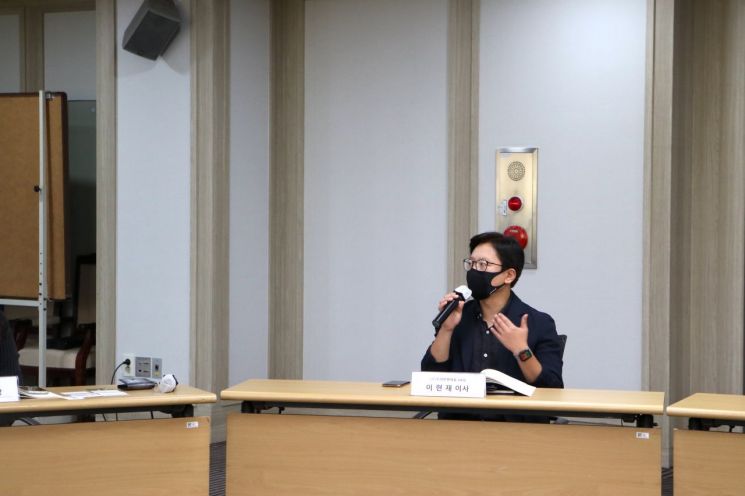 Lee Hyun-jae, director of Woowa Brothers, is speaking at the "Regulatory Innovation Forum for the Activation of the Autonomous Robot Industry" held on the 22nd at the Korea Federation of Small and Medium Business in Yeouido, Seoul. Photo by Newbility
In response, Yoon Chang-hoon, an official from the Green City Division of the Ministry of Land, Infrastructure and Transport, explained, “Urban parks are spaces where citizens enjoy comfortable urban environments and rest,” adding, “Elements that could pose safety risks, such as power devices, are strictly regulated by law to prohibit entry.” Yoon added, “(However) if some verification is done or there is no safety risk, like with personal mobility (PM), exceptions are made to allow entry,” and said, “We plan to operate special demonstration cases for autonomous robots in about seven parks nationwide by next year and then review institutional improvements.”
Government officials also agreed on the need for institutional improvements. Hwang Byung-so, director of the Machinery, Robot, and Aviation Division at the Ministry of Industry, said, “The potential, necessity, and importance of logistics robots need no further emphasis,” adding, “We are conducting about 10 robot-related regulatory sandboxes, seven of which involve logistics robots, showing our efforts to improve regulations.” Yoon said, “We recognize the need to activate delivery robots for last mile delivery,” but added, “It is true that it is difficult to allow robot entry based solely on weight and speed, like with PM.”
Delivery Robot Commercialization ‘Just Around the Corner’... “Need to Build Public Consensus”
There were also opinions emphasizing the need for public consensus. It was pointed out that positive perceptions of delivery robots must be formed before government regulatory reforms. Oh Seong-hoon, head of the Traffic Planning Division at the National Police Agency, said, “The target of persuasion should be the public, not government ministries,” adding, “If the public does not have confidence in the safety of delivery robots, it will be difficult for the amendment to pass.” Kim Jik-dong, head of the New Technology Personal Information Division at the Personal Information Protection Commission, said, “Because delivery robots operate at low speeds, they can capture more surrounding people than autonomous vehicles,” adding, “If recorded footage is transferred to partners who are not in a consignment relationship with delivery robot companies or users, it could lead to serious personal information violations.”
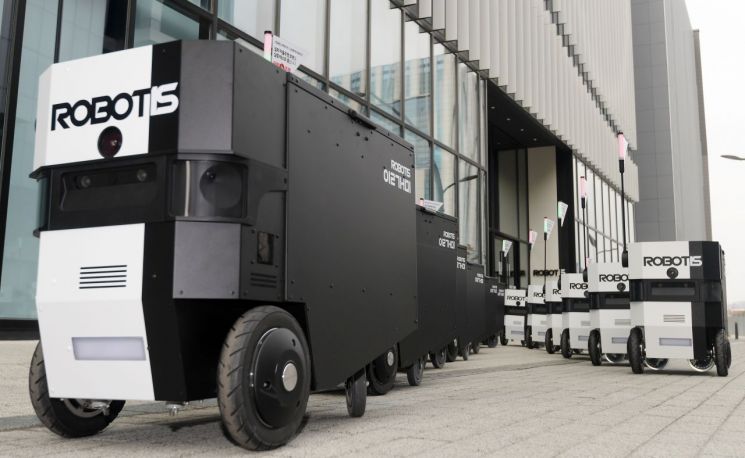 Delivery robot 'Ilgaemi' developed by Robotis. Since the end of 2019, Robotis has been conducting delivery robot demonstrations near its headquarters located in Gangseo-gu, Seoul.
 [Photo by Robotis]
Meanwhile, about 35 delivery robots are currently undergoing demonstrations in South Korea. Woowa Brothers’ ‘Dilly Drive,’ which was the first to develop delivery robots domestically, is representative. Since last year, Woowa Brothers has deployed about 10 Dilly Drive units in Suwon Gwanggyo for demonstration. ROBOTIS, through a regulatory sandbox, was the first in the industry to deploy about 20 delivery robots near its headquarters in Gangseo-gu, Seoul, in 2019.
Newbility began full-scale demonstrations starting last month in Songdo, Incheon. The company plans to launch delivery robot services as early as next month, focusing on the three Gangnam districts of Seoul (Seocho, Gangnam, Songpa) in collaboration with Seven Eleven and others.
© The Asia Business Daily(www.asiae.co.kr). All rights reserved.



















