The US Navy announced the previous day's test launch was successful
Deployment delayed compared to China and Russia, which reportedly operationalized in 2019
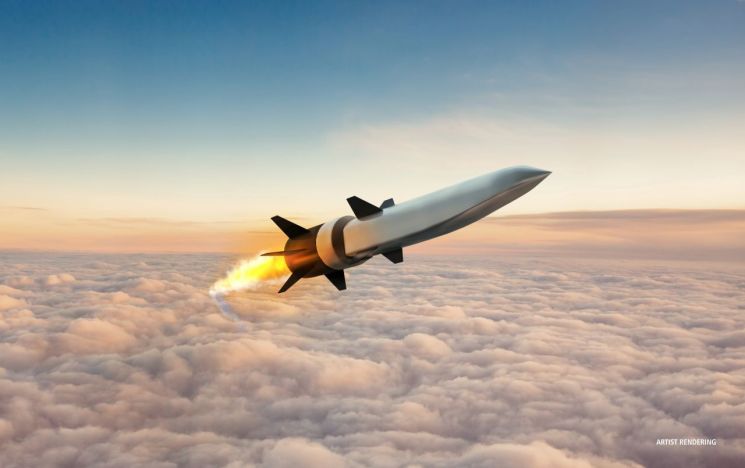
[Asia Economy Reporter Hyunwoo Lee] The U.S. Department of Defense announced that a hypersonic missile launch test conducted in Alaska failed due to a malfunction of the booster rocket. The previous day, the U.S. Navy had announced a successful test launch of a hypersonic weapon prototype. In the U.S., the Department of Defense, its branches, and private sectors are simultaneously developing hypersonic weapons, resulting in reports of both successes and failures. There are concerns that the U.S. may lag behind Russia and China, which are already known to have deployed such weapons in active service.
According to CNN on the 21st (local time), the U.S. Department of Defense attempted a test launch of a hypersonic glide vehicle (HGV) at the Pacific Spaceport Complex in Kodiak, Alaska, but the test failed due to a malfunction of the first-stage booster rocket, preventing a proper glide vehicle test. The HGV is a type of missile that ascends to the upper atmosphere using the thrust of the first-stage booster rocket, then separates and glides at an altitude of approximately 30 to 70 km at hypersonic speeds. It is known to be impossible to intercept with existing missile defense systems.
However, a day earlier, the U.S. Department of Defense reported that a joint test of hypersonic missile components conducted by the U.S. Navy and Army at NASA’s Wallops Flight Facility in Virginia was successful. The Department of Defense emphasized in a statement that "operating the prototype system in an actual operational environment allowed verification of advanced technologies and capabilities."
The U.S. Department of Defense is known to be conducting tests with various branches, research institutes, and private defense contractors independently developing hypersonic missiles while sharing both successes, failures, and technologies. Nonetheless, concerns remain that the delay in operational deployment could cause the U.S. to fall behind Russia and China, which are already believed to have deployed hypersonic weapons in active service. In April, the U.S. also attempted a test launch of a hypersonic missile from the strategic bomber B-52 but failed to launch the missile.
Meanwhile, hypersonic missiles are strategic weapons capable of flying at speeds exceeding Mach 5 (about 6,200 km/h), five times the speed of sound, and striking targets. They are known to be impossible to intercept with existing missile defense systems, leading to a development and deployment competition among the U.S., Russia, and China.
Previously, Russia deployed the Avangard hypersonic ICBM with speeds of Mach 20 in 2019 and successfully tested the hypersonic cruise missile Zircon last year. China also unveiled the Dongfeng (DF)-17 in 2019 and is reported to have developed its own hypersonic glide vehicle (HGV), continuing test launches to expand operational capabilities.
© The Asia Business Daily(www.asiae.co.kr). All rights reserved.

















