Prototype Testing with Army Following Air Force
Heightened Alert over Biden's Concerns on China's Hypersonic Missile Capability
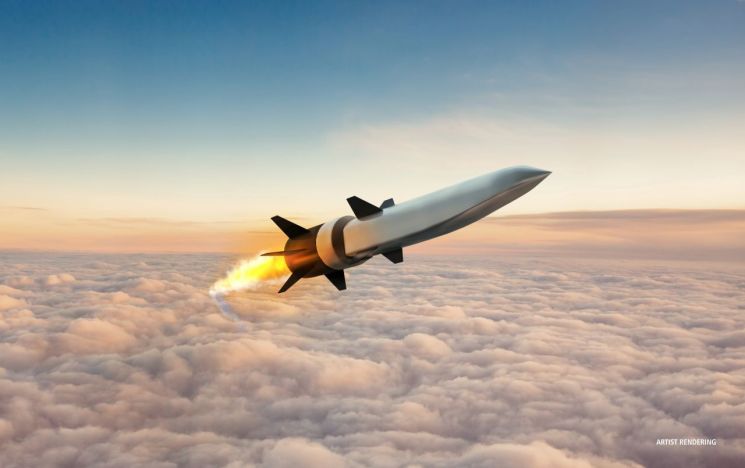
[Asia Economy Reporter Lee Hyun-woo] The U.S. Navy announced that it successfully conducted a hypersonic weapon launch test jointly with the Army. This announcement is interpreted as a prompt response following major foreign media reports that China succeeded in two hypersonic missile tests capable of carrying nuclear warheads in July and August, as well as U.S. President Joe Biden expressing concerns about China's hypersonic missile capabilities. There is growing anxiety that the U.S. might fall behind as China, along with Russia?which has already operationalized hypersonic missile forces?is expected to deploy these weapons before the U.S.
On the 21st (local time), the U.S. Navy announced that it successfully conducted a prototype test launch of a hypersonic weapon at NASA's Wallops Flight Facility in Virginia, jointly with the Army the previous day. The Navy stated, "We conducted three tests and all were successful, gaining critical technology for hypersonic missile development," emphasizing that "hypersonic missile development is a top priority."
Earlier, major foreign media reported that China succeeded in two test launches of hypersonic missiles capable of carrying nuclear warheads in July and August, heightening security threat concerns and a sense of crisis both inside and outside the U.S. President Biden also responded "Yes" when asked at a press conference the day before whether he was concerned about China's hypersonic missiles.
Hypersonic missiles are strategic weapons capable of flying at speeds exceeding Mach 5 (about 6,200 km/h), five times the speed of sound, and striking targets. They are known to be impossible to intercept with existing missile defense systems, leading the U.S., Russia, and China to compete in their development and deployment. Compared to Russia, which flaunted operational deployment in 2019, and China, which has also revealed hypersonic missiles, the U.S. is reportedly lagging in development, prompting the Department of Defense to accelerate its efforts.
Previously, Russia operationalized the Avangard hypersonic ICBM with speeds of Mach 20 in 2019 and successfully tested the hypersonic cruise missile Zircon last year. China unveiled the Dongfeng (DF)-17 in 2019 and is known to have developed its own hypersonic glide vehicle (HGV), continuing test launches to expand operational capabilities.
© The Asia Business Daily(www.asiae.co.kr). All rights reserved.
![Clutching a Stolen Dior Bag, Saying "I Hate Being Poor but Real"... The Grotesque Con of a "Human Knockoff" [Slate]](https://cwcontent.asiae.co.kr/asiaresize/183/2026021902243444107_1771435474.jpg)
















