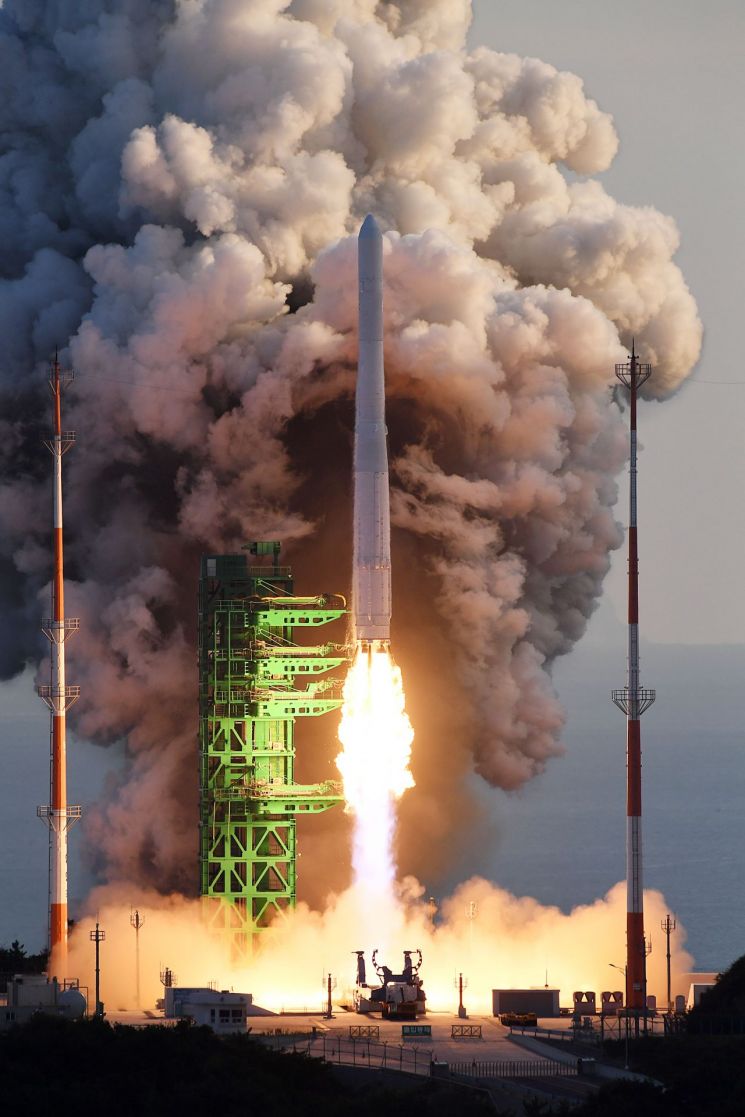
[Asia Economy Reporter Kim Bong-su] South Korea's space launch vehicle 'Nuriho,' developed independently with domestic technology for the first time, successfully reached the targeted altitude of 700km and achieved the separation of the satellite mock-up during its first launch on the 21st afternoon. However, it failed to enter the intended orbit, marking what is known as a 'half success.'
Nuriho ignited its first-stage engine precisely at 5 PM that day and immediately took off. After flying for about 127 seconds, the first stage separated just after reaching an altitude of 55km, and the separation of the satellite protective cover (payload fairing) was also successfully completed. Subsequently, the second-stage engine ignited safely, and Nuriho continued flying for about 147 seconds before separating the second stage at an altitude of 252km and igniting the third-stage engine. The third stage operated for about 521 seconds, safely placing Nuriho at the target altitude of 700km, and the satellite mock-up separation was also successfully carried out.
Earlier, Nuriho was transported and erected at the second launch pad from the comprehensive assembly building at Naro Space Center in Goheung-gun, Jeollanam-do, the day before. Following this, umbilical connections and airtightness inspections were conducted, and on the launch day, fuel and oxidizer were loaded, and final checks were completed before launch. The Ministry of Science and ICT and the Korea Aerospace Research Institute held a launch management committee meeting the previous afternoon to finalize the launch decision, and on the day, two additional meetings were held to check preparation status, weather conditions, and the presence of space hazards, ultimately proceeding with the launch at exactly 5 PM. Although the launch procedure initially targeted 4 PM, it was delayed by an hour due to an anomaly detected in a ground valve around 11:30 AM, which required inspection.
KARI and the Ministry of Science and ICT had expected a successful launch, stating that the 75-ton class liquid engine's performance was somewhat verified during a test launch in November 2018 and that thorough preparations had been made since then. However, given that the success rate of a first flight in the history of global space rocket development is about 28%, they could not hide their tension due to many variables.
Although South Korea failed to enter the intended orbit, it effectively became the seventh country in the world to possess the technology to launch practical satellites weighing over 1 ton into space. It secured an independent space transportation system with its own space launch vehicle technology and achieved results in fostering the space industry ecosystem and supporting the strengthening of industrial capabilities.
© The Asia Business Daily(www.asiae.co.kr). All rights reserved.

















