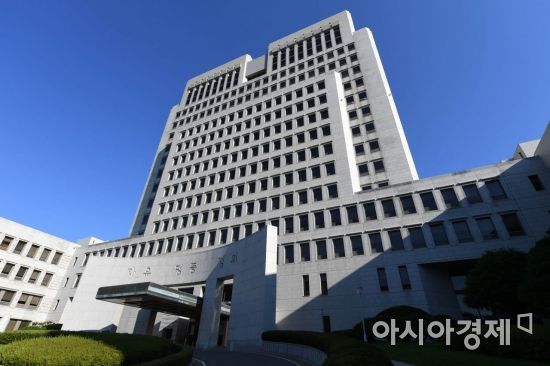
[Asia Economy Reporter Choi Seok-jin, Legal Affairs Specialist] The Supreme Court has granted electronic monitoring bail (electronic bail) with conditions for a defendant diagnosed with liver cancer while undergoing trial in custody. This is the first case since the electronic monitoring system was implemented following the amendment of the Electronic Monitoring Act last year.
On the 21st, the Supreme Court announced that the Second Division of the Supreme Court (Presiding Justice Lee Dong-won) had, ex officio, approved electronic monitoring bail with conditions for defendant A, who was diagnosed with multiple liver cancers during the appeal trial and found it difficult to continue detention.
The court approved A’s bail ex officio, imposing conditions including attaching an electronic device for real-time location tracking, restricting residence to home and hospital with a ban on going out, submitting a pledge not to destroy evidence and to appear at times and places designated by the court, and prohibiting harm to or contact with the victim.
Defendant A, indicted for forced sexual assault involving home intrusion and special forced sexual assault under the Sexual Violence Punishment Act, was sentenced to three years in prison and 40 hours of sexual violence treatment program in the first trial. While the appeal trial was ongoing, A was diagnosed with multiple liver cancers in June and has been receiving treatment.
Last month, A’s sentence was reduced to one year and nine months in the appeal trial. A filed a further appeal to the Supreme Court, but the cancer had metastasized to the lungs, and A’s health deteriorated to the point that detention became difficult.
Ultimately, on the 5th, Busan Detention Center, where A was incarcerated, recommended suspension of detention execution for A.
The reasons included ▲suspected metastasis of cancer cells to the lungs, but A’s small liver size making localized treatment difficult, ▲current liver function status making systemic chemotherapy or oral chemotherapy difficult, and ▲an estimated remaining lifespan of about six to fourteen months.
The prosecution also expressed the opinion that granting suspension of detention execution for A was appropriate.
However, considering A’s health condition, the Supreme Court granted electronic monitoring bail ex officio with the above conditions.
To address the low bail rate for detained defendants, the Ministry of Justice amended the Electronic Monitoring Act last year, establishing Article 3-2 (Bail and Electronic Monitoring). This added an order to attach an electronic device as a suitable condition prescribed by Article 98, Clause 9 of the Criminal Procedure Act, which regulates bail conditions as "other appropriate conditions set by the court to guarantee the defendant’s appearance."
Additionally, the Ministry of Justice mandated that electronic monitoring subjects, who are still undergoing trial and whose guilt or innocence is not yet confirmed, wear a smartwatch-type wrist electronic device different from the electronic anklets previously worn by sex offenders.
A Supreme Court official stated, "This is the first case since the electronic monitoring bail system was implemented in August last year that the Supreme Court has granted electronic monitoring bail with conditions to a defendant," highlighting its significance.
© The Asia Business Daily(www.asiae.co.kr). All rights reserved.
!["The Woman Who Threw Herself into the Water Clutching a Stolen Dior Bag"...A Grotesque Success Story That Shakes the Korean Psyche [Slate]](https://cwcontent.asiae.co.kr/asiaresize/183/2026021902243444107_1771435474.jpg)
















