Intensive Special Disinfection for Large and Medium-Sized Traditional Markets with High Infection Risk Until December
Introduction of 'Safe Call Entry Log' in 108 Traditional Markets with Over 100 Stores and Shared Workspaces
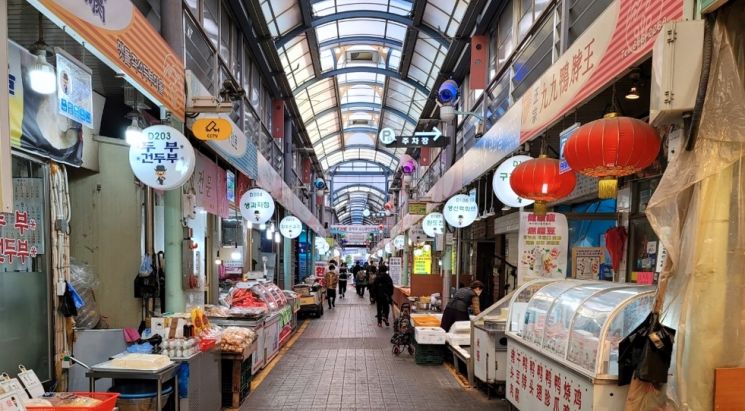
[Asia Economy Reporter Lim Cheol-young] The Seoul Metropolitan Government announced on the 21st that it will implement intensive special quarantine measures until December to prevent the occurrence of COVID-19 infections in traditional markets, where group infections among merchants have recently continued, and to respond quickly in case of infections to minimize community transmission.
According to Seoul City, the city will uniformly introduce the ‘Safe Call Entry Log System,’ which allows visitor information to be registered with a single phone call, to 108 medium-to-large traditional markets in Seoul with more than 100 stores. Additionally, to protect the safety and health of merchants who have postponed testing due to the inability to leave their stores for long periods, ‘Mobile Screening Clinics’ will also be operated.
Seoul City explained, "Since July, group infections and community transmission of COVID-19 have occurred in medium-to-large markets located in urban areas such as Garak Market in Songpa-gu and Sinjungbu Market in Jung-gu, and the risk of infection still exists in traditional markets. Therefore, strengthened quarantine measures considering the characteristics of safe traditional markets have been prepared."
First, the ‘Safe Call Entry Management’ system will be uniformly introduced to 108 medium-to-large traditional markets where it is difficult to identify visitors, which may cause difficulties during epidemiological investigations. The targets are traditional markets with more than 100 stores, large floating populations, and large scale, markets with joint workspaces such as meat processing facilities, and markets with many foreign workers.
The Safe Call system allows merchants and consumers to call a unique number for each market when entering the traditional market, and the entry time and phone number information are stored on a separate computer server and automatically deleted after four weeks. In reality, handwritten logs in traditional markets are often poorly managed and do not record accurate information, causing difficulties in epidemiological investigations when confirmed cases occur.
Seoul City expects that since the 108 markets adopting Safe Call have an average daily visitor count of about 655,000, rapid investigations of previously hard-to-track groups such as street vendors, mobile merchants, short-term workers, foreigners, and delivery workers will be possible, helping to prevent the spread of COVID-19. It also prevents personal information leakage or misuse caused by handwritten logs and allows elderly people who have difficulty using QR codes to easily use the system, enhancing efficiency in quarantine management.
Mobile ‘Screening Clinics’ for traditional market merchants and workers who cannot leave their stores for long periods will also begin operation in October. Operating hours will be adjusted according to market characteristics to increase utilization. The ‘Mobile Screening Clinics’ will be pilot-installed in 40 markets where group infections have occurred in the past or that have many visitors, including urban markets (Sungnyemun Import Market, Gwangjang Market, etc.), nationwide wholesale markets where merchants gather (Bangsan Market, Dongdaemun Market, etc.), and markets operating joint work facilities (Majang-dong Cattle Market, Doksan-dong Cattle Market, etc.), with plans to gradually expand after analyzing effectiveness.
Operating hours will also be customized according to market characteristics. Traditionally, merchants in traditional markets found it difficult to get tested because they had to work during the city’s screening clinic hours (9 a.m. to 5 p.m.) or had to leave their stores for a long time to visit distant screening clinics. In general markets, ‘morning screening clinics’ will operate during hours with fewer customers, and in markets with late-night operations, ‘after-work screening clinics’ will be operated after late-night business hours.
Currently, Seoul City is conducting ongoing quarantine support and self-quarantine material support, as well as regular quarantine inspections for about 300 traditional markets in the city. In addition, when confirmed cases occur in traditional markets, professional disinfection companies visit the markets within an hour to conduct emergency disinfection, striving to minimize community transmission.
Han Young-hee, Seoul City’s Director of Labor, Fairness, and Coexistence Policy, said, “Traditional markets have a structure where infection spreads easily due to dense stores and close relationships among merchants, and the large floating population can cause uncontrollable transmission speed when COVID-19 occurs. We will introduce Safe Call and operate screening clinics to protect merchants struggling due to COVID-19 and ensure visitor safety, achieving both prevention and containment of spread.”
© The Asia Business Daily(www.asiae.co.kr). All rights reserved.

















