Highest Since January 1965 Statistics
Rising Consumer Price Inflation Pressure... Inflation Concerns Increase
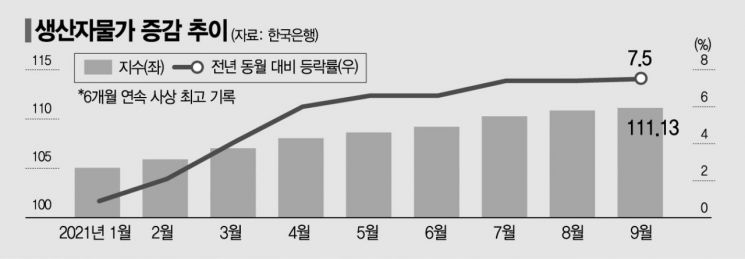
[Asia Economy Reporter Jang Sehee] Producer prices rose last month due to the strong crude oil prices. This marks the 11th consecutive month of increase, setting new record highs for six months following the all-time peak in April. Considering that producer prices are a leading indicator of consumer prices, inflationary pressures are expected to continue into the fourth quarter.
According to the Bank of Korea's announcement on the 20th, the Producer Price Index (PPI) for September was 111.13 (2015=100), up 0.2% from the previous month, marking the highest level since statistics began in January 1965. The PPI measures price changes of goods and services supplied by domestic producers to the domestic market and influences consumer prices.
Price increases were mainly seen in manufactured goods, electricity, gas, water, and waste. Manufactured goods rose 0.3% month-on-month, continuing an upward trend for 16 consecutive months. Among manufactured goods, coal and petroleum products increased by 2.1%, while primary metals and chemical products each rose by 0.4%. Electricity, gas, water, and waste prices increased by 2.0%. Energy prices also rose 2.1%, supported by the rise in international oil prices.
Choi Jinman, head of the Price Statistics Team at the Bank of Korea’s Economic Statistics Bureau, analyzed, "Manufactured goods increased mainly due to coal and petroleum products and primary metal products," adding, "The upward trend has continued this year as factors such as rising international oil and raw material prices persist."
On the other hand, agricultural, forestry, and fishery products fell 0.8% month-on-month due to favorable harvests and expanded supply. Agricultural product prices dropped 2.0%, while the increase in livestock product prices slowed to 0.6% from 1.0% the previous month.
Service prices remained flat as transportation services rose 0.3%, but business support services fell 0.4%.
The Domestic Supply Price Index, which adds import prices to the producer price index, rose 0.3% month-on-month to 113.81, mainly driven by intermediate goods. Raw materials increased 0.3%, mainly due to imports, and intermediate goods rose 0.4% as both domestic shipments and imports increased. Final goods also rose 0.2%, supported by consumer goods price increases.
As producer prices rise, pressure on consumer price inflation has also increased. Jung Kyu-cheol, head of the Economic Outlook Office at the Korea Development Institute (KDI), forecasted, "Due to the 20,000 KRW reduction in communication fees last October, consumer prices are likely to expand further this month."
In this regard, the Ministry of Economy and Finance also announced that the inflation rate for this month is expected to reach 3%.
Professor Sung Tae-yoon of Yonsei University’s Department of Economics stated, "With the phased daily recovery (With Corona), inflationary pressure from the demand side is expected to increase," adding, "Prices including personal services will rise, and the strong trend is expected to continue until the end of the year."
© The Asia Business Daily(www.asiae.co.kr). All rights reserved.