Samsung Electronics Faces Logistics Warehouse Theft but Demand Recovers
South African Government Insurance Company Pursues Loss Compensation
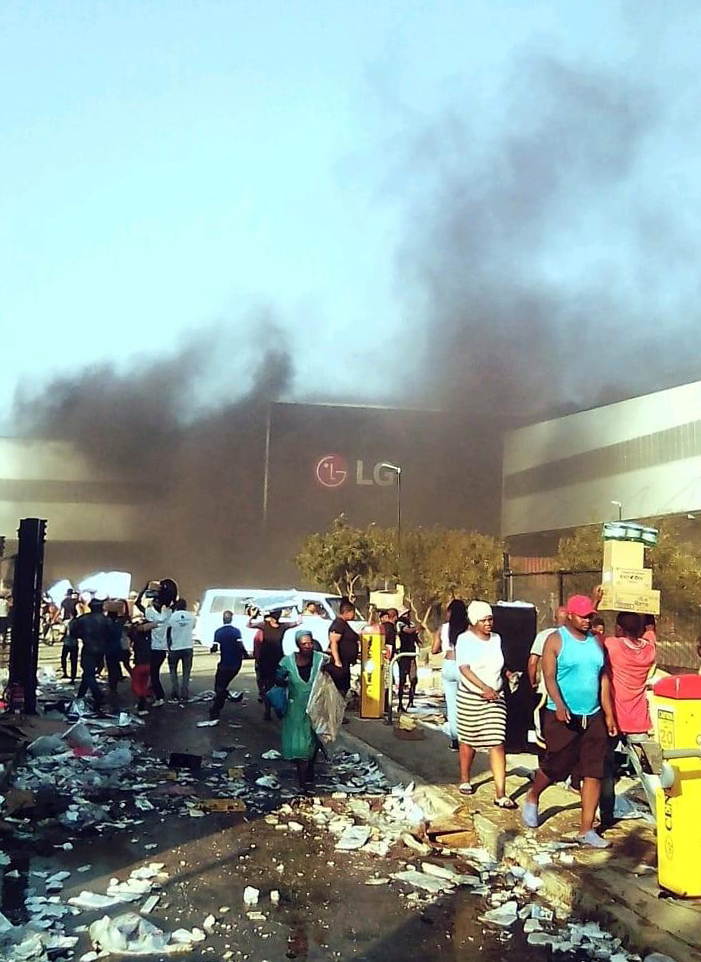 On July 12th, the LG Electronics factory in Durban was set on fire and looted by a crowd. [Image source=Yonhap News]
[Asia Economy Reporter Kim Suhwan] LG Electronics, whose factory was completely destroyed in the riots that occurred in South Africa last July, overcame the crisis in nearly 100 days and even showed growth.
Andeuksoo Ahn, Managing Director of LG South Africa Corporation, said on the 19th (local time), "Despite the threats of looting and arson in the third quarter, we recorded a growth rate of over 30% compared to last year," adding, "In the fourth quarter, we are stepping up sales targeting Black Friday, the discount shopping season in November."
LG Electronics suffered a heavy blow as its factory in Durban, a southeastern port city in South Africa, was burned down during the recent riots.
However, as seen in this business performance, considering South Africa's strategic position as a forward base for the African market, the company decided not to withdraw its business from the local market.
Instead, LG Electronics plans to switch to a contract manufacturing model in Johannesburg, the economic center, starting February next year.
Contract manufacturing differs from the existing factory model in that it is not a direct investment but production outsourced to local companies.
Since finished products are produced using subcontractors, the margin may be relatively lower than that of a directly invested factory, but it has the advantage of avoiding risks associated with the recurrence of riots.
Ahn said, "This is a change in business model from the perspective of mid- to long-term risk management."
The South African government is also reportedly providing institutional support for LG's resumption of contract manufacturing operations early next year.
Originally, LG operated a self-owned (direct investment) factory in Johannesburg that imported parts for assembly, but in 2019, to reduce logistics costs, it moved the factory to Durban, a cargo port.
During the riots in July, armed rioters broke into the factory in the early hours of the 12th, stealing electronic products, various equipment, and materials, and later that afternoon set fire to the factory, reducing the production facilities and logistics warehouse to ashes. According to industry sources, the damage was estimated at hundreds of billions of Korean won, but fortunately, there were no casualties.
The factory, which produced TVs and monitors, had about 100 employees working on one production line.
Due to the riots, at least 40,000 companies centered around KwaZulu-Natal and Johannesburg were affected, and more than 300 people died. Even shopping malls suffered looting and damage at about 200 locations.
Samsung Electronics also experienced looting of its logistics warehouse in KwaZulu-Natal, where Durban is located, but demand has reportedly recovered. Samsung Electronics also has a TV assembly plant in Durban but did not suffer direct damage from the riots.
A Samsung Electronics local subsidiary official explained on the same day, "We were unable to supply products because the logistics warehouse was looted, but we quickly resumed production and replenished all inventory."
Samsung Electronics, along with LG Electronics, is pursuing compensation for losses caused by the riots through SASRIA, an insurance corporation under the South African government.
The South African government operates insurance for natural disasters, riots, and disturbances, and has announced a compensation policy for this incident.
© The Asia Business Daily(www.asiae.co.kr). All rights reserved.

















