Afternoon of the 20th, Completion of Uprighting After Moving the Second Launch Pad
Currently Undergoing Umbilical Connection and Airtightness Inspection
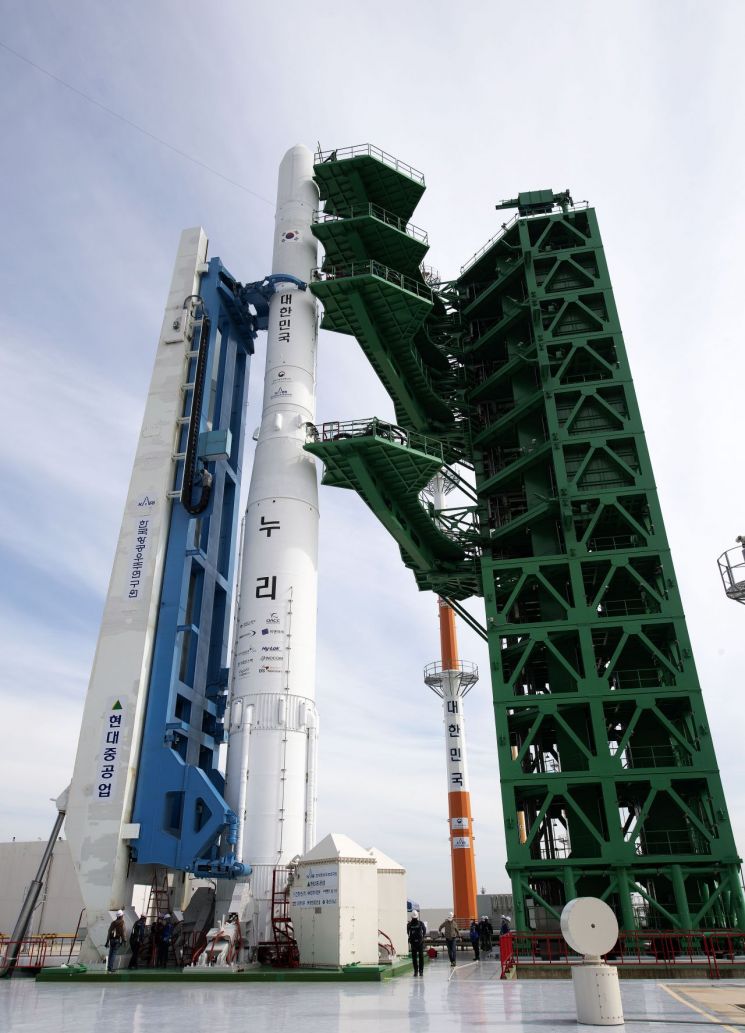
[Asia Economy Reporter Kim Bong-su] The Korean launch vehicle Nuriho was transported to the launch pad and erected on the morning of the 20th, one day before the launch, and entered the final inspection and preparation procedures.
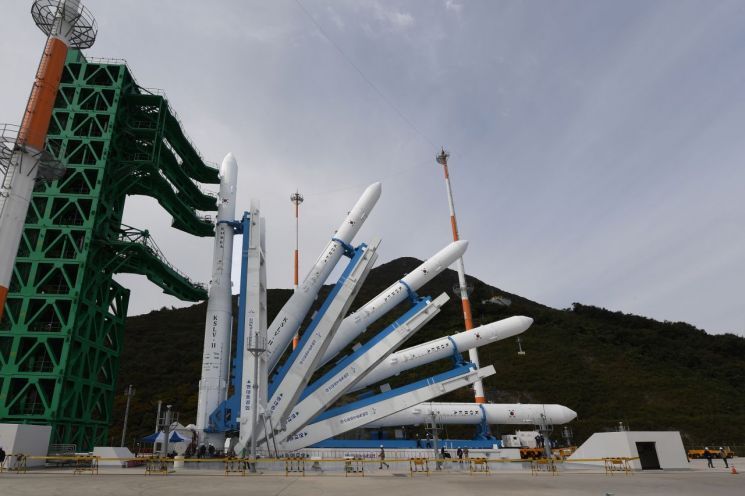
According to the Korea Aerospace Research Institute (KARI) on the day, Nuriho was loaded onto an unmanned special vehicle (transporter) at around 7:20 a.m. at the launch vehicle assembly building of the Naro Space Center in Goheung-gun, Jeollanam-do, and moved at a low speed of 1.5 km/h for about 1 hour and 25 minutes, arriving at the second launch pad at around 8:45 p.m.
Afterwards, the erection and fixation work on the launch pad was completed at around 11:30 a.m., and in the afternoon, umbilical connections for electrical and propellant (fuel + liquid oxygen) injection and subsequent airtightness inspections were carried out.
On the launch day, the 21st, fuel and propellant will be injected in the morning, and at around 2:30 p.m., the launch management committee will check the weather conditions and any risk factors within the Korean Peninsula's atmosphere to determine the final launch time. It is expected to launch around 4 p.m. However, if the weather conditions are unfavorable, such as winds exceeding 21 m/s or cloud cover, the launch may be postponed. KARI and the Ministry of Science and ICT have secured a backup launch schedule until the 28th.
Expected issues before the launch include COVID-19 outbreaks, malfunctions of launch pad equipment or the launch vehicle, leaks or fires during propellant injection, technical problems during automatic launch operation (PLO), and failure to separate the vehicle hold-down device (VHD) or umbilical connections.
During the launch, flight may be interrupted due to explosion or trajectory deviation during liftoff and flight. The separation of the fairing, first and second stages, or satellite mock-up may not proceed properly, and there could even be explosions or crashes. Even after a successful initial liftoff, unstable engine combustion during flight can cause explosions.
KARI and the government state that the probability of success on the first launch in the history of space launch vehicle development is only about 28%, and even if the launch is not successful, it should be regarded as "abnormal flight" rather than "failure." Since the core space launch vehicle technology has already been secured, it is acceptable to wait for the second launch in May next year or later. There is also the case of Naroho, which succeeded after the third launch in January 2013.
Nuriho is expected to carry a 1.5-ton dummy satellite and ascend to an altitude of 700 km in about 16 minutes. It will fly southward from the Goheung Space Center, reaching an altitude of 55 km (127 seconds after liftoff) during the first stage thrust phase, 252 km (274 seconds after liftoff) during the second stage thrust phase, and 700 km after the third stage thrust ends (967 seconds after liftoff). The success criteria include whether the engines of the first, second, and third stages operate properly, whether the payload fairing separates correctly after the first stage separation, and whether the third stage engine finally inserts the satellite into its orbit at a speed of 7.5 km/s.
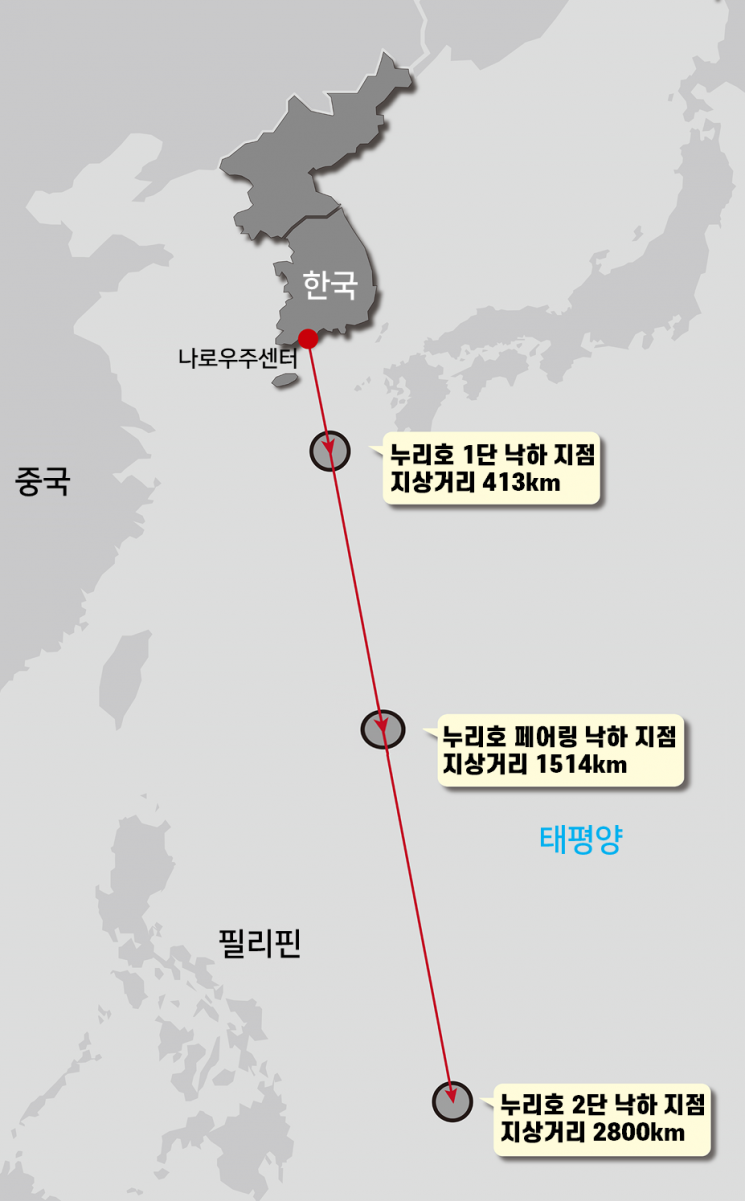
For safety, the area around the Nuriho launch will be controlled for one hour before and after the launch time. Entry of personnel and vehicles within a 3 km safety radius centered on the launch pad is prohibited. At sea, ship traffic is restricted within a 24 km width and 78 km length in the flight direction, and in the air, a controlled airspace of 44 km width and 95 km length in the flight direction is established.
© The Asia Business Daily(www.asiae.co.kr). All rights reserved.
![From Bar Hostess to Organ Seller to High Society... The Grotesque Con of a "Human Counterfeit" [Slate]](https://cwcontent.asiae.co.kr/asiaresize/183/2026021902243444107_1771435474.jpg)


















