At the National Assembly Land Committee Audit
Second Round of Daejang-dong
Excluding Clause
Seongnam City Damage?
Different Interpretations on Lee Jae-myung's Breach of Trust Charge
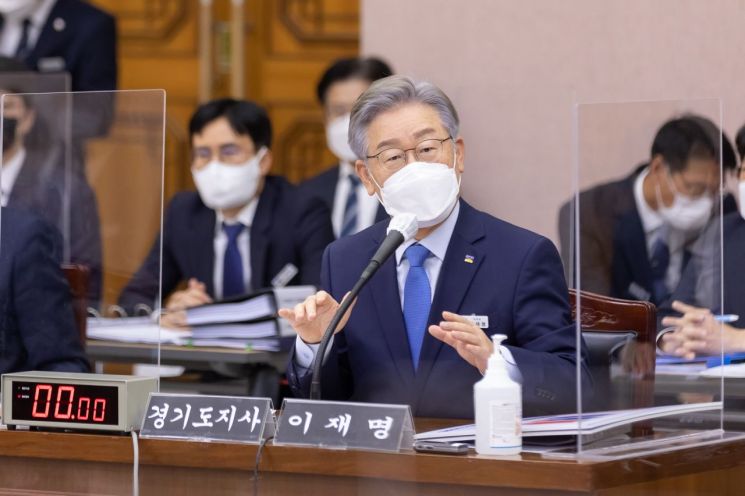
[Asia Economy Reporters Koo Chae-eun, Lee Hyun-joo, Kim Hyung-min] The controversy over the excessive profits from the Daejang-dong development going to private companies, and the decision to exclude the ‘excess profit recovery clause,’ has emerged as a key factor in determining the responsibility of Lee Jae-myung, the Democratic Party presidential candidate (current Governor of Gyeonggi Province).
At the National Assembly Land, Infrastructure and Transport Committee’s audit held on the 20th, dubbed the ‘Daejang-dong Round 2,’ this issue was intensely discussed. The opposition party claims that Lee, who decided to exclude the clause, is guilty of ‘breach of trust.’ Before attending the audit held at the Gyeonggi Provincial Government building that day, Lee entered the venue with a solemn expression, without responding to reporters’ questions. This was markedly different from his detailed explanations addressing various suspicions during the first audit on the 18th.
The controversy over the exclusion of the clause began during the audit on the 18th when Lee stated, “To be precise, the excess profit clause was not deleted; rather, the proposal from frontline staff to add it was not accepted. That is the fact.” The opposition fiercely attacked this as an ‘admission of de facto breach of trust and dismissal of excess profit demands.’ Whether Lee is guilty of breach of trust will be determined through future prosecution investigations and legal battles. However, for the People Power Party, which suffered a ‘defeat’ due to weak attacks in the first audit, this ‘gap’ and ‘vulnerability’ in Lee is seen as the biggest battleground in the current audit and the presidential election.
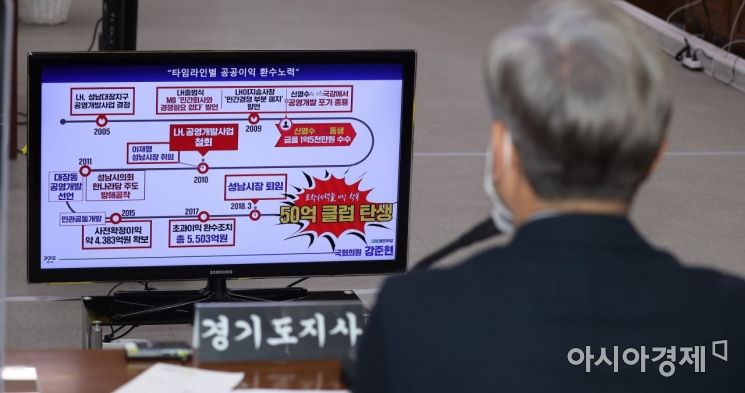 Lee Jae-myung, governor of Gyeonggi Province and the Democratic Party's presidential candidate, attended the National Assembly Land, Infrastructure and Transport Committee's audit of Gyeonggi Province held at the Gyeonggi Provincial Government Office in Suwon, Gyeonggi Province on the 20th, listening to a question from Democratic Party lawmaker Kang Jun-hyun regarding the '5 Billion Club.' Photo by the National Assembly Press Corps
An internal report from Seongnam Urban Development Corporation, written at 10:34 a.m. on May 27, 2015, included the opinion that “if the sale price proposed by the private developer exceeds expectations, a separate clause should be included to distribute profits according to shareholding ratio,” but this content was removed seven hours later. During the audit on the 18th, Lee explained that since the public offering at the time of project approval included ‘fixed profit assurance,’ adding a recovery clause was unnecessary. However, when accused of ‘admitting breach of trust,’ Lee’s camp clarified that “the subject is Seongnam Urban Development Corporation, not Lee Jae-myung.”
The prosecution currently views the exclusion of this clause as a form of preferential treatment, so if Lee’s involvement or interference is revealed, the breach of trust controversy could be ‘directly targeted’ at him. This is why former Seongnam Urban Development Corporation Planning Director Yoo Dong-gyu was charged with breach of trust under the Act on the Aggravated Punishment of Specific Economic Crimes. If the recovery clause was removed according to Lee’s wishes, he would also not be free from breach of trust allegations.
Legal circles are divided on whether breach of trust charges can be established. Lawyer Kim Jong-min stated on social media that “regardless of whether excess profits actually occur in the future, it is common sense for Seongnam City to include this as a safeguard,” and argued, “If it was not included and Seongnam City failed to receive excess profits, suffering huge losses, that itself constitutes breach of trust.” However, a senior Democratic Party lawmaker told this outlet in a phone interview, “If the excess profit recovery clause was to be included, the fixed profit clause would inevitably be removed in the negotiation process linked to it,” and added, “I do not believe breach of trust charges can be established.”
© The Asia Business Daily(www.asiae.co.kr). All rights reserved.
![Clutching a Stolen Dior Bag, Saying "I Hate Being Poor but Real"... The Grotesque Con of a "Human Knockoff" [Slate]](https://cwcontent.asiae.co.kr/asiaresize/183/2026021902243444107_1771435474.jpg)

















