[Asia Economy Reporter Lim Hye-seon] CJ CheilJedang announced on the 20th that it will promote 'Food Upcycling' and 'Plant-based Alternative Milk,' selected through its food business division's in-house venture program INNO 100, as new businesses. This is to build an 'innovative organizational culture' and accelerate future readiness by commercializing employees' fresh ideas. The first in-house venture commercialization, 'Food Upcycling,' is a product made by utilizing food by-products such as broken rice and soybean pulp. It applies the concept of 'sustainable ESG management' to reduce food waste. The packaging also recycles used PET bottles. 'Plant-based Alternative Milk' is a milk substitute made from plant-based ingredients such as brown rice and soybeans.
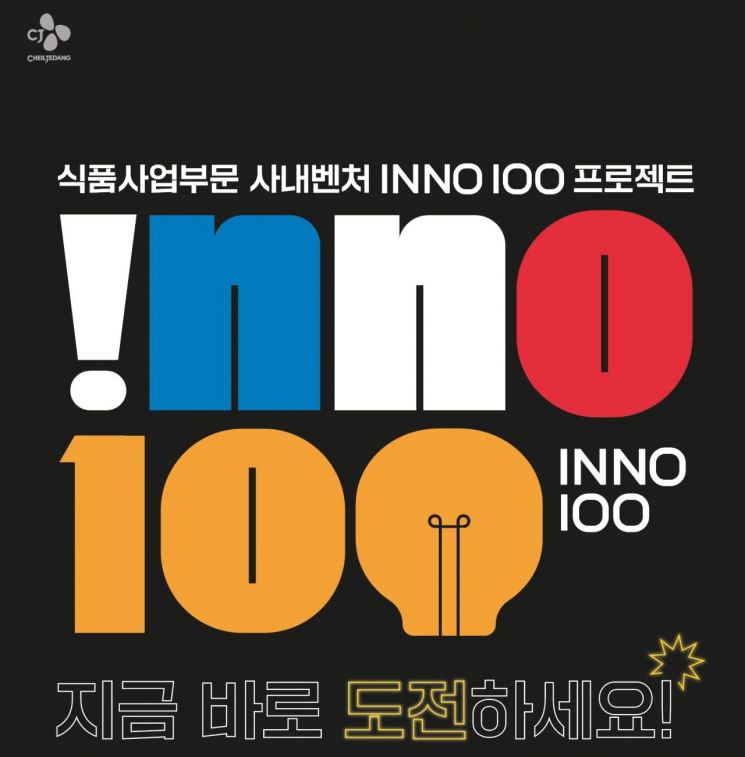
INNO 100, meaning '100 days immersed in innovation,' was introduced in February this year by CJ CheilJedang, with 68 years of tradition, to operate like a startup and secure future new growth engines. Employees who apply for the program completely step away from their existing work and focus solely on concretizing their ideas for 100 days.
With great interest and response from MZ generation employees in their 3rd and 4th years, a total of 120 teams have participated up to the 3rd term, and the 4th term is currently open for applications. The program proceeds in the order of 'idea submission, proposal presentation, 100-day project implementation, final presentation, business execution strategy establishment, and commercialization approval.' Teams that pass the final presentation receive rewards and support systems such as prize money and initial investment for commercialization.
The final commercialization decision is made by the 'Innovation Committee,' a decision-making group related to innovative growth. The Innovation Committee consists of key executives including the CEO and an employee-centered consultative body called the 'Open Council.' Major evaluation criteria include business suitability according to market trends, growth potential and attractiveness, entrepreneurial spirit and team capability for business execution, innovation, and technological ripple effects. Once commercialization is decided, the product portfolio is finalized, mass production verification begins, and further steps such as establishing an in-house independent organization (CIC) and corporate spin-off are possible.
Both the 'Food Upcycling' and 'Plant-based Alternative Milk' businesses have been confirmed to operate as in-house independent organizations. Senior employees and others are recruited both inside and outside the company to supplement areas lacking in business operation. The 'Food Upcycling' business is reviewing facility investments for by-product processing and mass production, and plans to meet consumers first through crowdfunding by the end of this year, followed by an official product launch next year.
In the Bio Business and Feed&Care Business, in-house venture systems such as the 'R (Revolution) Project' and 'NBC (New Business Challenge)' are actively operated respectively. A total of 127 teams applied for the first round of the Bio Business's 'R Project,' selecting six projects as incubation candidates, and commercialization reviews are currently underway. Through the Feed&Care Business's 'NBC' program, three projects have been selected and are under consideration for commercialization.
© The Asia Business Daily(www.asiae.co.kr). All rights reserved.

















