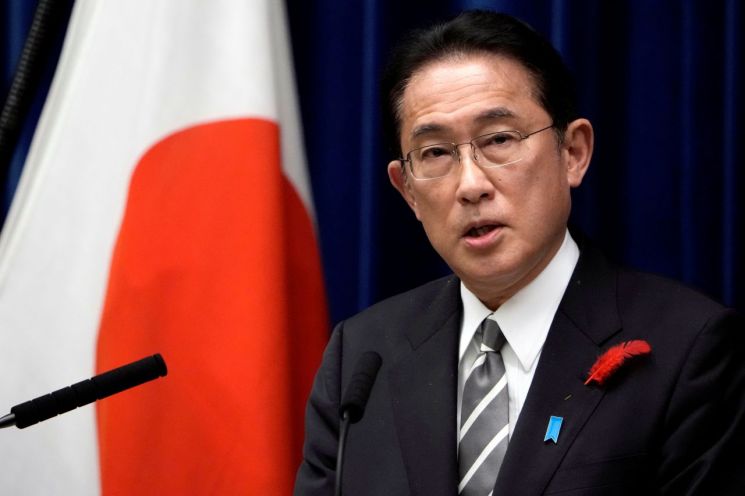
[Asia Economy Reporter Chunhee Lee] Japanese Prime Minister Fumio Kishida stated on the 19th that Japan will consider all options, including possessing the capability to strike enemy bases, in response to North Korea's launch of two ballistic missiles.
According to the Yomiuri Shimbun on the same day, Prime Minister Kishida chaired a National Security Council (NSC) meeting at the Prime Minister's residence in the afternoon and told reporters that they are currently analyzing the possibility that the missiles launched by North Korea were SLBMs (submarine-launched ballistic missiles). He added, "The remarkable advancement of North Korea's nuclear and missile-related technology cannot be overlooked in relation to our country's security," and "We have reaffirmed that we will consider all options, including possessing the capability to strike enemy bases, in preparation for such situations."
This implies that Japan may acquire the capability to conduct preemptive strikes on North Korean missile launch sites for self-defense purposes. The Liberal Democratic Party, to which Prime Minister Kishida belongs, has also stated in its manifesto ahead of the general election on the 31st that it will promote strengthening deterrence, including possessing the capability to intercept ballistic missiles within the adversary's territory, effectively expressing the intention to secure such capabilities.
However, this stance conflicts with Article 9 of the current Japanese Constitution, enacted after Japan's defeat in the Pacific War, commonly known as the "Peace Constitution," which permanently renounces the threat or use of force and prohibits maintaining land, sea, and air forces or other war potential, as well as denying the right of belligerency of the state. Therefore, if Japan formally acquires such capabilities, controversy is inevitable.
Earlier, according to Kyodo News, Prime Minister Kishida told reporters in Fukushima City, where he visited for election campaigning, "North Korea launched two ballistic missiles into the Sea of Japan today," and added, "It is very regrettable that North Korea has been continuously launching missiles since last month." After finishing his campaign in Sendai City, Miyagi Prefecture, he returned to Tokyo by Shinkansen and chaired the NSC meeting.
Yoshihiko Isozaki, Japan's Chief Cabinet Secretary, stated at a regular briefing that North Korea launched two ballistic missiles around 10:15 and 10:16 a.m., and that Japan lodged a protest with North Korea through the Beijing embassy channel. The South Korean Joint Chiefs of Staff reported that North Korea launched one unidentified short-range ballistic missile, presumed to be an SLBM, on the same day.
© The Asia Business Daily(www.asiae.co.kr). All rights reserved.
![Clutching a Stolen Dior Bag, Saying "I Hate Being Poor but Real"... The Grotesque Con of a "Human Knockoff" [Slate]](https://cwcontent.asiae.co.kr/asiaresize/183/2026021902243444107_1771435474.jpg)
















