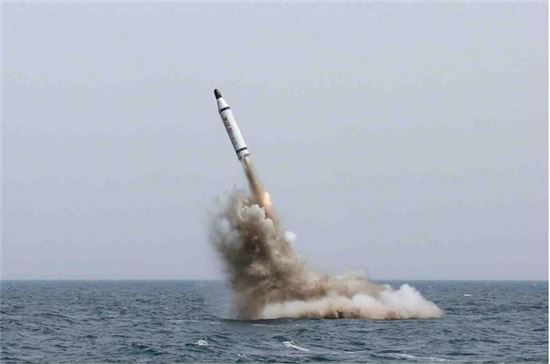
 The scene of the successful underwater launch and rocket ignition of the Pukguksong-1 SLBM from a Sinpo-class submarine under the supervision of Chairman Kim Jong-un on May 9, 2015. Photo by Korean Central News Agency / Yonhap News
[Asia Economy Yang Nak-gyu, Military Specialist Reporter] Amid North Korea's launch of a submarine-launched ballistic missile (SLBM), the Agency for Defense Development (ADD) expressed its determination to continuously enhance the South Korean military's SLBM capabilities.
On the 19th, Park Jong-seung, head of ADD, responded during the National Defense Committee's audit of ADD to the question, "Can our SLBM serve as a strategic weapon to deter threats from North Korea and neighboring countries?" by saying, "Yes," and added, "SLBMs of neighboring countries fundamentally assume nuclear warheads. Although we have not equipped ours with nuclear warheads, our accuracy is extremely high."
He stated, "If the warhead power and accuracy of our SLBM complement each other, the power will be multiplied significantly," indicating his intention to begin efforts to further improve the warhead power and accuracy of SLBMs in the future.
On the other hand, he expressed a negative view regarding North Korea's SLBM development. When asked, "What hurdles must North Korea overcome to actually launch an SLBM from a submarine?" Park explained, "The major technical difference between launching an SLBM from a barge and from a submarine is that the submarine must be operated underwater with a sense of speed."
He added, "The submarine is exposed to currents and various external environments while moving, and the physical phenomena underwater when the SLBM is ejected are very complex," and said, "If that issue is resolved, I can say that the SLBM can finally succeed."
When asked if he agreed that North Korea's 2015 SLBM test launch was not a complete success, Park replied, "I agree."
© The Asia Business Daily(www.asiae.co.kr). All rights reserved.
















