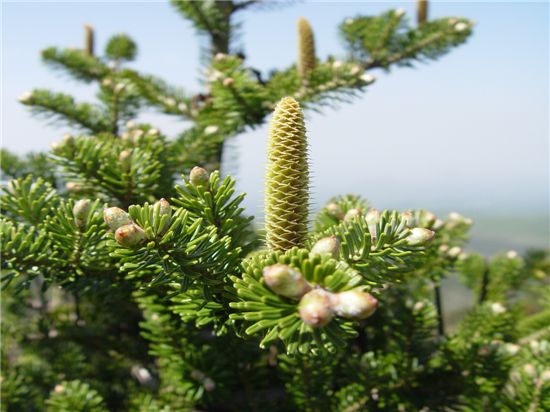
 The endangered Korean nutmeg tree has formed flower buds. Photo by Korea Forest Service
[Asia Economy (Daejeon) Reporter Jeong Il-woong] The Korea Forest Service is strengthening conservation and restoration activities for high-altitude conifer species, including the endangered Kuksangnamu (Abies koreana).
According to the Korea Forest Service on the 19th, the endangered high-altitude conifer species mainly include seven types: Kuksangnamu (Abies koreana), Bunbinamu (Abies nephrolepis), Gamunbina-mu (Picea jezoensis), Jumok (Taxus cuspidata), Nunjatnamu (Pinus pumila), Nunchukbaek (Thuja koraiensis), and Nunhyangnamu (Abies holophylla).
These species have been managed as priority conservation targets since 2016, when the '1st Conservation and Restoration Plan for Endangered High-Altitude Conifer Species' was established and implemented.
As part of the first plan, the Korea Forest Service achieved results such as introducing biennial field inspections (monitoring) through nationwide surveys and spatial information construction, and initiating the establishment of conservation bases including ex-situ conservation sites.
During this process, it was estimated that the seven major high-altitude conifer species grow across 12,094 hectares in 31 mountain areas nationwide, including Hallasan and Jirisan, accounting for 0.19% of domestic forest area, with approximately 3.7 million trees. By species, Kuksangnamu covers 6,939 hectares, Bunbinamu 3,690 hectares, and Jumok 2,145 hectares, showing large distribution areas.
Additionally, the first monitoring (2019?2020) confirmed decline rates of 33% in Kuksangnamu forests, 31% in Bunbinamu forests, and 40% in Gamunbina-mu forests, leading to the conclusion that strengthened conservation and restoration management for endangered high-altitude conifer species is necessary.
Based on this, the Korea Forest Service prepared the 2nd plan (2022?2026) and proposed conservation policy tasks for endangered high-altitude conifer species threatened in their growth.
The 2nd plan focuses on ▲improving local survey methods and strengthening spatial management systems based on remote sensing ▲developing restoration guidelines and establishing a national management system for restoration materials ▲full-scale conservation projects both in situ and ex situ ▲activating research and cooperation and organizing implementation foundations.
First, the Korea Forest Service will advance the monitoring system for high-altitude conifer species. In addition to maintaining existing monitoring methods, the core is to conduct detailed investigations of habitat environmental characteristics by growth type to verify hypotheses on decline causes and to build an information management system for accumulating and utilizing survey results.
Furthermore, by establishing a continuous forest ecosystem monitoring system based on mountain meteorological observation networks nationwide and satellite information, the Korea Forest Service plans to proactively identify areas unsuitable for high-altitude conifer growth and support in situ conservation measures.
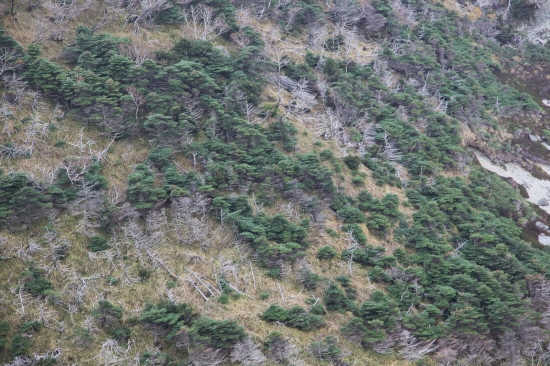 Korean fir trees are sparsely located on the mid-slope of Hallasan. Photo by Korea Forest Service
The Korea Forest Service will also establish an implementation foundation for conservation and restoration projects of high-altitude conifer species. To prioritize restoration by species and population, it will evaluate the genetic diversity of native populations and conduct site characteristic assessments to increase restoration success probability.
In particular, it plans to emphasize conservation projects both in situ and ex situ by promoting demonstration projects to induce natural regeneration of high-altitude conifer species. Natural regeneration refers to the natural formation of successor forests through seeds, roots, and sprouts from existing trees.
Conversely, for populations where natural regeneration is difficult, the Korea Forest Service’s plan is to prevent extinction in the wild by establishing ex situ conservation sites and securing restoration materials through systematic provenance management, starting with Kuksangnamu and Bunbinamu, and to promote pilot-scale restoration projects.
Im Sang-seop, Director of Forest Protection at the Korea Forest Service, said, “The 2nd plan focuses on strengthening the conservation and restoration resilience of the seven major high-altitude conifer species based on the outcomes derived from the 1st plan. Through the 2nd plan, the Korea Forest Service will strive to mitigate the decline of high-altitude conifer species and prevent the extinction of forest resources such as these species.”
© The Asia Business Daily(www.asiae.co.kr). All rights reserved.
















