Ministry of Land, Infrastructure and Transport Reports and Confirms 'Intelligent Transportation System Basic Plan 2030' at Cabinet Meeting on 19th
C-ITS Communication to be Established on Major Roads Nationwide from This Year in Preparation for Full Autonomous Driving (Lv.4) Commercialization in 2027
Expansion of Smart CCTV Monitoring System and Development of Indoor Positioning System for User Data Collection in 2023
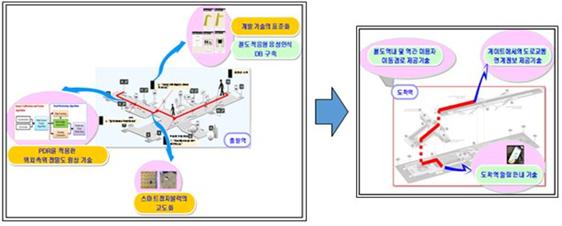 Indoor positioning system and individual railway user guidance system / Provided by the Ministry of Land, Infrastructure and Transport.
[Asia Economy Reporter Kangwook Cho] The government will begin building infrastructure for the introduction of new transportation modes such as autonomous vehicles and Urban Air Mobility (UAM) by 2027. It will also promote measures to eliminate blind spots in traffic safety by utilizing new technologies like artificial intelligence (AI) and big data.
The Ministry of Land, Infrastructure and Transport announced on the 19th that it has finalized the “Intelligent Transport System Basic Plan 2030” at a Cabinet meeting presided over by the Prime Minister.
The Intelligent Transport System (ITS) is a transportation system that applies advanced technologies to transportation means and facilities such as automobiles and roads to improve traffic flow and enhance traffic safety. The ITS Basic Plan is a legally mandated 10-year plan under the National Integrated Transport System Efficiency Act, serving as a strategy to develop and disseminate intelligent transport systems across various transportation sectors including automobiles and roads, railways, aviation, and maritime.
The newly established “Intelligent Transport System Basic Plan 2030” sets 2030 as the target year and adopts the vision of “providing eco-friendly, safe, and seamless people-centered transportation services.”
In preparation for the commercialization of Level 4 fully autonomous driving by 2027, the Ministry will begin this year to build C-ITS communication infrastructure on major roads nationwide, including highways. C-ITS is a technology that enables vehicles in motion to exchange various traffic information in real time with other vehicles or facilities, considered the foundation for the commercialization of fully autonomous driving. To support smooth operation of autonomous vehicles, a V2X security certification system will also be established to ensure reliable information exchange among vehicles, infrastructure, and control centers.
Additionally, standards will be set for UAM boarding facility structures and related equipment, characterized by vertical takeoff and landing within urban areas. To ensure safe operation and efficient navigation in cities, a three-dimensional urban map will be constructed to prepare for the full-scale utilization of UAM.
To strengthen traffic safety at major transportation facilities, an integrated safety management system covering both pre- and post-incident phases will be established.
The smart CCTV monitoring system, which detects unexpected situations such as wrong-way driving using artificial intelligence, will be expanded to key sections. Road condition management systems that detect real-time road surface conditions (such as icing) and obstacles (such as falling rocks) will be built to provide drivers with hazard information and enhance road traffic safety.
Furthermore, an electronic warning system that independently assesses traffic flow and hazardous situations at railway crossings will be introduced, along with a linkage system with adjacent road traffic signals. By 2025, smart railway crossings will be prioritized for installation at 200 high-traffic locations.
An indoor positioning system that collects user behavior data in locations such as indoors and underground will be developed by 2023.
A personalized virtual assistant service based on artificial intelligence will be implemented to provide optimal travel routes from home to airport boarding gates via mobile devices, and the introduction of autonomous and follow-driving passenger luggage transport cart robots will be expanded.
In connection with ODA projects, the government will also support overseas exports of railway operation and safety management technologies, as well as the overseas market entry of domestic companies related to marine digital technologies such as intelligent maritime traffic information services.
An Seok-hwan, Director General of Comprehensive Transport Policy at the Ministry of Land, Infrastructure and Transport, said, “The transportation system will be upgraded so that citizens can travel more safely and conveniently from departure to destination. We will steadily implement the detailed tasks in the basic plan by sector to realize the advanced transportation system that citizens have imagined.”
© The Asia Business Daily(www.asiae.co.kr). All rights reserved.

















