Diverging Opinions Among Housing Experts on Seoul's Sharp Cooling in Home Buying Demand
Using Examples Like Daegu's Unsold Housing Crisis
"Will Spread to Key Unsold Areas and Trigger House Price Declines"
Some Predict Price Increases Due to Supply Shortages
"With Decreasing New Housing Supply, Quick Resolution of Seoul's Real Estate Issues Is Unlikely"
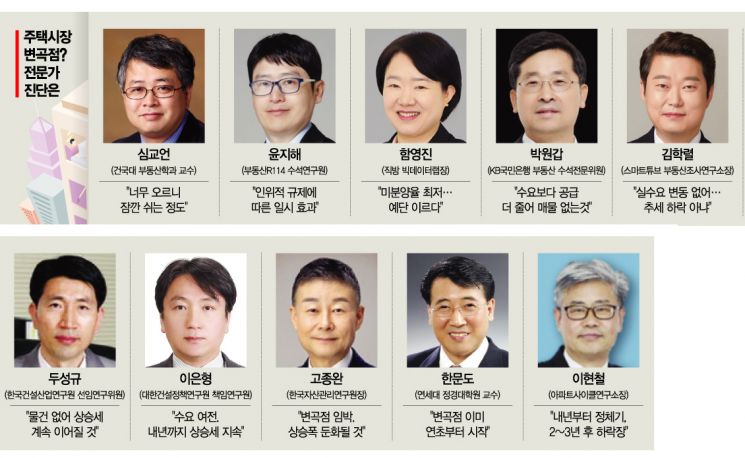
[Asia Economy Reporters Kangwook Cho, Hyemin Kim, Taemin Ryu] Is it a turning point or just a breather? As housing purchase demand sharply contracts, especially in the outskirts of Seoul, experts are divided over whether house prices have peaked. On one side, some argue that the market has already reached a turning point, while others contend that the current cautious stance is merely a temporary pause caused by government-imposed artificial regulations, and that the upward trend will continue. However, there is consensus that the market flow after next year’s presidential election will be a crucial variable.
◇ "One in three transactions in Seoul sees a price drop" = At ‘Bangbae Acro River’ in Bangbae-dong, Seocho-gu, a 149㎡ (exclusive area) unit was traded for 2.16 billion KRW on the 10th of last month. This price is 240 million KRW lower than the previous transaction price of 2.4 billion KRW. In Gangdong-gu, a 59㎡ unit at ‘Godeok Xi’ dropped by 250 million KRW from 1.35 billion KRW to 1.1 billion KRW. The number of complexes where prices were settled lower than the previous transaction is increasing.
According to data on ‘Seoul Apartment Real Transaction Price Trends’ submitted by the Ministry of Land, Infrastructure and Transport to Kim Hoe-jae, a member of the National Assembly Land, Infrastructure and Transport Committee from the Democratic Party, 35.1% of transactions in Seoul last month were at prices lower than the previous transaction. This means that one in three apartments in Seoul last month was sold at a price lower than the previous transaction. This is a 14.3 percentage point increase from the previous month’s 20.8%, marking the highest monthly figure this year. The slowdown in price increases is interpreted as a result of weakened buyer sentiment due to loan regulations and interest rate hikes, as well as a significant drop in transactions, sometimes referred to as a transaction cliff.
◇ "Turning point has already begun... Daegu’s unsold housing crisis is a representative case" = As the transaction market freezes rapidly, some voices suggest that the market may have shifted into a downturn.
Professor Han Mundo of Yonsei University’s Graduate School of Political Economy and Finance and Real Estate said, "The turning point in the real estate market began early this year," adding, "This is because transaction volumes are not supported at all." He pointed out that a monthly transaction volume of 7,000 to 8,000 is considered normal for Seoul apartments, and during last year’s boom, it rose to 15,000, but since January this year, it has remained continuously in the 3,000 to 4,000 range. Professor Han criticized, "It is unprecedented that 30 to 40% of transactions have lower prices despite new record highs, which suggests that there are many artificial forces propping up the market."
Lee Hyun-chul, director of the Apartment Cycle Research Institute, said, "Currently, the market is transitioning from the end of the rising phase to a stagnation phase," adding, "It is typical during stagnation that some complexes record new high transactions while others experience price drops, resulting in a mixed trend." He cited Daegu’s unsold housing crisis as a representative example. According to the Korea Real Estate Board, as of the end of August, unsold housing units in Daegu reached 2,365, more than double the previous month. This contrasts sharply with the nationwide unsold housing units, which hit a record low. There are even concerns that the worst-ever Daegu-originated unsold housing ‘nightmare’ from the 2008 global financial crisis might be replayed. He warned, "As unsold units spread to core areas, it will trigger house price declines," adding, "The Seoul metropolitan area cannot be complacent either."
◇ "Temporary phenomenon due to artificial regulations... upward trend to continue until next year" = On the other hand, some argue that the housing market contraction is due to fatigue over rising prices and recent loan regulations. They diagnose that this is only a temporary phenomenon and that the upward momentum remains, so it will not lead to a major downturn.
Yoon Ji-hae, chief researcher at Real Estate R114, said, "Several measures have been introduced under the current government, and each time, the upward momentum temporarily slowed down," adding, "The current slowdown in market price increases should be understood as an artificial effect." She explained that since there are still uncertainties in the rental market, the slowdown is only temporary.
Lee Eun-hyung, senior researcher at the Korea Institute of Construction Policy, said, "There has been considerable home buying by people in their 20s and 30s over the past few years, and demand remains strong," predicting, "This year is not the peak, and prices will continue to rise for some time, including next year."
There is also a diagnosis that house prices will continue to rise as long as supply shortages are not resolved. Doo Sung-kyu, senior research fellow at the Korea Research Institute for Construction Industry, said, "Starting this year, the number of new housing units entering the market is significantly decreasing compared to the previous year, and this decline will be even more pronounced in 2022 and 2023," adding, "The Seoul real estate market will not be resolved quickly."
◇ "Next year’s presidential election is a key variable" ? unanimous agreement = Experts unanimously agree that next year’s presidential election will be a key variable.
Ko Jong-wan, director of the Korea Asset Management Research Institute, said, "If the next government introduces large-scale supply measures and loan restrictions, the market could cool down instantly," adding, "The most important turning point will be March next year."
Additionally, Kim Hak-ryul, director of Smart Tube Real Estate Research Institute, pointed out, "It is difficult to talk about trends because it varies by apartment and region," but added, "We need to watch for any policy changes after the presidential election in the first half of next year."
© The Asia Business Daily(www.asiae.co.kr). All rights reserved.

















