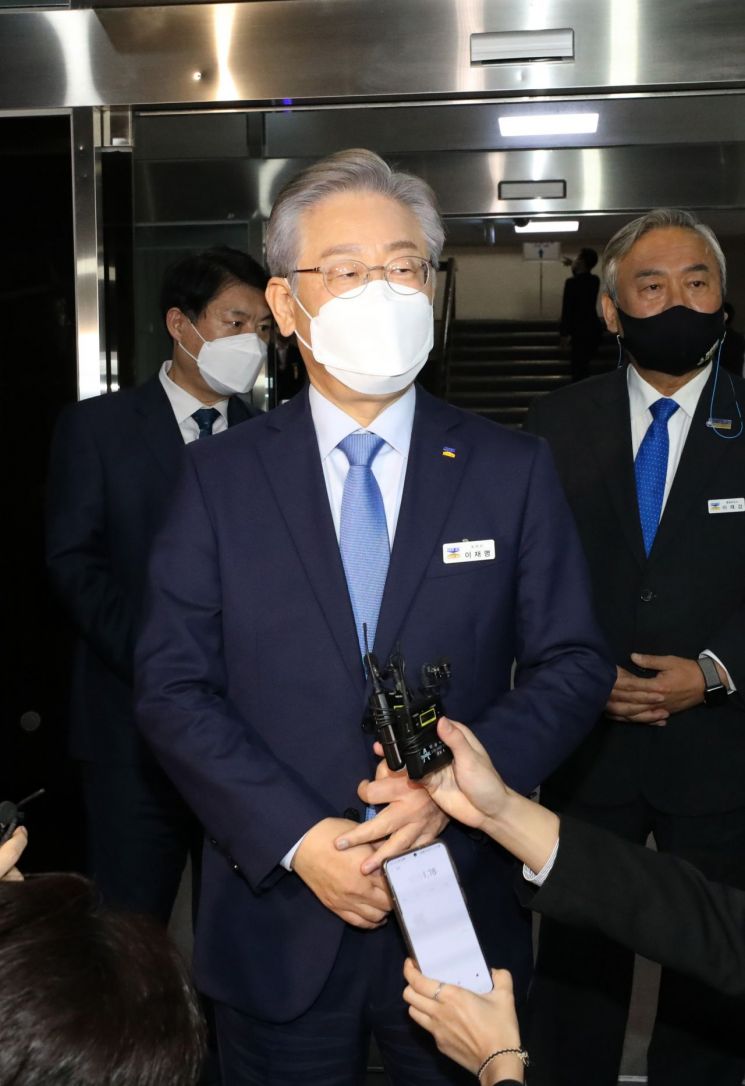
 Lee Jae-myung, the presidential candidate of the Democratic Party of Korea and governor of Gyeonggi Province, is answering questions from reporters after the National Assembly's Public Administration and Security Committee's audit of Gyeonggi Province held at the Gyeonggi Provincial Government Office in Suwon, Gyeonggi Province on the afternoon of the 18th.
 Amid ongoing investigations into preferential treatment allegations related to the Daejang-dong development project in Seongnam, Gyeonggi Province, suspicions surrounding other urban development projects within Seongnam are snowballing. All these projects share a commonality in that they were promoted during Lee Jae-myung's tenure as mayor of Seongnam and involve controversies over preferential treatment concerning permits and approvals.
According to political circles on the 19th, during the National Assembly inspection held at the KAIST auditorium in Daejeon the previous day by the Science, Technology, Information and Broadcasting and Communications Committee, suspicions were raised that the Baekhyeon-dong development project in Seongnam could be a "second Daejang-dong." Before relocating its headquarters to Jeonbuk, the Korea Food Research Institute sold a 112,861㎡ site to a private business entity A through a private contract worth 218.7 billion KRW in February 2015. Originally, this area was designated as "natural green space," where apartment construction was prohibited, but Seongnam City upgraded the land use to quasi-residential in four stages and later permitted the conversion of rental apartments into sale apartments. The project finance company (PFV) established for this project reportedly earned at least 300 billion KRW in profits from sales revenue. These issues were also raised in the Seongnam City Council, and the Board of Audit and Inspection's findings led to severe disciplinary actions, including the dismissal of some employees.
The site of the Korea Gas Corporation in Jeongja-dong, Bundang-gu, Seongnam (total area 16,725㎡) is also under suspicion for private developers' unfair gains through increased floor area ratio. When the Gas Corporation relocated to Daegu in September 2014, the sale process began but was auctioned off six times despite the excellent location, due to regulations limiting the floor area ratio to 400% or less and building coverage ratio to 80% or less. At the time, candidate Lee stated, "Building apartments on the Gas Corporation site would only worsen overcrowding and bring no benefits." However, the atmosphere changed when private business entity B won the bid in July 2015. By the end of that year, Seongnam City approved most of the site for residential use and significantly raised the floor area ratio to 560%. Although the construction of dormitories for Seongnam Medical Center was attached as a donation condition, the developer's sales revenue exceeded 500 billion KRW.
A Seongnam City Council official said, "These projects are similar to Daejang-dong in that the local government provided profits to private developers through permit authority," adding, "Especially, changing the land use to allow housing construction on prime land where apartments were originally prohibited is a clear case of preferential treatment." He also stated, "We will thoroughly investigate these matters through administrative audits at the upcoming regular session of the Seongnam City Council next month."
© The Asia Business Daily(www.asiae.co.kr). All rights reserved.

















