Professor Jaeheung Cho's Research Team, Department of Chemistry, UNIST
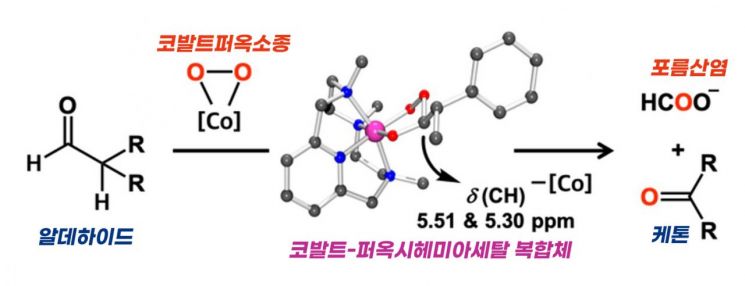 Aldehyde deformylation reaction proceeding through the formation stage of the peroxyhemiacetal complex diagram
[Asia Economy Reporter Kim Bong-su] Intermediate substances that induce the conversion of sex hormones within the human body have been identified for the first time by domestic researchers. This is regarded as a breakthrough in treating diseases related to sex hormones.
Ulsan National Institute of Science and Technology (UNIST) announced on the 19th that Professor Jaeheung Cho's chemistry team succeeded in isolating the active intermediate of the aldehyde decarbonylation reaction called the ‘cobalt-peroxyhemiacetal complex.’ The decarbonylation reaction is a chemical process in which the formyl group of aldehyde compounds is separated. This reaction occurs in major biological metabolisms such as the conversion of male hormones into female hormones, as well as in chemical processes that convert aldehydes into gasoline or natural gas during crude oil refining.
Until now, the existence of this active intermediate had only been theoretically confirmed, but it has now been experimentally identified for the first time. This substance is an intermediate in the chemical reaction (decarbonylation reaction) that converts sex hormones, and it forms and disappears rapidly, making it difficult to capture. The experiment also revealed a new chemical reaction pathway for the decarbonylation reaction. This is expected to aid in the development of drugs that regulate sex hormones by accelerating or slowing down the decarbonylation reaction.
The research team synthesized a separable ‘cobalt-peroxyhemiacetal complex’ using a biomimetic enzyme substance called ‘cobalt-peroxo species.’ By reacting cobalt-peroxo species with aldehydes at low temperatures, they isolated the cobalt-peroxyhemiacetal complex and analyzed its various spectroscopic properties for the first time.
In particular, analysis revealed that the peroxyhemiacetal complex is formed in a manner different from previously proposed theories. The analysis of the isolated complex showed that the carbonyl group of the aldehyde is inserted between the oxygen-oxygen bond formed by the cobalt-peroxo species. Previously, it was believed that the cobalt-peroxo species attacked the carbonyl functional group to form the complex.
Professor Cho stated, “Not only did we isolate the intermediate of the decarbonylation reaction, a major physiological metabolic reaction, and identify its characteristics, but we also confirmed a reaction pathway different from the previously proposed theoretical pathway, which is academically significant. In the future, this could contribute to research regulating hormone conversion and the development of biomimetic catalysts that convert aldehydes into gas or gasoline during crude oil refining.”
The research team also collaborated with Professor Roitova’s team at Radboud University in the Netherlands to conduct comparative analyses of intermediate formation reaction pathways using cryogenic analysis and computational chemistry techniques against previously proposed pathways.
The results of this study were published online on the 6th in the international chemistry journal ‘JACS Au’ of the American Chemical Society.
© The Asia Business Daily(www.asiae.co.kr). All rights reserved.

















