- Joint research team of Professor Lim Jae-hoon from Sungkyunkwan University and Professor Lee Do-chang from Korea Advanced Institute of Science and Technology (KAIST)
- Unveiling the principle of barrier-free charge injection phenomenon in QLEDs
- Enables low-power operation and extended lifespan
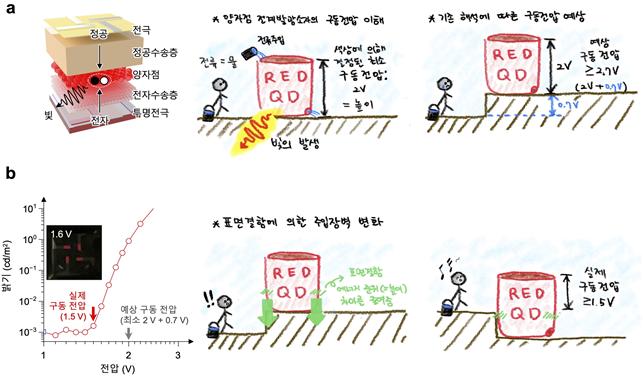 (Figure 1) Driving Characteristics and Energy Levels of Quantum Dot Electroluminescent Devices
 a. Structure of the quantum dot electroluminescent device (left) and understanding of the driving voltage (right). In the case of an ideal barrier-free device, the minimum driving voltage is determined by the emission wavelength of the quantum dot, which is known to be about 2 V for red emission.
The driving voltage represents the electrical potential energy required to inject current into the quantum dot, indicating how high the water (=current) must be raised (=voltage). In actual devices, the driving voltage increases due to limitations of charge transport materials. According to existing theory, the device structure used in this study increases the driving voltage to about 2.7 V.
b. Brightness-voltage characteristics of the quantum dot electroluminescent device (left) and explanation (right). Experimental values of actual devices show similar or even lower driving voltages (1.5 V in this study) compared to ideal barrier-free devices. This is because the relative electrical potential between the quantum dot and surrounding layers changes due to surface states of the quantum dot.
Figure description and provided by: Hyunjun Lee, Ph.D. candidate, Korea Advanced Institute of Science and Technology (KAIST)
[Asia Economy Reporter Kim Bong-su] The commercialization of quantum dot light-emitting diodes (QLED), which are gaining attention as next-generation displays, is imminent, but improving efficiency and lifespan remains a challenge. However, a domestic research team has found a clue to solving this issue.
The National Research Foundation of Korea announced on the 19th that a joint research team led by Professor Lim Jae-hoon of Sungkyunkwan University and Professor Lee Do-chang of the Korea Advanced Institute of Science and Technology (KAIST) has elucidated the principle of barrier-free charge injection in QLEDs.
QLED is a display using quantum dots, a next-generation luminescent material that realistically reproduces the purity of natural colors perceived by our visual cells. While improving the efficiency and lifespan of quantum dots remains a commercialization task, the research team discovered that defects on the surface of quantum dots actually serve as a clue to enhancing luminescent performance.
QLEDs emit light by directly injecting electrons (negative charges) and holes (positive charges) into quantum dots. They are attracting attention as next-generation flat-panel display technology due to their excellent color purity, power consumption, and brightness characteristics. It was known that the electrically conductive layer surrounding the quantum dots acts as a barrier that hinders the flow (injection) of electrons and holes in QLEDs, where electrons and holes injected through each electrode meet in the quantum dots to emit light. Therefore, it was established that red QLEDs require a driving voltage exceeding 2V, which corresponds to the energy of visible red light.
However, the research team found that some quantum dots emit light at a voltage as low as 1.5V, below the 2V threshold, despite the presence of charge injection barriers. Lower driving voltage reduces the energy required for device operation, which is advantageous for commercialization. A charge injection barrier is an obstacle that impedes current flow and is the main cause of the high minimum driving voltage in QLEDs, arising from differences in energy levels between materials. The research team discovered that defects on the quantum dot surface induce a realignment of energy levels between different materials arranged around the quantum dot, acting as a stepping stone that partially offsets the charge injection barrier. Electrons in the electrically conductive layer surrounding the quantum dots move to the defects on the quantum dot surface, forming an internal electric field that narrows the energy level differences between layers within the device, facilitating charge movement.
The research team explained, "This study, which presents the principle for realizing low-power, high-efficiency quantum dot electroluminescent devices, is expected to accelerate the realization of high-resolution, long-lifespan displays."
The research results were published on the 27th of last month in the international academic journal Nature Communications.
© The Asia Business Daily(www.asiae.co.kr). All rights reserved.

















