President Moon Jae-in asks Prime Minister Kim Boo-kyum
"Please look into the reasonable network usage fee issue"
Netflix conflicts with SKB over cost burden despite increased traffic capacity
Industry urges ban law... Consensus also in the National Assembly
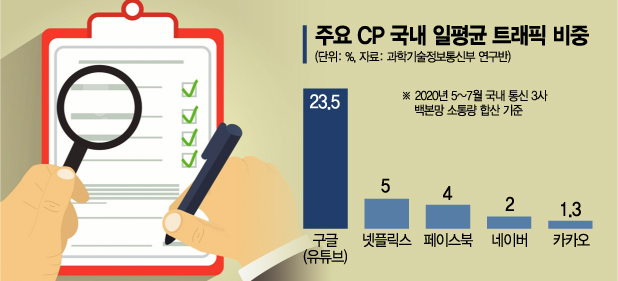
[Asia Economy Reporter Cha Min-young] Global online video service (OTT) Netflix, which has avoided the issue of network usage fees for years, received an order from President Moon Jae-in to "look into the issue of reasonable network usage fee imposition." The legislative discussions to resolve the controversy over free-riding on networks by global platforms, which account for more than 30% of domestic internet traffic transmission volume, are drawing industry attention as they gain momentum.
"Responsibility Appropriate to Global Platforms Needed"
On the 18th, during a weekly meeting with Prime Minister Kim Boo-kyum, President Moon said, "Global platforms need to fulfill responsibilities commensurate with their scale," and added, "Please also look into fair contracts (such as standard contracts) between platforms and producers along with the issue of reasonable network usage fee imposition." He pointed out as a key issue that global platform companies, which generate enormous profits worldwide using K-content such as 'Squid Game,' do not fulfill their obligation to pay network usage fees in Korea.

Netflix is in conflict with domestic internet service provider (ISP) SK Broadband over the issue of free-riding on networks. As of September, Netflix's traffic volume increased 24 times compared to 2018, but SK Broadband has been solely bearing the costs to maintain network quality. Netflix bypassed mediation by the Ministry of Science and ICT, the competent authority, and directly filed a declaratory judgment lawsuit claiming 'no payment obligation' in court but lost in the first trial. Netflix immediately appealed, and the two companies are continuing the lawsuit into the second trial.
Netflix's approach contrasts with other global OTT competitors. The Walt Disney Company, which operates Disney+ scheduled to launch domestic service next month, signed an agreement with a content delivery network (CDN) operator that mediates data traffic transmission between ISPs and content providers (CPs). Since the CDN pays network usage fees to domestic ISPs, Disney indirectly makes the payment. Jay Trinidad, Head of DTC (Direct-to-Consumer) Business for the Asia-Pacific region at The Walt Disney Company, explained, "Disney will actively cooperate with various CDN operators as a good corporate citizen."
"Strong Prohibition of Network Free-Riding Needed"
Industry experts point out the need for legislative efforts to strongly prohibit free-riding on networks by global platforms. This is because global operators changed their stance after the 'In-App Payment Forced Prohibition Act (Amendment to the Telecommunications Business Act),' which bans the forced in-app payment practice by app market operators such as Apple and Google, came into effect on September 14. Google and Apple have submitted implementation plans to the Korea Communications Commission, stating they will comply with domestic laws.
There is also a consensus in the National Assembly that legal gaps need to be supplemented. Article 22-7 of the current Telecommunications Business Act stipulates that value-added telecommunications service providers exceeding certain user numbers and traffic standards must secure service stability measures and fulfill user request handling obligations. However, some abstract legal provisions have caused ambiguous interpretations or unclear scope of necessary measures, limiting the competent authority's ability to impose quality maintenance obligations on global CPs' telecommunications services. As a few large CPs such as Google and Netflix account for over 30% of total domestic internet traffic, there have been criticisms of reverse discrimination against Naver and Kakao, which pay legitimate fees.
Related bills are also pending in the National Assembly. On July, Kim Young-sik of the People Power Party introduced a bill to amend the Telecommunications Business Act, focusing on introducing an 'obligation to pay reasonable network usage fees.' The bill prohibits value-added telecommunications service providers above a certain scale from demanding or receiving network connections without paying fair compensation, considering network configuration and traffic volume, when using internet networks to provide their services.
Senior Specialist An Jeong-sang of the Democratic Party said, "Global CPs have shown a pattern of refusing to pay network usage fees only in Korea, which is discriminatory treatment by country," adding, "In the future, clearer legal grounds should be prepared to resolve the issue of reverse discrimination between domestic and foreign companies regarding network usage fee payments."
© The Asia Business Daily(www.asiae.co.kr). All rights reserved.
![Clutching a Stolen Dior Bag, Saying "I Hate Being Poor but Real"... The Grotesque Con of a "Human Knockoff" [Slate]](https://cwcontent.asiae.co.kr/asiaresize/183/2026021902243444107_1771435474.jpg)

















