'Financial Debt Holdings of Wage Workers (Average per Household)'
Credit Loans for Regular Worker Households Increased by 16.1% in 2 Years
Concerns Over Loan Refugees Among Vulnerable Groups
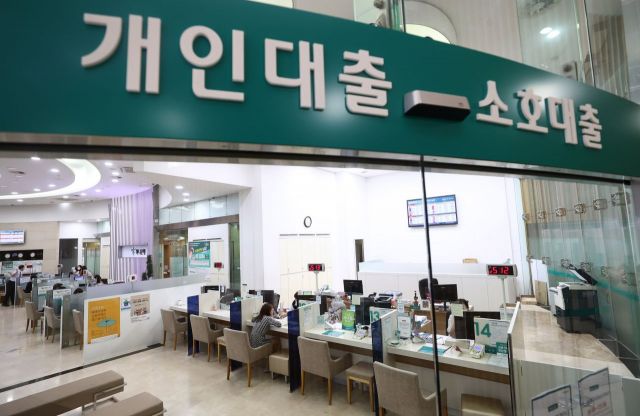
[Asia Economy Reporter Jang Sehee] Amid the reduction of loan limits due to the financial authorities' total household debt management, it has been revealed that credit loans for temporary daily workers have significantly decreased. Concerns are rising that if loan regulations are further tightened in the future, vulnerable groups such as temporary daily workers and youth will face increased difficulties in securing funds.
According to the "Status of Financial Debt Holdings of Wage Workers (Average per Household)" submitted by the Bank of Korea to the office of National Assembly member Park Hong-geun of the Planning and Finance Committee on the 19th, the average credit loan per household for temporary daily workers decreased by 5.5% over two years. In contrast, the average credit loan per household for regular workers increased by 16.1% during the same period. The phenomenon of the rich getting richer and the poor getting poorer was also evident in bank credit loans.
In terms of amounts, regular worker households saw a slight increase from 10.1 million KRW in 2018 to 10.21 million KRW in 2019, then rising to 11.73 million KRW in 2020. Temporary daily worker households recorded 3.3 million KRW in 2018 and 3.49 million KRW in 2019, but decreased to 3.12 million KRW in 2020. This shows that the bank threshold was even higher for temporary daily workers.
Banks Prioritize Risk Reduction Over Profit Increase... Vulnerable Groups May Become Loan Refugees
By lending only to a limited group among those seeking loans, banks appear to have already chosen risk reduction over profit increase. According to the 2020 Household Financial Welfare Survey, households with a regular worker as the head had the highest proportion (25.3%) with loans exceeding 100 million KRW, while households with temporary or daily workers had the highest proportion (42.4%) in the 10 to 30 million KRW range. It seems that loans to those with relatively lower repayment ability were reduced.
There are concerns that if additional regulations by authorities are implemented, vulnerable groups may become loan refugees. Furthermore, if interest rates rise, the burden of debt repayment will increase even more.
Democratic Party member Park Hong-geun stated, "The risk of financial imbalance caused by the flow of funds into the asset market and the increase in household debt under a low-interest rate environment is more pronounced in households with unstable income," adding, "Selective credit loan regulations should be implemented to ensure sufficient funds for livelihood stability and job transitions for temporary daily workers who frequently change jobs."
Professor Lee In-ho of Seoul National University's Department of Economics emphasized, "If authorities tighten credit loans, vulnerable groups already facing economic difficulties may be pushed into secondary or tertiary financial sectors."
Meanwhile, according to related ministries including the Financial Services Commission, Financial Supervisory Service, and Ministry of Economy and Finance, the upcoming household debt management plan to be announced next week is expected to include regulations on mortgage loans and credit loans. A senior government official said, "The direction will be to reduce the supply of credit loans and mortgage loans that exceed income," adding, "Regarding jeonse loans, flexible responses will be made as damage could be significant mainly for actual demanders."
© The Asia Business Daily(www.asiae.co.kr). All rights reserved.

















