Haenam Bangsan-ri Janggo-bong Burial Mounds Academic Conference Held
Valuable Data Secured to Identify Construction Forces... National Historic Site Designation Underway
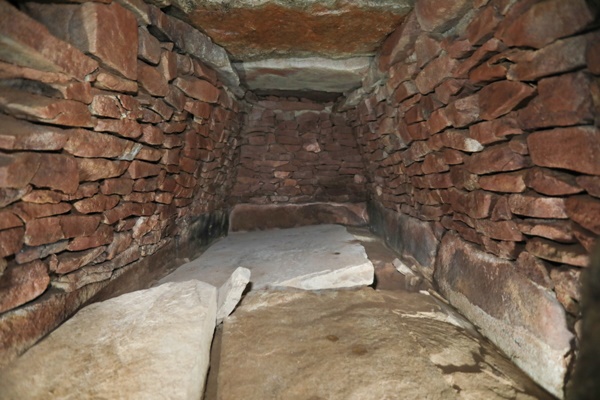
[Haenam=Asia Economy Honam Reporting Headquarters Reporter Kim Hyun] Haenam-gun, Jeollanam-do announced on the 18th that it has completed the excavation survey of the Bangsan-ri Janggo-bong tomb mound, the largest jar-type tomb mound in Korea, and held an academic conference on the 14th.
This academic conference was organized to report the results of the excavation survey conducted over the past year since last year and to examine the nature and significance of the tomb mound through expert discussions.
The Bangsan-ri Janggo-bong tomb mound in Haenam is the largest jar-type tomb mound in Korea. Its existence was revealed in 1984, and it was designated as Jeollanam-do Monument No. 85 in February 1986.
In 2000, a looting pit was exposed, and a simple trial excavation was conducted by the National Gwangju Museum, confirming that artifacts had already been looted.
It has attracted attention as an important site for the study of ancient Korean and Japanese history, especially because its tomb style is similar to that of ancient Japan. It is also gaining interest as a source material for re-examining the Haenam area’s relics related to the restoration of the Mahan cultural zone in the Yeongsan River basin.
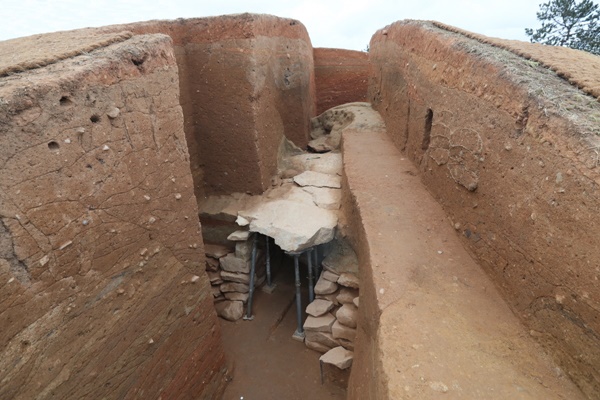
The excavation survey conducted by the Mahan Culture Research Institute revealed that the Janggo-bong tomb mound is not only the largest in Korea at 82 meters but also the first to confirm a completely sealed burial chamber, securing significant data clarifying the nature of jar-type tomb mounds remaining in Korea.
Previously, it was known to be 76 meters long, but the exact size was identified as 82 meters including the entrance passage confirmed through the survey.
At the entrance of the burial chamber, ritual vessels and pottery used after sealing the chamber were excavated, and fish bones, presumed to be from a croaker, were also found. Based on the construction techniques and excavated artifacts, it is estimated to have been built from the late 5th century to the early 6th century.
In this regard, Professor Choi Young-ju of Chonnam National University viewed the Bangsan-ri Janggo-bong tomb mound as a ‘creative-type’ stone chamber newly formed by combining indigenous characteristics under the influence of the Kyushu-style stone chambers of Japan through the academic conference.
He argued that the background of the creation of the ‘creative-type’ stone chamber in Bangsan-ri, Haenam, should be understood as a phenomenon that emerged after the early 5th century amid changes in international relations, where a new relationship was established between Baekje and Wa (ancient Japan), and a new coastal route was opened during this process.
Odongseon, a curator at the National Ganghwa Cultural Heritage Research Institute, explained that since the Bangsan-ri Janggo-bong tomb mound lacks an indigenous base and many Wa-style stone coffins are adjacent around it, “the deceased was likely a group managing a nodal point or port of call connecting maritime and inland, or maritime and maritime routes related to Baekje’s foreign relations.”
Professor Seo Hyun-joo of the Korea National University of Cultural Heritage estimated the period as the late 5th to early 6th century based on the lid plate (cover dish) excavated from the Janggo-bong tomb mound.
She viewed the nature of the Bangsan-ri Janggo-bong tomb mound as a product of the regional power in Haenam, which had active exchanges with Wa, Silla, and Gaya in the 5th century, establishing closer relations with Baekje and expressing their identity through tombs and pottery.
The Bangsan-ri Janggo-bong tomb mound, with its massive exterior and perfectly preserved burial chamber structure, is expected to be utilized not only as excellent academic material but also as a tourism resource.
Researcher Lee Su-jin of the Naju Bokam-ri Tomb Exhibition Hall emphasized the need for “continuous research for the preservation and utilization of the tomb mound, and integrated management as a collective heritage by linking it with other large tomb mounds such as Sinwol-ri Bangdae-type tomb mound, Yongil-ri Yongun tomb mound, Geochilma tomb mound, Bangsan-ri Doksuribong tomb mound, and Oedo Batseom tomb mound in Bukil-myeon.”
Haenam-gun plans to systematically conduct academic surveys not only on the Bangsan-ri Janggo-bong tomb mound but also on the tomb clusters in the Bukil-myeon area, apply for designation as a national historic site, and develop plans to foster it as a tourism resource, while actively focusing on restoring the Mahan cultural zone and recovering historical and cultural legitimacy.
Haenam=Asia Economy Honam Reporting Headquarters Reporter Kim Hyun kh0424@asiae.co.kr
© The Asia Business Daily(www.asiae.co.kr). All rights reserved.


















