2021 National Brand Competitiveness Index...41 Industries Rise
Overall Brand Average Score 75.6 Points...Up 0.6 Points from Previous Year
Despite the prolonged COVID-19 pandemic this year, the competitiveness of domestic manufacturing and service industry brands has been found to have increased compared to last year. In manufacturing, the brand competitiveness of compact cars, electric rice cookers, and TVs was the highest, while in the service sector, bakeries retained the top position for the second consecutive year.
According to the Korea Productivity Center (Chairman An Wanki) on the 19th, the National Brand Competitiveness Index (NBCI) was surveyed for 236 brands across 67 domestic industries this year. The average score of all surveyed brands was 75.6 points, an increase of 0.6 points (0.8%) from last year's 75.0 points. The NBCI is a representative domestic brand competitiveness measurement index announced since 2004, aimed at spreading a management mindset focused on brand value and enhancing national brand value. Now in its 18th year, the NBCI survey and publication accurately assess the current brand value level as perceived by consumers and provide meaningful information about the brand to companies and consumers, helping to predict near-future market conditions. The Korea Productivity Center leads the survey, with support from the Ministry of Trade, Industry and Energy.
Looking at the NBCI scores by industry this year, among 65 industries comparable to last year, 41 industries saw an increase in NBCI. Fourteen industries recorded the same scores as last year, and 10 industries saw a decline, the same number as last year. The NBCI increase in more than 60% of industries (41 industries) is interpreted by the Productivity Center as a result of domestic companies' efforts to enhance brand competitiveness bearing fruit.
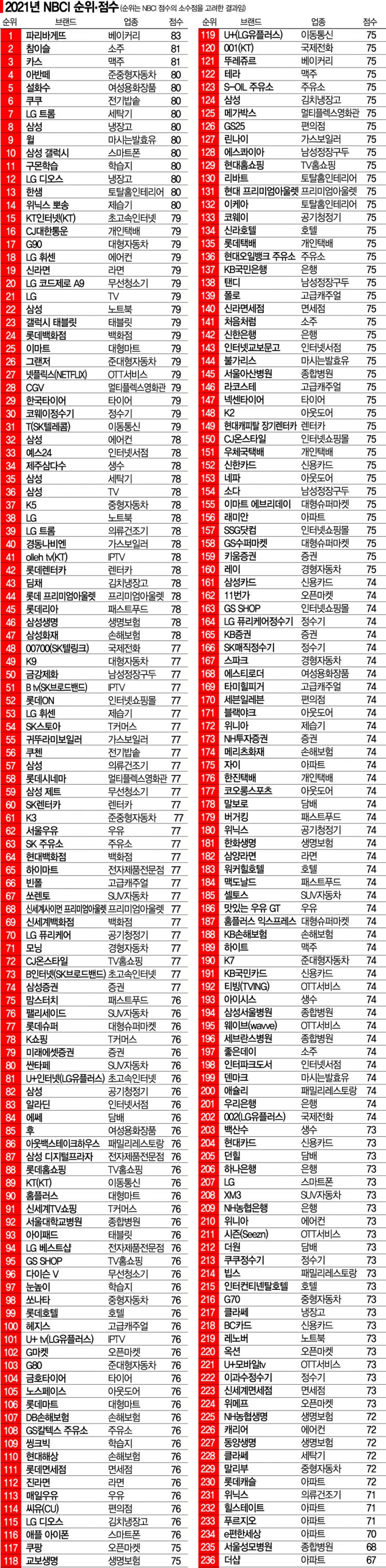
Specifically, the average NBCI score for 35 manufacturing industries and 117 brands was 75.8 points, up 0.8 points from the previous year. Compact cars, electric rice cookers, and TVs all scored 79 points, the highest NBCI scores, followed by tablets, large cars, and refrigerators at 78 points. NBCI increased in 24 industries compared to last year, with refrigerators (5.4%), compact cars (5.3%), and soju (4.1%) showing significant growth. Seven industries, including kimchi refrigerators, cigarettes, outdoor gear, women's cosmetics, and milk, remained stagnant. Industries such as clothes dryers, apartments, bottled water, and light cars experienced declines. Among individual brands, the SUV ‘Sorento’ (4.1%), mid-size car ‘K5’ (4.0%), dehumidifier ‘Winix Pposong’ (3.9%), and refrigerators ‘Samsung’ (5.3%) and ‘LG Dios’ (3.9%) showed notable increases compared to last year.
The improvement in manufacturing brand competitiveness in this survey was due to balanced increases in key evaluation factors: brand awareness, image, and relationships. The portable electronics, automobile, home appliances, and food and beverage sectors, which influenced the overall NBCI rise in manufacturing, also showed balanced growth in awareness, image, and relationships.
The average NBCI score for the service sector, covering 32 industries and 119 brands, was 75.5 points this year, up 0.4 points from last year. Bakery brand competitiveness was the highest at 79 points, followed by department stores at 78 points. Large supermarkets, rental cars, multiplex cinemas, mobile communications, high-speed internet, premium outlets, study materials, and IPTV scored 77 points. Seventeen industries saw increases, with non-life insurance (4.1%), fast food (2.7%), parcel delivery (2.7%), rental cars (2.7%), high-speed internet (2.7%), and department stores (2.6%) showing relatively significant gains. Meanwhile, seven industries, including large supermarkets, multiplex cinemas, credit cards, banks, internet shopping malls, and electronics specialty stores, remained unchanged from last year. Family restaurants, duty-free shops, international calls, general hospitals, open markets, and hotels experienced declines. Among individual brands, ‘Hyundai Marine & Fire Insurance’, ‘DB Insurance’, and ‘B Internet’ had the highest increase of 4.1%.
The rise in NBCI levels in the service sector was driven by brand awareness and image. Among the three evaluation factors, brand awareness and image increased by 0.5% and 0.6%, respectively, while brand relationships rose by 0.1%. Evaluation of marketing activities also increased by 0.5% compared to last year, indicating that recent corporate marketing efforts have led to improvements in brand awareness and image.
The overall increase in NBCI for both manufacturing and service sectors is analyzed to be due to many industries and brands effectively delivering customer benefits and value. This means that the abundant information provided by companies was efficiently or distinctively appealing to customers. The Productivity Center emphasized, "In the future, each company will need to engage more in branding activities to maintain loyal customers and acquire conversion customers for their brands," adding, "In a fiercely competitive business environment flooded with diverse channels, content, and information, efforts to promote brands, effective communication, and feedback activities with customers will become increasingly important."
© The Asia Business Daily(www.asiae.co.kr). All rights reserved.
![Clutching a Stolen Dior Bag, Saying "I Hate Being Poor but Real"... The Grotesque Con of a "Human Knockoff" [Slate]](https://cwcontent.asiae.co.kr/asiaresize/183/2026021902243444107_1771435474.jpg)

















