Rising Home Prices Cause Property Tax and Loan Interest Expenses to Soar
"There Are Practical Limits" → "Will Not Delay"... Governor Lee Ju-yeol's Remarks Change
Experts Say "If Reflected, This Year's Inflation Rate Could Jump to 4-5%"
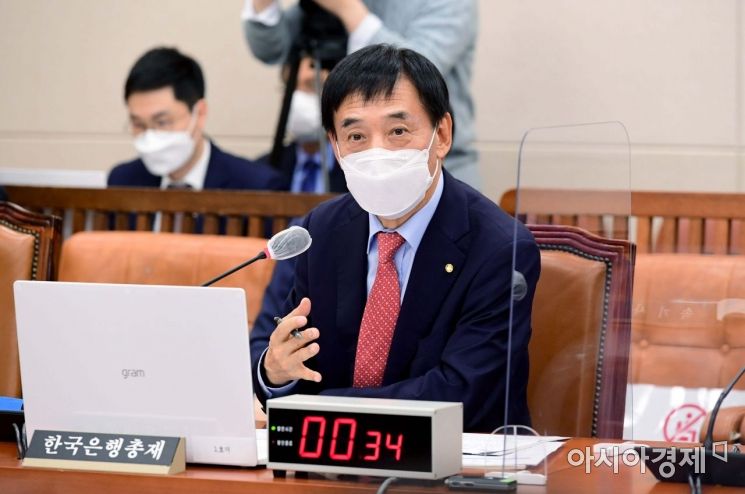 Lee Ju-yeol, Governor of the Bank of Korea, attended the National Assembly's Public Accounts Committee's audit of the Bank of Korea held on the 15th and is responding to questions from lawmakers. Photo by Yoon Dong-joo doso7@
[Asia Economy Reporter Jang Sehee] Lee Ju-yeol, Governor of the Bank of Korea, has expressed a proactive stance on including owner-occupied housing costs in the consumer price index, drawing attention to the future direction of discussions. Owner-occupied housing costs refer to the rent that could be received if the owned house were rented out. Experts believe that since owner-occupied housing costs have surged due to recent housing price increases, including them in the consumer price index could raise the annual consumer price inflation rate to 4-5% this year.
Governor Lee's remarks advocating for the inclusion of owner-occupied housing costs in the price index have become stronger recently. At last week's National Assembly Planning and Finance Committee audit, he stated, "I agree with the criticism that it is not appropriate to view the consumer price index without including owner-occupied housing costs," adding, "It will take some time, but we will actively proceed without delay." This contrasts with his somewhat lukewarm stance at a previous press briefing, where he noted, "There are considerable practical constraints as the volatility of consumer prices is much greater than before."
The background to Governor Lee's progressive position is the criticism that the surge in housing prices has not been properly reflected in inflation. Underestimating inflationary pressures could hinder the Bank of Korea's core mission of price stability. According to Statistics Korea, the index including owner-occupied housing costs was 108.30 in September, up 2.3% year-on-year. This marks 15 consecutive months of year-on-year increases since July 2020 (0.3%). Additionally, international trends such as the European Central Bank (ECB) including owner-occupied housing costs in their price indices starting in 2026, following the United States, have also influenced this stance.
Statistics Korea, which manages the price indices, holds a negative view. A Statistics Korea official emphasized, "While the consumer price survey targets expenditures with a consumption nature, owner-occupied housing costs have a strong investment asset characteristic, so their attributes differ." They added, "The weighting of owner-occupied housing costs is also large, which could act as an obstacle to understanding the overall price trend." The weighting for owner-occupied housing costs is 243.6, higher than the combined weighting of 308 goods (448.5) and 152 services (551.5). Reflecting this could cause distortions in the price index.
Experts unanimously agree that owner-occupied housing costs should be included in the consumer price index for accurate assessment. Professor Kim Sangbong of Hansung University’s Department of Economics said, "The monetary value related to real estate is gradually diminishing," and "Including owner-occupied housing costs in the consumer price index would raise the annual consumer price inflation rate to the 4-5% range."
© The Asia Business Daily(www.asiae.co.kr). All rights reserved.

















