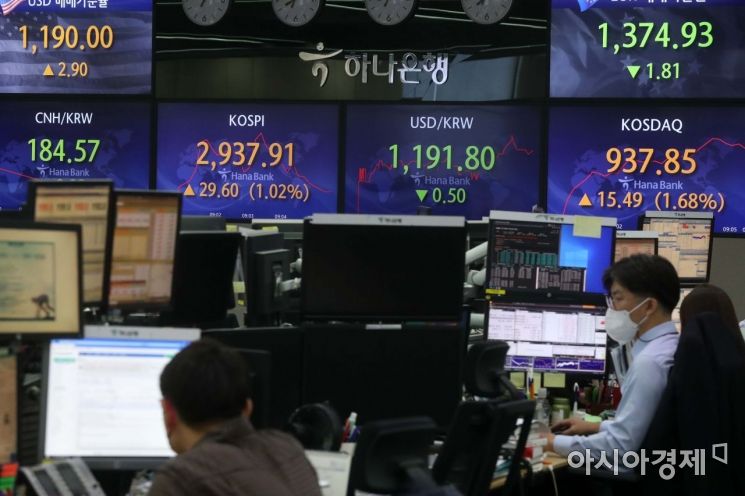
 On the 7th, dealers are working in the Hana Bank dealing room in Euljiro, Seoul, where the KOSPI index started higher. On that day, the KOSPI opened at 2936.87, up 28.56 points (0.98%) from the previous trading day, and the gains are increasing. Photo by Moon Honam munonam@
[Asia Economy Reporter Junho Hwang] Although the KOSPI barely recovered the 3000-point level, forecasts suggest that the cold spell will continue. Foreign investors made net purchases for the first time this month, lifting the index, but it is expected to be difficult for the stock market to experience a sustained upward trend amid ongoing inflationary pressures.
On the 18th, the KOSPI opened at 3017.48, up 2.42 points (0.08%), but soon fell and was recorded at 2933.95 as of 9:27 a.m. After falling below 3000 on the 5th (2962.17), it rose above 3000 at 3015.06 on the 15th, eight trading days later, but the situation remains precarious.
Foreign investors made their first net purchase of 77.4 billion KRW this month on the previous trading day (the 15th), pushing the index above 3000, but a significant improvement in investor sentiment seems unlikely. The Korean Volatility Index (V-KOSPI), which indicates KOSPI volatility, also dropped from 18.21 to 17.03. This suggests that many market participants expect little fluctuation in the index despite the return of foreign investors. It also implies a high possibility that the KOSPI will remain trapped in a trading range.
Shin Seung-jin, a researcher at Samsung Securities' Investment Information Team, explained, "The bottom has been confirmed, but it is too early to predict a V-shaped rebound. The earnings uncertainties of major sectors constituting the market capitalization, such as semiconductors, bio, and platforms, have not been completely resolved."
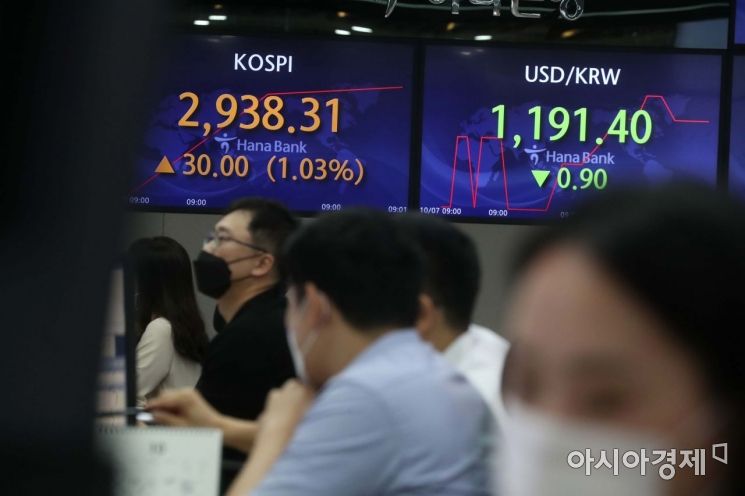 On the 7th, when the KOSPI index started higher, dealers were working in the Hana Bank dealing room in Euljiro, Seoul. On that day, the KOSPI opened at 2,936.87, up 28.56 points (0.98%) from the previous trading day, and continued to widen its gains. Photo by Moon Honam munonam@
The fundamental concern about inflation remains the biggest burden. The intensity of inflation affects corporate earnings and the timing of tightening measures. Last week, the stock market saw a brief rise as concerns about inflation caused by rising raw material prices and logistics disruptions, which had been pressuring the Korean stock market, eased, along with the dollar's strength due to signals of U.S. interest rate hikes.
Park So-yeon, an investment strategy researcher at Shin Young Securities, said, "Prices are rising as electricity production costs increase, and the peak electricity consumption season of winter is approaching. Also, most vaccinations are nearly complete, but the labor shortage in the U.S. persists. The stock market's momentum will likely remain weak until the Federal Open Market Committee meeting, where a U.S. interest rate hike is expected next month." Kim Young-hwan, a researcher at NH Investment & Securities, also noted, "It is necessary to confirm whether inflation requires early tightening by the Federal Reserve. The realization of tapering (asset purchase reduction) in the U.S. and the market's digestion of tapering issues will be key factors for the stock market."
If corporate earnings remain strong despite external headwinds, it could act as a catalyst to boost the stock market. However, this is expected to be difficult.
Lee Jae-man, a researcher at Hana Financial Investment, analyzed, "A peak in the profit growth rate following the COVID-19 base effect is expected. High operating profit growth rates were recorded based on the base effect until the first half of this year, but a downward trend is anticipated thereafter."
Park Seung-young, a researcher at Hanwha Investment & Securities, said, "The stock index is expected to fluctuate within a trading range going forward. In such times, the way is not to sell stocks but to extend the investment horizon."
© The Asia Business Daily(www.asiae.co.kr). All rights reserved.


















