18th First External Economic Security Strategy Meeting
Discussion on 'Trends and Future Response Directions Regarding US Semiconductor Information Request'
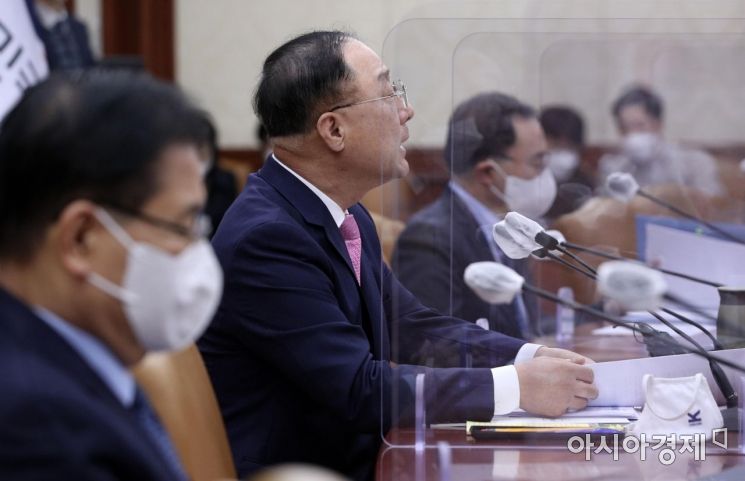 Deputy Prime Minister and Minister of Economy and Finance Hong Nam-ki is delivering opening remarks at the 1st External Economic Security Strategy Meeting held at the Government Seoul Office in Jongno-gu, Seoul on the 18th. Photo by Hyunmin Kim kimhyun81@
[Asia Economy Reporters Kim Heung-soon and Jung Hyun-jin] As the government has begun inter-ministerial consultations to respond to the United States' request for semiconductor information, domestic companies such as Samsung Electronics and SK Hynix, which have been asked to participate in the survey, are closely monitoring whether related support measures will be established.
On the 18th, Deputy Prime Minister and Minister of Strategy and Finance Hong Nam-ki held the first External Economic Security Strategy Meeting at the Government Seoul Office to discuss "Trends and Future Response Directions Regarding the U.S. Semiconductor Information Request." Regarding this matter, Deputy Prime Minister Hong emphasized the need to consider issues related to sensitive corporate information and government support to alleviate corporate burdens, stating, "In particular, the government will strengthen communication and cooperation with the business community."
"If the confidentiality clause is broken, operational damage will occur"
Domestic companies are anxious
Domestic semiconductor companies such as Samsung Electronics and SK Hynix must decide whether to respond to a survey related to the semiconductor supply chain by the 8th of next month, following a request from the Joe Biden administration. This was announced during a virtual meeting hosted by the White House last month, and the survey includes sensitive information related to inventory, orders, and sales of global semiconductor companies.
An industry insider said, "Because confidentiality clauses in semiconductor supply contracts are strict, security is rigorously maintained even among domestic companies," adding, "If the information requested by the U.S. is exposed, the company could suffer disadvantages in relationships with clients and face significant operational damage such as loss of sales or market share." There is also a possibility that this information could be used to benefit the growth of U.S. semiconductor companies.
Accordingly, TSMC, the world's leading foundry (semiconductor contract manufacturing) company, expressed opposition to the U.S. government's semiconductor supply chain data request on the 6th. Sylvia Fang, TSMC's head of legal affairs, stated at a press conference, "The U.S. government's demand for supply chain information involves sensitive data, especially customer information, which we cannot accept," and added, "We are evaluating future response measures."
Although the U.S. has declared that participation in the survey is voluntary for the industry, there are forecasts that participation in public procurement could be restricted, effectively forcing disclosure of information. Because of this, it is difficult for individual companies to raise objections against the U.S. government, and voices are calling for the government to step in and find a solution.
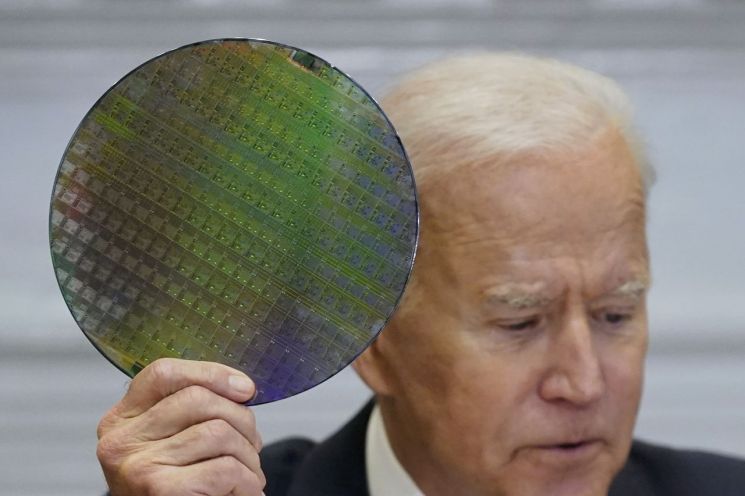 U.S. President Joe Biden is holding up a silicon wafer at the Semiconductor Supply Chain CEO Meeting held at the White House last April.
 [Photo by Yonhap News]
Individual company responses are inevitable
Expectations for public-private cooperation and support measures
This External Economic Security Strategy Meeting was the first event to explore specific response measures by our government and companies. Deputy Prime Minister Hong said, "It is necessary to respond based on corporate autonomy, government support, and Korea-U.S. cooperation." Accordingly, the government will share trends among major countries and related industries with companies to support timely responses and will actively respond by easing the burden on our companies through close communication even after the information submission deadline.
Earlier, the Taiwanese government also stated that while the U.S. request focuses on corporate voluntariness, it will communicate with companies and assist in responding if domestic companies face "unreasonable demands."
Our government also conveyed concerns during a bilateral meeting between Trade Negotiations Director General Yeo Han-gu of the Ministry of Trade, Industry and Energy and Katherine Tai, U.S. Trade Representative (USTR), at the OECD Ministerial Council held in Paris on the 5th and 6th, stating, "The scope of the requested data is extensive and includes many trade secrets, causing significant domestic concerns."
An industry insider said, "From the perspective of domestic companies, it is not possible to refuse the survey or to withhold information entirely," adding, "They are likely to carefully observe the situation until the deadline, including the extent of data to be submitted and the atmosphere among the U.S. and other global companies, before making a move."
Meanwhile, the External Economic Security Strategy Meeting, which the government decided to establish on the 27th of last month, will be chaired by the Deputy Prime Minister for Economic Affairs and composed of 11 members, including five ministers from economic departments and five officials from the National Intelligence Service, National Security Council (NSC), and the Blue House. Related ministers may attend as needed depending on the agenda.
© The Asia Business Daily(www.asiae.co.kr). All rights reserved.


















