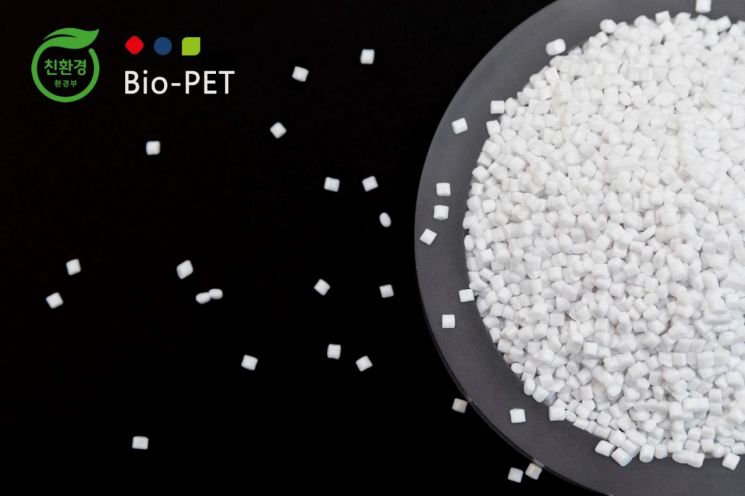
[Asia Economy Reporter Kim Hyewon] Lotte Chemical announced on the 18th that its Bio-PET material has been recognized for its excellence in using eco-friendly raw materials and reducing greenhouse gas emissions, becoming the first domestic PET manufacturer to obtain the Environmental Label certification (EL727).
The Environmental Label is a certification authorized by the Ministry of Environment, awarded to products that demonstrate improved "environmental performance" by saving resources and energy and reducing emissions throughout the entire process of manufacturing, distribution, consumption, and disposal compared to other products with the same purpose. This system is implemented to provide consumers with information to compare and select eco-friendly products and to encourage companies to develop environmentally friendly products.
Lotte Chemical's Bio-PET, which received the Environmental Label certification, uses Bio-MEG (Mono-ethylene glycol) extracted from sugarcane as a raw material, reducing carbon dioxide emissions by 28% compared to conventional PET based on petrochemical raw materials. It has the same quality as conventional PET while being 100% recyclable and reusable. Since Lotte Chemical first produced Bio-PET domestically in 2011, only three companies worldwide, including companies in Thailand and Taiwan, manufacture it.
Hwang Jingu, CEO of Lotte Chemical's Basic Materials Business, said, "As consumer interest in the environment increases, domestic and international sales of Bio-PET are steadily growing every year. We plan to actively promote the expansion of the Bio-PET material market going forward."
In May, Lotte Chemical partnered with SPC Group's packaging production affiliate SPC Pack to develop eco-friendly packaging materials applying Bio-PET to beverage cups and salad containers, and is expanding its supply to domestic and international sources for water, cosmetics, and beverage container materials.
Lotte Chemical plans to convert all 70,000 tons of PET produced at its Yeosu plant to Bio-PET by 2030 and invest approximately 100 billion KRW by 2024 to build the country's first chemical recycling PET production facility with a capacity of 110,000 tons at its Ulsan plant.
© The Asia Business Daily(www.asiae.co.kr). All rights reserved.

















