[Asia Economy Military Specialist Yang Nak-gyu] The Metaverse, regarded as a key future industry, is considered the playground for the global MZ generation (Millennials + Generation Z). The term Metaverse, a compound of 'meta,' meaning transcendence or change, and 'universe,' refers to a virtual reality world on the internet. With advancements in virtual reality (VR), augmented reality (AR), and 3D video technology enabling more sophisticated virtual worlds, it has become a core industry attracting attention from domestic defense companies. On the 7th, we visited Naviworks, located in the Smart Square Industrial Complex in Anyang, Gyeonggi Province, to explore defense-related Metaverse technology.
Upon entering the company, a representative explained, "Naviworks has been developing military training software and simulators based on VR technology since the 2010s, before the term Metaverse even existed." Going up to the fourth floor, a pair of sports goggles sat on a small office desk. Wearing the goggles, a hologram appeared within arm's reach. Pressing the start button, a forward observation post (GP) unfolded before my eyes, resembling a scene from a movie. Operational orders came through the earphones: "The enemy has appeared and infiltrated our military post; the commander is ordered to seize the building and block the intrusion." In the past, military commanders explained operations by placing virtual building models on the ground, which made it difficult for soldiers unfamiliar with the terrain to understand the plans. However, with holographic explanations, all necessary procedures were understood within three minutes.
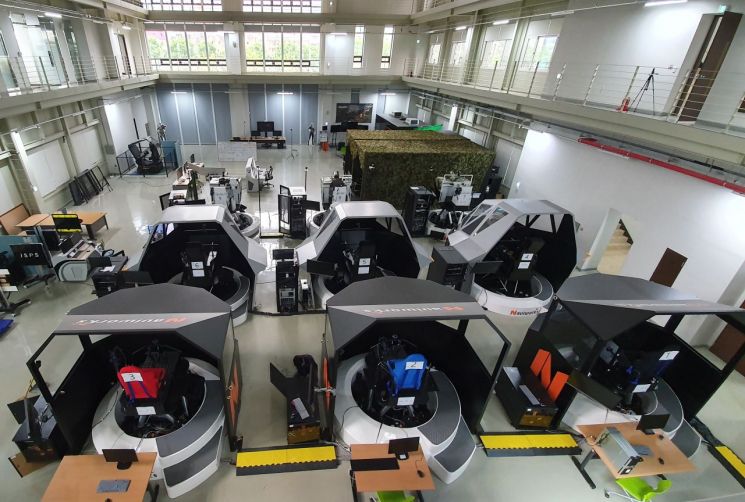
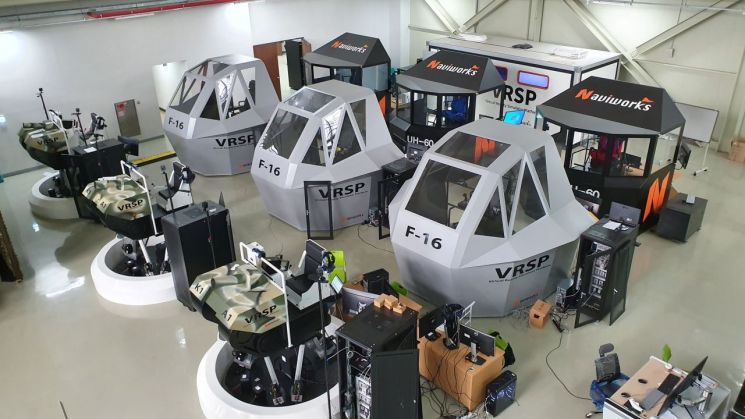
Descending to the first floor, a space resembling a small indoor gymnasium measuring 1,160㎡ (350 pyeong) in area and 12 meters in height came into view. Here, Naviworks' 2014-developed small unit tactical training game (RealBX) and VR-integrated simulators for helicopters, tanks, and fighter jets (VRSP) were gathered, allowing virtual mission execution. A company representative said, "The new concept virtual-augmented training platform ‘VTB-X (Virtual Training Block-XR)’ is a system that can operate all existing simulators within the Metaverse," calling it a "comprehensive virtual training solution." They added, "In the Metaverse, battalion-level army units and regiment-level navy and air force units can conduct operations simultaneously, reducing costs and complaints caused by noise."
The K1A1 tank simulator appeared complex. Although there was only one seat, it allowed performing the roles of gunner, driver, and tank commander. Wearing the headset, the interior environment of the tank unfolded before my eyes. Switching to the gunner role, the seat and surroundings were faithfully reproduced. Following the actual procedures a tank gunner must perform, I powered on the system and loaded the ballistic rounds. Then, moving the tank steering wheel to the center of the dashboard and switching to driver mode, the environment seen by an actual driver appeared. The driver sped toward enemy forces ambushed in an apartment complex in Deokso-eup, Namyangju-si, Gyeonggi Province, and when within range, the gunner fired the rounds.
The system also allowed virtual ‘joint tactical training’ based on the actual specifications of the K1A1 tank, armored vehicles, and helicopters. According to the company, AI technology creates an opposing force for combat exercises. Notably, the navy plans to apply this to the ‘submarine crew training system’ to create a realistic submarine environment, and the air force intends to use it in the ‘base operations training system’ to simulate virtual enemy attacks and enhance operational capabilities. Walking around the first floor simulator area, the space felt extremely small compared to the virtual reality operations conducted across the Korean Peninsula. However, there was a sense of optimism that domestic technology could sufficiently dominate the Metaverse market, expected to reach approximately 315 trillion won by 2025.
© The Asia Business Daily(www.asiae.co.kr). All rights reserved.


















