[Asia Economy Reporter Seo So-jeong] It has been found that apples continue to produce the plant hormone ethylene even after harvest, which can cause some of the flesh to soften, requiring careful storage.
The Ministry of Food and Drug Safety (Commissioner Kim Gang-rip) announced on the 17th the characteristics of agricultural products such as apples that continue to produce ethylene after harvest, affecting storability and quality.
Ethylene is a hormone naturally produced as fruits and vegetables ripen, promoting plant maturation and aging, and it is released as a gas through the plant's stomata even after harvest.
For climacteric fruits such as bananas, tomatoes, persimmons, and kiwis, which are harvested unripe and ripen gradually, ethylene has the advantage of ripening the fruit quickly and uniformly. However, it can also cause quality deterioration by softening some flesh or breaking down chlorophyll, leading to yellow discoloration.
Fruits and vegetables that produce a lot of ethylene after harvest, such as apples, tomatoes, bananas, apricots, peaches, avocados, plums, and mangoes, can accelerate ripening and aging and spoil easily if stored together with ethylene-sensitive fruits or vegetables like kiwis, persimmons, pears, and cucumbers.
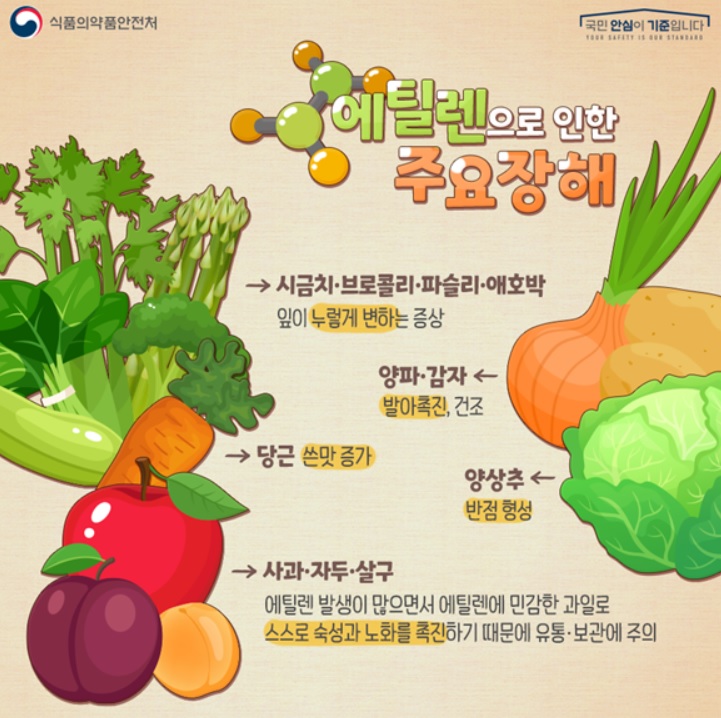
Apples, plums, and apricots produce a lot of ethylene and are sensitive to it, promoting their own ripening and aging, so caution is needed during distribution and storage.
Additionally, ethylene degrades vegetable quality by breaking down chlorophyll, causing discoloration in broccoli, parsley, and spinach; spot formation on lettuce; increased bitterness in carrots; sprouting and drying in onions; and toughening of asparagus tissue.
Therefore, to utilize the characteristics of ethylene when storing fruits and vegetables, fruits that produce a lot of ethylene, such as apples and peaches, should be stored separately from other fruits whenever possible.
Also, fruits that are damaged or affected by pests and diseases produce more ethylene due to stress, so they should be sorted out before storage. Ethylene production decreases at low temperatures (refrigeration), low oxygen concentrations (below 8%), and high carbon dioxide concentrations (above 2%), so it is recommended to individually wrap them with food wrap that blocks air and store them at low temperatures.
Since ethylene promotes maturation and coloring of crops, storing unripe bananas and astringent persimmons together with fruits and vegetables that produce a lot of ethylene helps with ripening.
The Ministry of Food and Drug Safety said, "We hope that understanding and properly utilizing the characteristics of ethylene in each household will help people consume fresher fruits and vegetables," and added, "We will continue to provide useful information for daily life to our citizens."
© The Asia Business Daily(www.asiae.co.kr). All rights reserved.

















