Korean Researchers Develop High-Efficiency Perovskite Material Without Post-Treatment
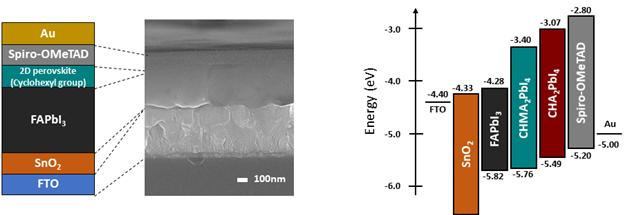 (Figure 1) Schematic Diagram of Perovskite Solar Cell Structure and Band-Aligned Heterojunction Structure
(Left) The perovskite solar cell consists of a perovskite light-absorbing layer (shown in black in the figure) that absorbs light to generate electrons/holes, an electron transport layer (SnO2, shown in red in the figure), and a hole transport layer (Spiro-OMeTAD, shown in gray in the figure) for proper extraction and transport.
Since the perovskite thin film is fabricated through solution and low-temperature processes, defects inevitably form on the surface. To heal these defects, a heterojunction structure based on cyclohexylammonium-based 2D perovskite is formed on the surface to enhance hole extraction and transport capabilities.
(Right) Schematic of the energy band alignment structure of the designed 2D/3D perovskite. Compared to 3D (FAPbI3), the 2D perovskite (CHMA2PbI4, CHA2PbI4) with higher conduction band and valence band energy structures forms a heterojunction that suppresses electron movement and enables smooth hole extraction and transport.
Figure description and provided by: Professor Hyunjeong Shin, Sungkyunkwan University
[Asia Economy Reporter Kim Bong-su] Domestic researchers have developed a method to significantly simplify the manufacturing process of perovskite, a next-generation solar cell material, while maintaining high efficiency.
The National Research Foundation of Korea announced on the 17th that the research teams of Professors Shin Hyun-jung and Park Nam-gyu from Sungkyunkwan University and Professor Park Jung-hyuk from Yonsei University jointly succeeded in improving the efficiency (23.91%) of perovskite solar cells made by a simple solution process that requires no additional treatment, bringing it close to the efficiency of silicon solar cells (26.7%).
Perovskite solar cells refer to thin-film next-generation high-efficiency solar cells that use organic-inorganic metal halide materials with a perovskite structure as the light-absorbing layer. Compared to silicon, they are easier to manufacture, lower in cost, and can be made thin and flexible, attracting significant attention.
The research team developed a high-efficiency perovskite solar cell by controlling the charge behavior characteristics in the perovskite heterojunction structure. The photoelectric conversion efficiency of solar cells depends on how well the defects on the surface of the perovskite thin film used as the light-absorbing layer can be compensated and controlled. Defects related to lead and iodine on the surface act as traps that capture photogenerated charges, reducing photoelectric conversion efficiency.
The team aimed to combine two-dimensional perovskite structures, which have insufficient photoelectric conversion capability, with three-dimensional perovskite structures that have an appropriate bandgap for use as a light-absorbing layer. Although attempts have been made to combine 2D and 3D perovskites before, there were limitations requiring post-processing such as heat treatment or pressure due to the high formation energy of the 2D material.
The researchers searched for molecules suitable for spontaneously forming a 2D planar perovskite structure to omit the heat post-treatment. Through an optimal chemical reaction between the solvent and molecules, they induced the spontaneous junction of a 2D stereoscopic structure on the surface of the 3D perovskite.
In the heterojunction structure thus created, charge transport was facilitated due to the stepwise energy band alignment, increasing the photocharge extraction efficiency and resulting in a photoelectric conversion efficiency of 23.91%. The photoelectric conversion efficiency of the conventional single structure was about 20.41%.
This research was published online on the 20th of last month in the international academic journal in the field of energy new materials, Advanced Energy Materials. Recognized for its academic advancement, it was also selected as the cover photo of the journal.
© The Asia Business Daily(www.asiae.co.kr). All rights reserved.

















