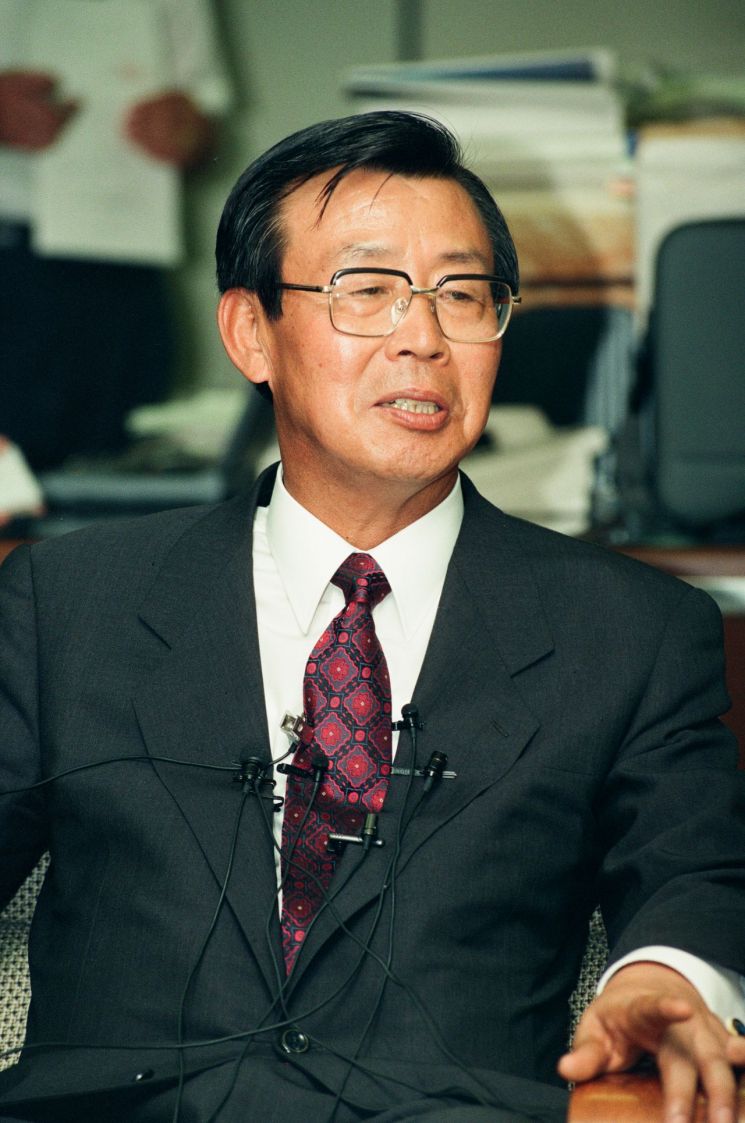
 Former Deputy Prime Minister Lee Kyung-sik Passes Away
 (Seoul=Yonhap News) Lee Kyung-sik, who served as Deputy Prime Minister and Minister of Economic Planning under the Kim Young-sam administration and as Governor of the Bank of Korea, passed away on the 15th due to old age. He was 88 years old.
After beginning his public service career in 1957 at the Bank of Korea's Research Department, he held various positions including Director General of the Planning Bureau at the Economic Planning Board (1971), Vice Minister of the Ministry of Communications (1976?1979), President of Daewoo Motors (1987), and President of Korea Gas Corporation [036460] (1991), serving as a leader in both private and public enterprises.
Following the inauguration of the civilian government, he was appointed the first Deputy Prime Minister and Minister of Economic Planning (1993), and later served as Governor of the Bank of Korea (1995?1998), recognized as a prominent economic official of the YS administration.
Lee Kyung-sik, then Governor of the Bank of Korea, holds a press conference after his inauguration ceremony on August 24, 1995. October 16, 2021 [Yonhap News archive photo]
photo@yna.co.kr
[Asia Economy Reporter Lee Jun-hyung] Lee Kyung-sik, who served as Deputy Prime Minister and Minister of Economic Planning during the Kim Young-sam administration and as Governor of the Bank of Korea, passed away on the 15th due to old age. He was 88 years old.
Former Governor Lee was born in 1933 in Uiseong, Gyeongbuk, and graduated from Korea University’s College of Commerce and Economics in 1957. In 1981, he went to the United States for further studies and completed graduate school at the University of Minnesota. In 1997, he received an honorary doctorate in economics from Sejong University.
He began his public service career in 1957 through the research department of the Bank of Korea. He served as Director General of the Planning Bureau at the Economic Planning Board in 1971 and as Vice Minister of the Ministry of Communications from 1976 to 1979. Later, he also worked in the private and public sectors, including as President of Daewoo Motors in 1987 and President of Korea Gas Corporation in 1991.
After the inauguration of the civilian government, he was appointed as the first Deputy Prime Minister and Minister of Economic Planning in 1993. From 1995 to 1998, he also served as Governor of the Bank of Korea, making him a prominent economic bureaucrat of the Kim Young-sam administration. Notably, during his tenure as Deputy Prime Minister, he collaborated closely with then Bank of Korea Governor Kim Myung-ho, his colleague from when they both joined the Bank of Korea, contributing to the establishment of the real-name financial system.
However, as an economic bureaucrat favored by the Kim Young-sam government, he could not avoid the turmoil of the 'foreign exchange crisis,' a dark chapter of that administration. In December 1997, when the crisis struck, former Governor Lee, along with then Deputy Prime Minister for Economic Affairs Lim Chang-ryul, signed the International Monetary Fund (IMF) bailout agreement.
According to a report submitted by the Bank of Korea to the National Assembly’s IMF Crisis Investigation Special Committee in 1999, the Bank of Korea under former Governor Lee recognized signs of the foreign exchange crisis as early as March 1997, eight months before applying for IMF bailout funds. It is known that he recommended the necessity of emergency IMF funds to the government.
Former Governor Lee also made significant contributions to enhancing the independence of the Bank of Korea and reforming the financial supervisory system. He and then Deputy Prime Minister and Minister of Finance and Economy Kang Kyung-sik drafted a reform plan that transferred the Bank of Korea’s bank supervision functions to the Banking Supervisory Authority while strengthening the Bank of Korea’s monetary policy independence. Although there was strong opposition within the Bank of Korea at the time, this decision laid the foundation for the Bank of Korea’s monetary policy independence.
After the Kim Dae-jung administration took office, former Governor Lee went to the United States and served as a visiting researcher at Stanford University. After returning to Korea, he served as chairman of the '21st Century Businessmen’s Club,' a social organization for businesspeople, from 2009 until now.
© The Asia Business Daily(www.asiae.co.kr). All rights reserved.

















