Ulsan Health and Environment Research Institute Records Lowest PM10 and PM2.5 Levels This Year Since Measurements Began
[Asia Economy Yeongnam Reporting Headquarters Reporter Kim Yong-woo] Among the seven special and metropolitan cities, which place has the lowest fine dust concentration?
This year, Ulsan recorded the lowest fine dust and ultrafine dust concentrations since measurements began. The average dust concentration was also found to be the lowest among the seven major cities nationwide.
Ulsan started measuring fine dust in 1995 and has been measuring ultrafine dust since 2015.
According to the Ulsan City Health and Environment Research Institute on the 16th, Ulsan's fine dust and ultrafine dust concentrations in September recorded the lowest levels since official measurements began.
The fine dust and ultrafine dust concentrations in September were 16㎍/㎥ and 8㎍/㎥, respectively.
The previous lowest concentrations were 20㎍/㎥ for fine dust (July 2020) and 11㎍/㎥ for ultrafine dust (October 2019).
The institute analyzed that the unusually low dust concentrations were influenced by ▲a decrease in foreign fine dust inflow due to north-northeast wind directions, ▲meteorological factors (number of rainy days, precipitation), ▲reduced operation rates of coal-fired power plants in China due to energy supply-demand imbalance, and ▲a decrease in fine dust emissions.
Comparing data from September this year with September last year, Ulsan's ultrafine dust concentration decreased by 42.9%, from 14㎍/㎥ to 8㎍/㎥, the largest reduction among the 17 cities and provinces nationwide, and fine dust concentration also decreased by 36.0%, from 25㎍/㎥ to 16㎍/㎥.
Additionally, the number of 'Good' (0?30㎍/㎥) fine dust days increased from 24 to 30 days, and 'Good' (0?15㎍/㎥) ultrafine dust days increased from 21 to 27 days, each rising by 6 days. There were no occurrences of 'Bad' or worse air quality.
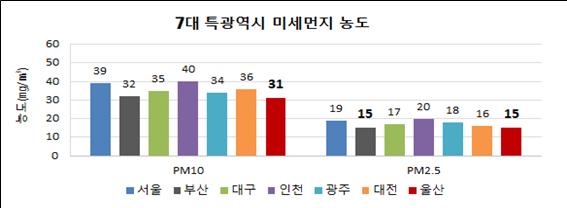
From January to September this year, Ulsan's average fine dust concentration was 31㎍/㎥, the lowest among the seven special and metropolitan cities, and ultrafine dust was also at a low level of 15㎍/㎥, tied with Busan.
The annual average concentration of fine dust has been gradually decreasing from 69㎍/㎥ in 1995, 52㎍/㎥ in 2000, 48㎍/㎥ in 2010, to 30㎍/㎥ in 2020.
Ultrafine dust has also gradually improved from 25㎍/㎥ in 2015 to 17㎍/㎥ in 2020.
Comparing pollutant emissions in Ulsan between 2015 and 2018, fine dust decreased from 5,910 tons to 4,080 tons, and ultrafine dust decreased from 2,987 tons to 2,274 tons, supporting the trend of decreasing fine dust concentrations.
An official from the institute explained, "The overall decrease in fine dust concentrations is due to a combination of factors including reduced foreign inflow of fine dust, decreased domestic and international economic activities following the COVID-19 outbreak, improved meteorological conditions, and various city-level fine dust reduction policies."
The institute measures air quality through 18 urban air monitoring stations and 2 roadside air monitoring stations established throughout Ulsan, and provides real-time data on the institute's website and the Ministry of Environment's Air Korea platform.
They also operate 5 atmospheric heavy metal monitoring networks and 3 acid rain monitoring stations.
Dust refers to particulate matter suspended in the air; particles with a diameter of 10 micrometers or less are classified as 'fine dust (PM-10)', and those with a diameter of 2.5 micrometers or less are classified as 'ultrafine dust (PM-2.5)'.
© The Asia Business Daily(www.asiae.co.kr). All rights reserved.

















