"North Korea's Missile Capability Advancement... All Options Must Be Considered to Protect the People"
Criticism That It Violates the Principle of Exclusive Defense in the Peace Constitution
Interview with Yomiuri Shimbun... "US-Japan Summit Aims for This Year If Possible"
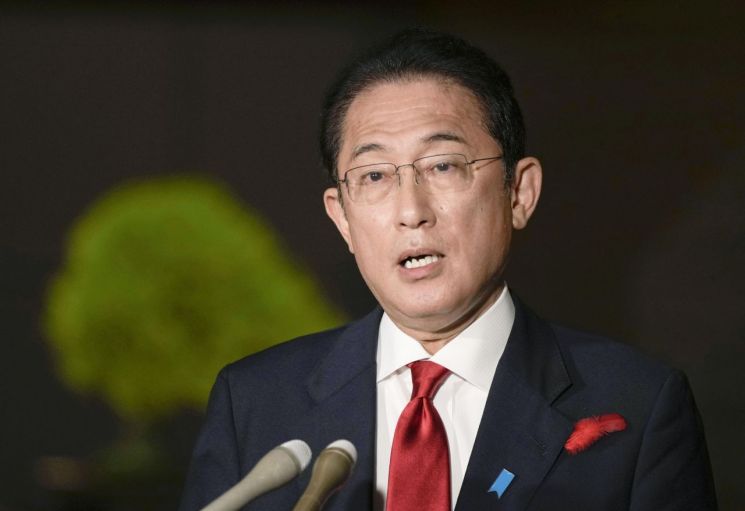
[Asia Economy Reporter Kim Suhwan] Japanese Prime Minister Fumio Kishida stated that including the possession of "enemy base strike capability" in the National Security Strategy is "one option."
On the 16th, Yomiuri Shimbun reported an interview with Prime Minister Kishida, in which he responded this way to the question of whether the revised National Security Strategy would include the possession of enemy base strike capability to destroy enemy missile launch bases for self-defense purposes.
He mentioned threats such as hypersonic glide weapons and missiles flying on irregular trajectories being developed by North Korea, saying, "Missile capabilities are advancing daily," and added, "It is important to consider all realistic options to protect the lives and livelihoods of the people."
The possession of enemy base strike capability became a serious topic of discussion in Japan after then-Prime Minister Shinzo Abe expressed consideration last year, based on the development of new types of missiles by North Korea and others that are difficult to intercept.
Since existing missile defense systems struggle to defend against new weapons, the plan is to strengthen deterrence by acquiring the ability to attack enemy missile launch bases.
Possession of enemy base strike capability means having long-range precision strike means.
There are also criticisms that this contradicts the principle of exclusive defense (senshu b?ei), which is based on Article 9 of the Japanese Peace Constitution that renounces war as a means of settling disputes and prohibits maintaining war potential, allowing defense force only when attacked.
Former Prime Minister Yoshihide Suga, who took office in September last year, and the coalition partner Komeito had also put the discussion on enemy base strike capability on hold.
However, Prime Minister Kishida, who took office on the 4th, has shown a stance to consider explicitly including the possession of enemy base strike capability in the National Security Strategy, which is the framework for diplomatic and security policy.
The National Security Strategy was drafted in December 2013 during the second Shinzo Abe administration, and Kishida expressed his intention to revise it for the first time during his policy speech to the Diet on the 8th.
In the interview with Yomiuri Shimbun conducted the previous day, Kishida also said he wants to "hurry as much as possible" regarding the timing of the revision of the National Security Strategy.
Regarding the US-Japan face-to-face summit, he said, "Including my visit to the United States, I want to meet with Mr. Biden (US President Joe Biden) as soon as possible," adding, "I aim for as early as within this year."
© The Asia Business Daily(www.asiae.co.kr). All rights reserved.
![User Who Sold Erroneously Deposited Bitcoins to Repay Debt and Fund Entertainment... What Did the Supreme Court Decide in 2021? [Legal Issue Check]](https://cwcontent.asiae.co.kr/asiaresize/183/2026020910431234020_1770601391.png)
















