Judge Who Ruled in Favor of Former Prosecutor General Yoon in Two Injunction Cases Replaced... "Usually, the Practice Is to Rule on the Merits"
Administrative Court Chief Judge Bae Gi-yeol: "Transfer Was Unavoidable Due to Completion of Service Period"
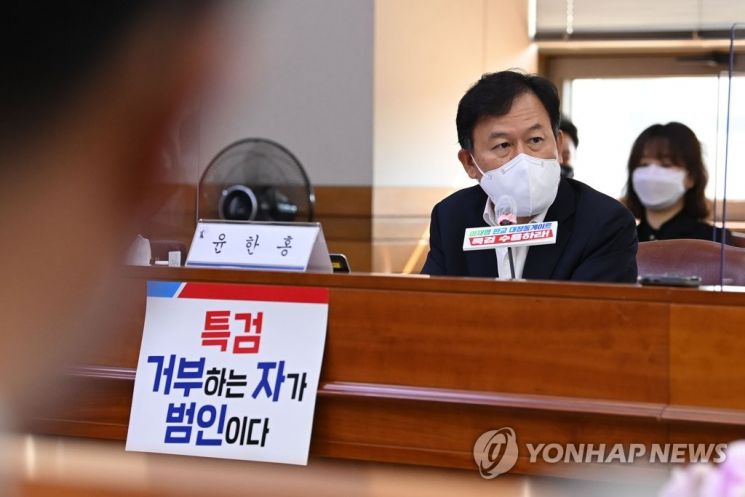 Yoon Han-hong, a member of the People Power Party and the secretary of the National Assembly's Legislation and Judiciary Committee.
[Asia Economy Reporter Choi Seok-jin, Legal Affairs Specialist] Yoon Han-hong, a member of the People Power Party and the whip of the National Assembly's Legislation and Judiciary Committee, raised suspicions on the 15th during the National Assembly's audit of the courts that the replacement of the trial panel handling former Prosecutor General Yoon Seok-yeol's disciplinary action cancellation lawsuit and the scheduling of the verdict date just one day before the court audit were politically motivated considerations by the judiciary's top leadership.
During the afternoon session of the National Assembly audit targeting the Seoul High Court, Seoul Central District Court, Seoul Eastern, Southern, Northern, and Western District Courts, and Seoul Administrative Court, Yoon questioned Baek Gi-yeol, Chief Judge of the Seoul Administrative Court, about the disciplinary action cancellation lawsuit verdict against former Prosecutor General Yoon, which was delivered the previous day.
First, Yoon asked, "Yesterday, the first trial verdict for former Prosecutor General Yoon Seok-yeol's disciplinary action cancellation lawsuit was delivered. When was the trial date set to be yesterday?"
Chief Judge Baek replied, "I do not know exactly because the court chief is not informed about the progress of the trial."
Yoon said, "I think setting the trial date for yesterday was somewhat political, quite a politically motivated scheduling. I have my suspicions, and many others do as well. This is because the judiciary has been making many political considerations lately, so I am asking. Chief Judge, did you not receive any prior notice about the trial date?"
Chief Judge Baek responded, "If the court chief takes too much interest in the trial progress these days, it could be seen as interference in the procedure..."
Yoon continued, "The reason I bring this up is that at the end of last December, there were two injunction (suspension of execution) lawsuits, both of which were granted. Then, the judge was immediately replaced. The new Judge Jeong Yong-seok took over that role," he said.
He added, "Usually, the judge who handled the injunction lawsuit also presides over the first trial verdict, but in this case, the judge was replaced."
Chief Judge Baek explained, "That was an unavoidable situation due to regular judicial personnel transfers. In the Administrative Court, the chief judge's term is generally three years, and associate judges serve for two years. Coincidentally, all members of the trial panel had reached their term limits."
Yoon then said, "But that is not correct," and called the Chief Judge of the Central District Court.
Yoon said, "Chief Judge of the Central District Court, there are judges loyal to this administration who have served for six years and four years. For example, Judge Yoon Jong-seok, who handled the case of Vice Minister Lee Yong-gu's taxi driver assault, has been serving at the Central District Court for six years. He is a member of the Uri Law Research Association. Judge Kim Mi-ri, who handled the Cho Kuk case and the Blue House Ulsan mayor election interference case, has been serving at the Central District Court for four years," he emphasized.
He continued, "Judges who act in line with the administration's preferences, who delay trials accordingly, and who dismiss arrest warrants accordingly, serve for six or four years."
He pointed out again, "But the previous judge, who granted two injunctions in favor of Prosecutor General Yoon Seok-yeol, was immediately replaced, and Judge Jeong Yong-seok came in."
Yoon said, "Looking at this judge's past rulings, he acquitted a lawyer from the Minbyun (People's Solidarity for Participatory Democracy) who assaulted police officers at the Ssangyong Motor rally site. Minbyun now controls the judiciary and legal circles in our country. Also, he acquitted the spokesperson of the Korean Confederation of Trade Unions, which currently dominates the country. This judge," he mentioned Judge Jeong's past rulings.
He added, "Then, he acquitted the executive committee chairman of the June 15 Joint Declaration Youth and Student Headquarters in a National Security Law violation case. That judge was assigned there. The verdict was already decided at that time. I don't understand how the Chief Justice of the Supreme Court, who has many people, can single out a judge like this," he said.
The day before, the Administrative Division 12 of the Seoul Administrative Court (Presiding Judge Jeong Yong-seok) ruled against former Prosecutor General Yoon's lawsuit seeking cancellation of the disciplinary action filed against the Minister of Justice.
The court recognized two of the reasons cited by the Ministry of Justice for the two-month suspension disciplinary action against former Prosecutor General Yoon: the order to prepare a trial panel analysis document and obstruction of the Channel A case investigation and inspection. Regarding the trial panel analysis document, the court found that it contained a large amount of information collected in violation of the Personal Information Protection Act.
Immediately after the verdict, Yoon's side, dissatisfied with the court's judgment differing from the injunction granted in December last year, filed an appeal with the court.
The injunction decision was also made by the same trial panel, but the panel members changed due to the court's regular personnel reshuffle in February this year.
Yoon said, "I reviewed the details," and systematically refuted the specific findings of the first trial verdict delivered the previous day.
He said, "When the injunction was granted earlier, the ruling pointed out the need to check whether there was repetition or risk of abuse regarding the collection of judges' information and surveillance, which caused an uproar in the ruling party and government. However, there was no content about repetition or risk of abuse, so it was recognized as a disciplinary reason that personal information was collected without consent."
He added, "It's not personal information in the media. Judges and court chiefs, if your names are published in the media, everything comes out. Even the National Assembly provides paid access to personal searches at the National Assembly Library. Family relations, hobbies, drinking capacity, education, birthplace?all come out. Calling this personal information is utterly lame," he criticized.
Yoon continued, "Next, regarding obstruction of inspection in the Channel A case, the previous injunction ruling said there was no confirmed fact, and it was necessary to verify whether it was subject to the inspection committee's review. Now, I see that Prosecutor General Yoon ordered a fact-finding investigation by the Human Rights Department. Moreover, this important case is supposed to go through the inspection committee according to the inspection committee regulations, but the inspection department started the inspection arbitrarily without the committee," he said.
He said, "They say he obstructed the inspection, but in my view, he did not obstruct it. Given the nature of this case, the investigation should be conducted first, and then the inspection should follow after the results come out. Because only an investigation can reveal the facts, inspection alone cannot. He ordered a stronger investigation than inspection. But they falsely claim he obstructed the inspection," he argued. "This does not make sense."
Yoon said, "'Delegation and possible withdrawal of investigative command authority' was accepted in the previous injunction ruling. The verdict yesterday acknowledged this. However, it said the composition requirements for the professional investigative advisory group were not met. The reason for forming the advisory group was that the heads and researchers of the Criminal Division of the Supreme Prosecutors' Office at the time all said there was no crime, so they wanted to hear from a third party, experts. Is that wrong? This was a ridiculous, fabricated judgment," he criticized.
He added, "To make such a ruling, they assigned obedient judges loyal to the administration. That's how this ruling was made. I see it that way, and the public sees it that way too," he said.
Finally, Yoon concluded his questioning by saying, "Moreover, the date was arranged to be the day before the Administrative Court's National Assembly audit. I have suspicions about even the date."
Meanwhile, regarding the verdict date of former Prosecutor General Yoon's case, Chief Judge Baek, in response to another lawmaker's question, said that he heard that "Chief Judge Jeong apologized for causing a burden to the court chief by scheduling the verdict date just one day before the National Assembly audit," or words to that effect.
© The Asia Business Daily(www.asiae.co.kr). All rights reserved.

















