6 out of 10 Board Members Are 'Finance and Business Professionals'
Only 2 Digital Experts Among 186 Members
[Asia Economy Reporter Oh Hyung-gil] Among the six domestic financial conglomerates, it was found that 6 out of 10 board members, who play a key role in internal control, are experts in finance and management.
Although financial institutions are putting their lives on the line for digital transformation, there are only two digital or IT experts on the boards.
It is stated that outside directors with expertise in various fields are included to ensure the board’s function of checking and balancing the management, so that they do not share common backgrounds or represent specific interests, but this is criticized as merely a formal measure.
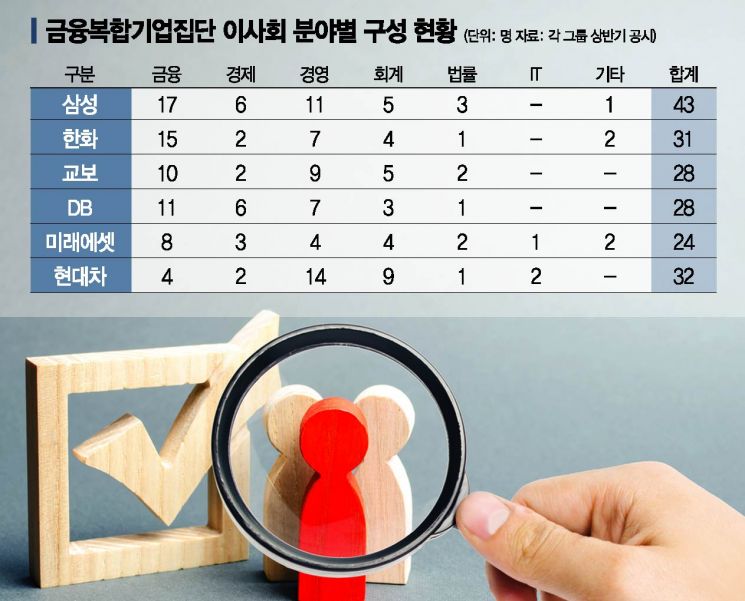
According to the group disclosures for the first half of this year by financial conglomerates on the 15th, the total number of board members across six groups?Samsung (representative company Samsung Life Insurance), Hanwha (Hanwha Life Insurance), Kyobo (Kyobo Life Insurance), DB (DB Insurance), Mirae Asset (Mirae Asset Securities), and Hyundai Motor (Hyundai Capital)?was 186.
Among them, 65 were financial experts, accounting for 34%, the largest share, followed by 52 management experts (28%). Financial and management experts together accounted for over 60% of the entire board.
Next, there were 30 accounting experts (16%), 21 economics experts (11%), and 10 legal experts (5%). Notably, IT (digital) experts were represented by one person each at Mirae Asset and Hyundai Motor.
By group, Samsung Financial Group had the largest number of board members at 43 among the six groups. There were 23 inside directors and 20 outside directors. Among them, 17 (40%) were financial experts, followed by 11 management experts (26%), 6 economics experts (14%), 5 accounting experts (12%), 3 legal experts (7%), and 1 other.
Hyundai Motor, with 32 board members, was the only financial group where management experts (14) outnumbered financial experts (4).
Hanwha had 15 financial experts (48%) out of 31 board members, the highest proportion among financial groups. It also had 7 management experts (22%), 4 accounting experts (13%), and 1 legal expert.
Kyobo and DB each had 10 (36%) and 11 (39%) financial experts out of 28 board members, respectively. Mirae Asset showed a balanced distribution with 8 financial experts (33%), 4 management experts (16%), 4 accounting experts (16%), 3 economics experts (12%), 2 legal experts, and 1 IT expert among 24 members.

The role of the board of directors is becoming increasingly important in the internal control of financial groups. According to the “Act on the Supervision of Financial Conglomerates” (Financial Conglomerate Supervision Act), which has been in effect since June, internal transactions exceeding 5 billion KRW must be approved by the board.
Risk management officers of financial companies within each financial group must conduct their own crisis situation analysis, report the results and countermeasures to the board, and then submit them to the risk management department of the representative financial company.
Also, in the risk management performance evaluations that financial groups must conduct, the authority and operation of internal control, including the board’s authority and role, are key evaluation items.
Despite the critical role, controversy over the board of directors acting as a “rubber stamp” for financial companies has not ceased. Jeong Eun-bo, Governor of the Financial Supervisory Service, recently mentioned at a National Assembly audit, “There have been changes in the composition and operation of the board, but it has not sufficiently met the public’s expectations,” indicating that financial holding company boards are not functioning properly.
In reality, outside directors of financial holding companies tend to express “approval”-oriented opinions, and the roles of internal control and checks and balances are not functioning.
From the first half of last year to the first half of this year, among outside directors of the five major financial holding companies, there were only seven cases of dissenting opinions on board resolutions: six at Shinhan Financial Group (Chairman Cho Yong-byeong) and one at Hana Financial Group (Chairman Kim Jung-tae). Outside directors at KB Financial Group (Chairman Yoon Jong-kyu), NongHyup Financial Group (Chairman Son Byung-hwan), and Woori Financial Group (Chairman Son Tae-seung) did not express any dissenting opinions.
An industry insider explained, “We are trying to bring in experts from various fields, but considering the reality that we cannot ignore the special nature of finance, we compose the board accordingly,” adding, “We are making efforts so that the board can perform its role with maximum objectivity.”
© The Asia Business Daily(www.asiae.co.kr). All rights reserved.


















