On the 17th, morning lows fall below 5°C across most regions nationwide
Strong winds combine, causing perceived temperatures in central areas to drop below freezing
Mid-October cold wave warning in Seoul, first since 2004
Rain possible on the 19th, cold weather continues through the 20th and 21st
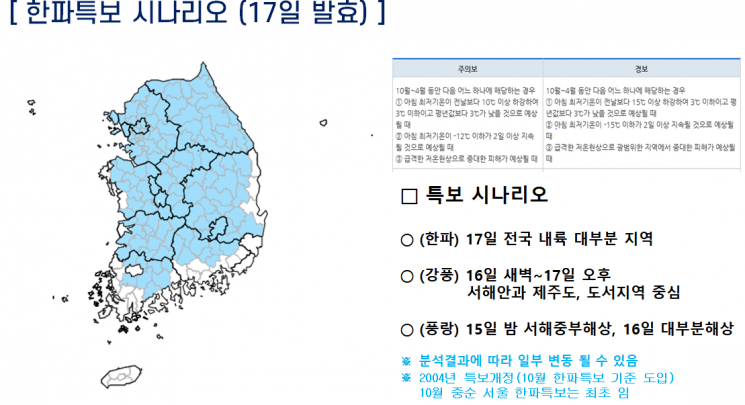
[Asia Economy Reporter Han Jinju] On Sunday the 17th, a sudden cold snap will bring morning temperatures down below 5 degrees Celsius, and a cold wave advisory will be issued. It is the first time since 2004 that a cold wave advisory has been announced in Seoul in mid-October.
On the 14th, the Korea Meteorological Administration (KMA) announced that cold air is moving southward from the northwest and continental high pressure is expanding, leading to the issuance of a cold wave advisory on the 17th. The morning low temperature on that day is expected to drop by about 10 to 15 degrees compared to the previous day, and strong winds will make the perceived temperature 2 to 6 degrees lower.
Han Sang-eun, a meteorological expert at KMA, explained, "From the morning of the 17th to the 18th, low temperatures will continue and strong winds will blow, causing the perceived temperature on the morning of the 17th to drop below freezing. We need to pay special attention to health management in preparation for the sharp temperature drop and also prepare for cold damage to crops and frost damage."
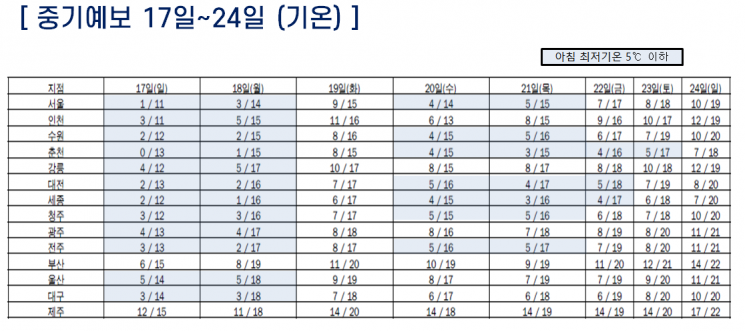
The sudden cold will continue until the 17th and 18th, when the cold wave advisory is in effect. The nationwide morning low temperatures on the 17th are expected to be between 1 and 6 degrees Celsius, and between 1 and 8 degrees on the 18th. Daytime highs will also drop by about 10 degrees to between 11 and 15 degrees. Those planning mountain hikes or outdoor activities over the weekend should also prepare for hypothermia.
A cold wave advisory is issued between October and March when the morning low temperature drops by more than 10 degrees compared to the previous day to 3 degrees or below and is expected to be 3 degrees lower than the average, or when the morning low temperature remains below minus 12 degrees Celsius for two or more days.
Before 2004, cold wave advisories were issued from November to April, but since 2004, they have included October. However, this year is the first time a cold wave advisory has been issued nationwide in mid-October. In 2011, a cold wave advisory was issued on October 13, and in 2019 on October 8, but only in parts of Gyeonggi Province and Gangwon Province.
The expert explained, "This is the first time a cold wave advisory has been issued in Seoul in mid-October. The subtropical high pressure in the upper atmosphere contracted, allowing the previously blocked cold air to move southward from the north, and the timing coincided perfectly, causing it to persist for a long time."
This cold snap will continue until the 21st. Temperatures will rise on the 19th but then the morning low temperature will drop again from the 20th, falling below 5 degrees Celsius. Depending on how much a low-pressure system develops on the 19th, there is also a possibility of rain.
The expert added, "As the cold air develops, a trough will also develop, increasing the possibility of rain. After temperatures drop again on the 20th and 21st, morning and evening temperatures will be lower than average, making it chilly."
He continued, "Temperatures are expected to return to average levels by next Sunday, but due to the characteristics of autumn weather, large daily temperature variations and fluctuations will repeatedly cause temperatures to fall or rise."
© The Asia Business Daily(www.asiae.co.kr). All rights reserved.


















